

Layout Geometry: Where Circular Patio Paving Ideas Live or Die
Circular patio paving ideas demand a level of geometric discipline that rectangular layouts simply don’t require — and the radius you choose at the design stage determines every subsequent cut, every joint line, and ultimately whether the finished surface reads as intentional or improvised. The relationship between your chosen stone format and the circle’s diameter is not flexible; a 12-inch paver laid in a true radial fan pattern around a 6-foot center circle requires a fundamentally different cut sequence than the same stone wrapped around a 10-foot opening. Getting this calculation locked in before material is ordered is the difference between a 5% off-cut waste rate and a 25% one.
Your first decision is whether to work from a keystone-cut radial layout, a concentric ring layout, or a fan-bond hybrid. Each produces a distinct visual character and each carries different installation complexity. The keystone layout — where each stone is individually shaped into a trapezoid — delivers the most architecturally refined result, but it demands precision cutting and considerably more time on-site. Concentric rings, by contrast, use standard rectangular or square pavers laid in expanding circular bands, which dramatically reduces cut complexity while still producing a clearly circular form.
Stone Formats That Actually Work for Circular Layouts
Not every patio stone translates cleanly to a curved layout, and this is where material selection intersects directly with pattern feasibility. Thin-bed natural stone — anything under 1.25 inches — is rarely the right choice for circular patio stones because the number of cuts required creates stress points along the edges that accelerate chip loss over time. You want a minimum 1.5-inch thickness when cutting radial keystones, and 2 inches is a more comfortable specification for high-foot-traffic areas.
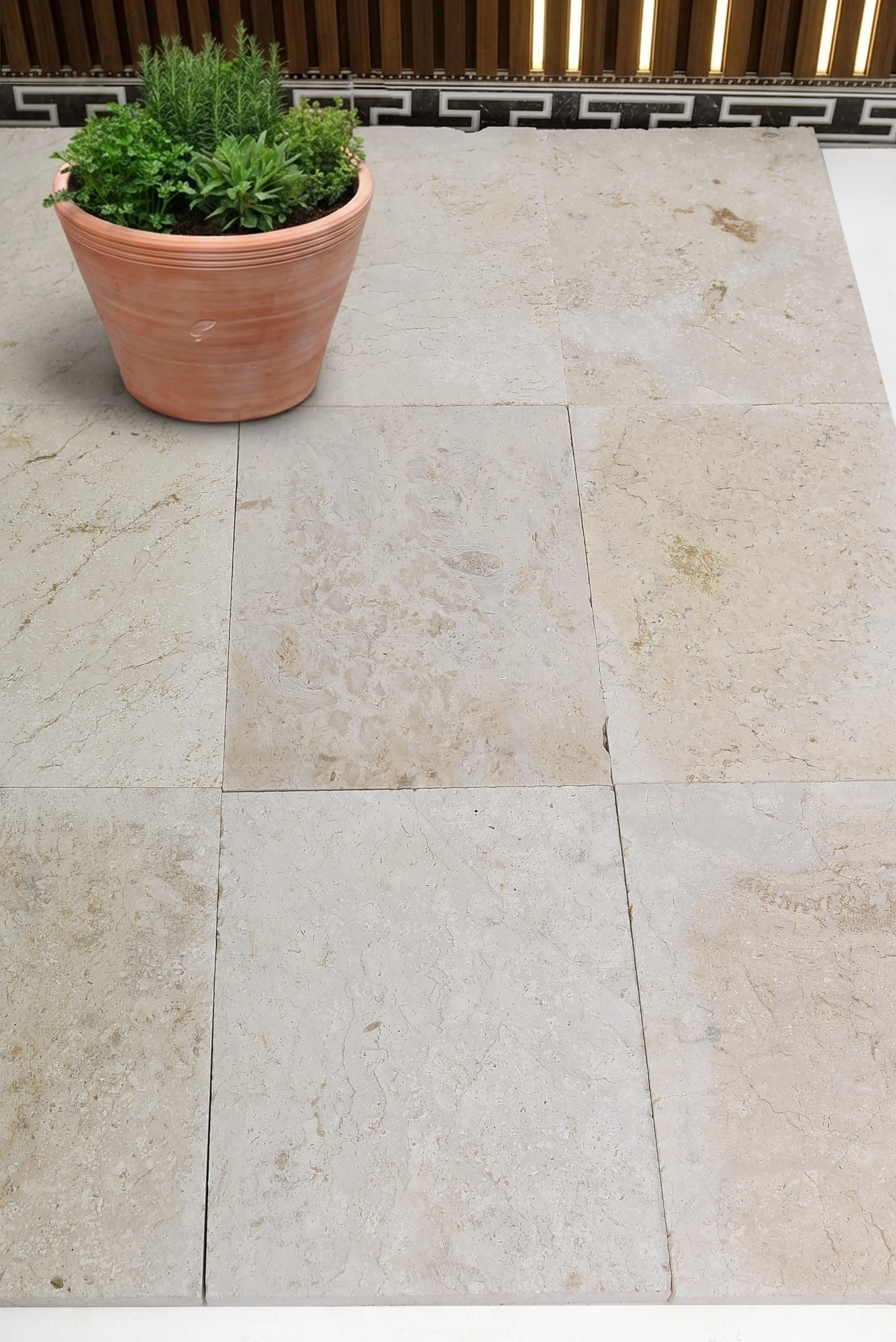
Limestone is one of the most forgiving materials for radial cuts because its uniform grain structure doesn’t fracture unpredictably the way some coarser sandstones do. According to NSI limestone specifications, the material’s consistent density profile makes it well-suited to dimensional cutting applications — exactly the kind of precision shaping that circular patio layouts require. Travertine is another strong performer in circular patio stones formats, particularly tumbled travertine where the softened edges help mask the slight imprecision that’s almost inevitable in field-cut radial joints.
Basalt deserves consideration when your project calls for a contemporary aesthetic. Its tight grain and compressive strength above 20,000 PSI means cut edges stay crisp over years of use, and the charcoal tones contrast well against lighter grout joints that visually reinforce the circular geometry. The trade-off is tool wear — dense igneous stone eats through diamond blades faster than sedimentary alternatives, which is a cost factor worth building into your project budget.
- Limestone: predictable cut behavior, excellent for tight-radius keystone patterns
- Travertine: tumbled finishes help absorb minor joint inconsistencies in curved layouts
- Basalt: maximum edge definition, higher fabrication cost per linear foot of cut
- Sandstone: use only for concentric ring patterns, not radial keystones — prone to edge loss under repeated cutting stress
- Granite: exceptional durability for circular patio stones in high-traffic or commercial settings
Patio Stones Circle Patterns: Three Designs Worth Specifying
The most common request in circular patio design is the full radial fan — a sunburst pattern that emanates from a defined center point, typically a feature stone or mosaic medallion. This layout works best with a diameter of 12 feet or larger; anything smaller compresses the joint lines so tightly at the center that the pattern reads as muddled rather than deliberate. Your joint widths at the interior ring should target 3/8 inch, expanding naturally to 5/8 inch at the outermost ring — this geometric splay is a feature of the design, not a defect.
The second option worth serious consideration is the concentric ring layout using patio stones round in overall format but rectangular in individual unit shape. You lay each standard paver with its length oriented tangentially to the circle’s circumference, producing a series of bands that create strong circular reading without any keystone cutting. This approach is dramatically faster to install and keeps waste below 8% on a well-planned layout. The ASLA outdoor patio stone design guidance supports this concentric band approach for its structural continuity and lower material stress relative to full radial layouts.
A third option that frequently gets overlooked is the pinwheel-circle hybrid — a square-oriented pinwheel pattern contained within a circular boundary, with the perimeter stones cut to the radius curve. This delivers the visual complexity of a pinwheel layout with the spatial clarity of a circular form, and it’s particularly effective when the circle is set into a rectangular terrace of contrasting material. You’ll need precise radius marking — a chalk-line compass anchored at the true center works better than any laser tool in most outdoor conditions.
Base Preparation for Circular Layouts
Circular patio paving ideas look stunning on paper and fall apart in the field when the base isn’t prepared to the same precision as the surface geometry. The compacted aggregate base for a natural stone circular patio should be a minimum of 6 inches for pedestrian use and 8–10 inches if any vehicle access is possible — not because circular layouts are structurally weaker, but because differential settlement at the center point of a radial pattern is immediately visible in a way that settlement in a running-bond layout simply isn’t.
Your center point needs to be marked and protected throughout the base preparation phase. Drive a steel pin at the true center before compaction begins, and don’t disturb it. Every radial line references that point, and even a 1/2-inch shift in center position during base work will translate to compounding joint misalignment by the time you reach the outer rings. The base must be perfectly level within ±1/4 inch across the full diameter — standard for patio work, but worth re-checking specifically at the center point where the geometric demands are most concentrated.
- Compacted aggregate base: minimum 6 inches pedestrian, 8 inches mixed use
- Level tolerance: ±1/4 inch across full circle diameter
- Center pin: steel stake, installed before base compaction, protected throughout
- Bedding sand layer: 1 inch nominal, screeded to true level before stone placement
- Drainage slope: 1/8 to 1/4 inch per foot away from any structure
Edge Restraint, Joint Integrity, and Storm Durability
Circular layouts introduce an edge restraint challenge that straight-edged patios don’t face — you can’t simply run a straight metal edging channel around the perimeter. Purpose-made flexible plastic edge restraint designed for curves is the correct specification here, spiked at maximum 6-inch intervals to prevent the perimeter from walking outward under load. Where edge restraint fails in circular layouts, the consequence is visible immediately: the outer ring opens up and the whole pattern loses its geometric integrity within a single season.
Storm durability is a genuine performance consideration for circular patio stones, and one that influences both material selection and installation method. Wind-driven rain penetrates joints at a higher rate than vertical rainfall, and circular layouts — particularly full radial fan patterns — have a higher total joint-to-surface-area ratio than most rectangular formats. This means more pathways for water infiltration under sustained storm conditions. Polymeric sand joint filler is essential here, not optional. Standard silica sand in circular patio joints will wash out progressively under repeated storm events, creating sub-surface voids that accelerate differential settlement at precisely the joints where geometry is most critical.
Hail impact is another factor worth addressing in your material specification. Dense materials — basalt, hard limestone with a compressive strength above 15,000 PSI — resist impact chipping better than softer sedimentary alternatives. According to NSI natural stone durability standards, absorption rates below 0.75% generally correlate with superior impact resistance and freeze-thaw performance, both of which become relevant in exposed circular patio installations that see seasonal weather variation. Selecting stone with these physical characteristics upfront is considerably less expensive than replacing chipped keystones after a severe storm event.
Ordering Circular Patio Paving: Quantities, Lead Times, and Logistics
Calculating material quantities for a circular patio requires converting the area formula (π × r²) into a paver count — and then adding your waste allowance on top of that net area figure. For a full radial fan pattern, budget a 15–20% waste allowance for cuts; for concentric ring layouts, 8–12% is realistic. Order everything in a single delivery where possible; matching stone from two separate shipments introduces color variation that becomes very apparent in a circular patio stones round layout where your eye naturally travels around the full perimeter.
Verify warehouse stock levels before committing to a project timeline. Circular patio paving ideas that specify premium-grade natural stone — particularly hand-selected or matched-thickness material — may not be available in full quantity from domestic warehouse inventory and could require a 4–6 week lead time from import. Citadel Stone maintains consistent warehouse inventory of natural paving stone nationally, which typically allows project-ready fulfillment within 1–2 weeks for standard material grades. Coordinating your truck delivery schedule against site access is worth doing early — a fully loaded flatbed requires level access within 50 feet of the drop zone, and circular patio projects are often in rear garden locations where truck routing needs advance planning.
Browse our radial paving stone options to review current stock across limestone, travertine, and basalt formats suited to circular layouts.
Center Feature Options for Circular Patio Stones Round Layouts
The center of a radial circular patio is architecturally the most important single square foot of the entire installation — it anchors the geometry and sets the visual tone for everything around it. The simplest approach is a single oversized paver, ideally 24×24 inches or larger, set in a contrasting material or finish. A honed limestone center stone surrounded by tumbled limestone pavers delivers strong tonal continuity with clear material differentiation. A black basalt center disc set against buff limestone creates maximum contrast and is a particularly effective choice when the patio surrounds a fire feature.
Mosaic medallions are a more ambitious option, pre-fabricated off-site and dropped into the center position as a single unit. Confirm that the medallion’s finished thickness matches your field stone’s finished thickness to within 1/16 inch — even small thickness differentials at the center point become a trip hazard and create a visually jarring level break that undermines the design intent. The USGS natural stone production data documents the range of dimension stone types available for decorative applications, which is useful context when specifying center feature material that may come from a different quarry source than your field stone.
- Single feature stone: 24×24 inches minimum, contrasting material or finish to field stone
- Mosaic medallion: pre-fabricated, thickness-matched to ±1/16 inch of field pavers
- Raised basin or fire pit collar: requires structural engineer sign-off if weight exceeds 500 lbs
- Flush center drain: stainless steel frame, sized to match the joint scale of the surrounding pattern
Finish Selection and Surface Performance for Circular Layouts
Your finish choice for circular patio paving affects not just aesthetics but long-term surface performance under the specific wear patterns a circular layout generates. People naturally gravitate toward the center of a circular patio and then move outward along radial paths — this creates concentrated wear at the inner ring joints and at the center feature stone. A honed finish, with its closed surface texture, handles this concentrated foot traffic better than a tumbled finish, which opens up more surface texture variation and can develop accelerated wear at high-traffic radial paths.
Sawn and brushed finishes represent a useful middle ground — they provide adequate slip resistance for outdoor use while maintaining a surface density that resists wear concentration. For circular patio stones intended for exposed outdoor installation where wet-weather slip resistance is a priority, an R11 or higher surface roughness rating is worth specifying explicitly. This becomes particularly important on the inner ring, where the geometric convergence of joint lines creates wetter micro-zones during rainfall that dry more slowly than the open field area.
Getting Your Circular Patio Paving Specification Right
Circular patio paving ideas succeed when the geometry, the material, and the installation method are treated as a unified system rather than three separate decisions. Your pattern choice determines your cut complexity, which determines your material format, which determines your stone thickness and finish — it’s a sequential chain, not a menu of independent options. Lock in the layout geometry first, confirm your stone format against that geometry, and then specify finish and feature details within the parameters those earlier decisions have established.
Once your patio installation is complete, maintaining the surface properly is what protects the investment long-term. A look at sealing natural stone patios will give you a clear framework for protecting circular installations through seasonal weather cycles.
A focal-point circular patio pairs well with the warm buff tones of the travertine Citadel Stone sources from quarries across the Mediterranean region.
Related reading: how to clean patio stones · patio stones types · patio stones installation cost.