Most bulk procurement decisions for granite marble get derailed at the vendor stage — not because the material is wrong, but because the specification wasn’t tight enough before the first call was made. A solid granite marble buying guide doesn’t start with price per square foot; it starts with understanding exactly what you’re ordering, how it will be handled through the supply chain, and what failure modes to watch for before the stone ever leaves the warehouse. The variables that separate a successful bulk buy from a costly re-order are technical, not commercial — and they’re almost always discoverable before you commit.
Understanding the Material Before You Order
Granite and marble behave differently under load, moisture, and thermal cycling — and treating them as interchangeable in a bulk order is one of the most common specification errors in commercial procurement. Granite delivers compressive strength typically in the range of 19,000 to 28,000 PSI, while marble sits lower, generally between 8,000 and 15,000 PSI. According to Natural Stone Institute granite durability and application specifications, granite’s crystalline igneous structure makes it highly resistant to abrasion and surface wear — an important distinction when you’re specifying flooring for high-traffic commercial environments. Marble’s metamorphic calcite structure gives it superior aesthetic depth and workability but demands more careful surface maintenance planning.
Your application drives the material split. Granite marble buying guide decisions that default to marble throughout a project without considering foot traffic zones, cleaning chemistry, or drainage exposure often produce avoidable long-term maintenance costs. In wet-zone applications — commercial kitchens, lobby entries with exterior door exposure, or covered outdoor dining — granite’s lower absorption rate (typically under 0.4%) versus marble’s wider range (0.2% to 1.5% depending on variety) makes it the more forgiving choice in moisture-heavy conditions.
Understanding the difference between these two materials at a mineralogical level also shapes how you write your specification. Marble is sensitive to acidic cleaning agents; granite is not. Marble polishes to a higher optical clarity; granite holds a consistent texture longer without refinishing. These aren’t abstract facts — they’re the details that determine whether your maintenance team can sustain the installation over a 15-year span without expensive remediation.
Specifying Thickness and Finish for Bulk Orders
Thickness tolerances matter more in bulk procurement than in small orders because variation compounds. A single pallet of 3/4-inch nominal granite slabs with a ±3mm variance is manageable on a single installation. Across 200 pallets, that same variance can create lippage patterns that trigger a full floor-leveling correction mid-project — a cost that rarely shows up in the original budget.
Your specification document should define thickness by finish type, not just by nominal dimension. Honed finishes on marble, for example, typically require a minimum 3/4-inch thickness to support the calibration process without breakthrough. Polished granite in large-format tiles — anything above 24 × 24 inches — benefits from 3/4-inch to 1-1/4-inch stock to resist flex during transport and installation. Here’s what most procurement managers miss: the finish specification affects not just appearance but also the stone’s COF (coefficient of friction) performance, which matters under ASTM C615 granite dimension stone quality standards for commercial applications.
Bulk finish consistency is a separate quality concern from thickness. On marble, veining patterns create visual lot variation that’s nearly impossible to fully control — but book-matched or sequentially numbered slabs pulled from the same quarry block will give you the closest match you can realistically achieve at scale. Request lot documentation with your order so your installation team can sequence slabs on-site before setting.
- Specify nominal thickness AND tolerance range (e.g., 3/4 inch ± 1.5mm) — not just nominal
- Confirm finish calibration method: machine-calibrated versus hand-gauged affects consistency
- Request COF certification for any finish used in wet or exterior-adjacent zones
- For polished marble, confirm scratch resistance rating before committing to a floor application
- Always specify edge profile alongside finish — the two are interdependent in fabrication scheduling
Sourcing, Quarry Documentation, and Material Traceability
The origin of your granite marble directly affects consistency across large orders. Quarries vary in block yield, color range, and structural density — and a supplier pulling from multiple quarry blocks to fill a single large order will often deliver material that looks visually uniform in sample form but diverges noticeably across installed runs. At Citadel Stone, we source granite and marble directly from verified selected quarries, which allows us to confirm block numbers, extraction dates, and lot sequencing before material ships — a level of traceability that matters enormously when you’re matching floors across multiple phases of a commercial build.
For projects sourcing from Middle East quarries, traceability documentation becomes especially important because regional block output can vary between extraction seasons. Material pulled from the same named quarry in spring versus late summer may exhibit measurable differences in background tone and vein density. Your specification should require a lot certificate — not just a country of origin — as part of the delivery paperwork. This is standard practice for architects specifying premium marble on institutional projects, and it should be standard practice for any bulk commercial procurement regardless of budget tier.
Explore our granite and marble inventory to see current stock with quarry sourcing documentation available on request. Reviewing available lots before writing your final specification prevents the common scenario where a tight spec cannot be matched from available stock, causing project delays.
- Request block or lot numbers with every bulk quotation — not just product names
- Ask whether material is pre-staged in warehouse or still in transit — this affects lead time accuracy
- For multi-phase projects, confirm whether the supplier can hold reserved stock between project phases
- Specify that all material for a single phase ships from the same lot — substitutions mid-project create color break problems that are expensive to resolve
Drainage, Moisture, and Substrate Compatibility
Drainage design is one of the most underweighted factors in any granite marble buying guide aimed at exterior or semi-exterior applications. Material selection and base preparation cannot be evaluated in isolation from how water moves across and beneath the installation — and this is where procurement decisions have real long-term consequences. In freeze-thaw regions or areas with heavy seasonal rainfall, the interaction between your substrate drainage system and the stone’s absorption characteristics determines whether your installation survives its first wet season intact.
Granite performs well in high-moisture exterior environments precisely because of its low absorption rate and non-reactive mineralogy. Marble in exterior paving applications is more problematic — freeze-thaw cycling combined with moisture penetration into calcite grain boundaries causes spalling and surface degradation that becomes visible within two to three seasons in consistently wet environments. For covered terraces, entry plazas, or shaded zones where drainage is slower and moisture lingers, granite’s absorption resistance gives it a clear performance edge. According to USGS granite production and construction use statistics, granite continues to be the dominant dimension stone for exterior commercial paving in North America precisely because of this durability profile.
Your base preparation specification must account for drainage geometry before the first slab is laid. A minimum 1/8-inch per foot cross-slope ensures surface water moves off the installation without ponding. In areas with drought-flood precipitation cycles — where prolonged dry periods followed by sudden heavy rain events are typical — the base aggregate must be graded to allow rapid subsurface drainage without base migration. A compacted crusher-run base of 6 to 8 inches depth, topped with a properly sloped sand setting bed, handles this cycling more reliably than a thin mortar bed over a concrete sub-base, which can trap moisture beneath the stone during saturation events.
- Minimum slope of 1/8 inch per foot for all exterior granite marble applications
- In flood-prone or high-rainfall zones, extend base depth to 8–10 inches with perforated drain tile at the perimeter
- Avoid direct mortar-bed installation over non-perforated concrete slabs in climates with heavy rainfall seasons — hydrostatic pressure builds beneath the stone
- Seal granite and marble exterior applications with a penetrating impregnator rated for the specific stone density — surface sealers fail under hydrostatic pressure from below
- Specify open-joint or sand-filled joints in exterior applications to allow lateral moisture escape during saturation events
Bulk Ordering Logistics and Managing Lead Times
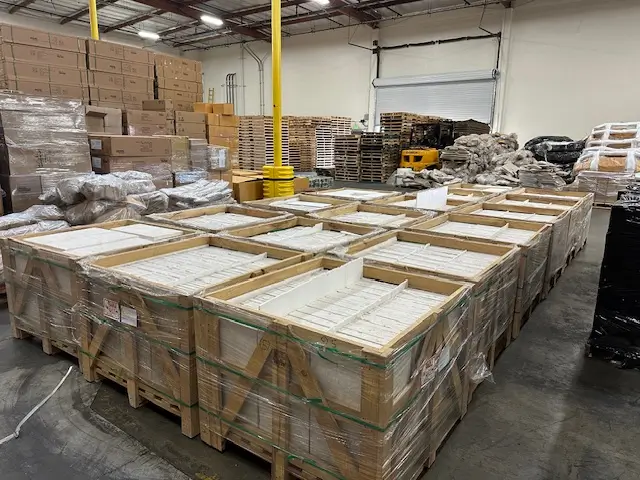
The logistics of a large granite marble order involve more moving parts than most project timelines account for. Warehouse stock availability, truck scheduling, unloading site access, and on-site storage all interact in ways that can compress or extend your effective lead time by weeks. The procurement step most commonly skipped is confirming whether the supplier’s warehouse holds the specified lot in sufficient quantity to fulfill the full order — or whether the quote is based on anticipated stock that hasn’t yet arrived.
Your project timeline should build in a verification window of at least five business days to confirm lot availability, inspect samples against your specification, and sign off on documentation before the truck is scheduled. For commercial projects with phased material deliveries, coordinate each truck drop with the installation schedule — delivering three months of material to a site with inadequate covered storage is a fast way to create moisture damage before the stone is ever installed. Citadel Stone can coordinate staged warehouse releases to match your installation sequence, which is particularly useful on multi-floor commercial builds where each floor phase requires a separate delivery event.
Lead time from warehouse to site for in-stock material typically runs 7 to 14 days for standard truck freight across most of the continental market. For oversized slab orders or custom-cut material, factor an additional 2 to 4 weeks for fabrication before freight scheduling. Building these windows into your procurement schedule prevents the scenario where installation crews are on-site and waiting because material hasn’t arrived — a cost that rarely appears in material line items but shows up clearly in labor invoices.
- Confirm warehouse lot quantities against your full order volume before signing a purchase order
- Schedule truck deliveries around installation progress — avoid bulk delivery to sites with limited covered storage
- For phased projects, negotiate a warehouse hold agreement to reserve stock between delivery events
- Standard freight lead time: 7–14 days for in-stock material; 3–6 weeks for custom fabrication plus freight
- Verify truck access at your site — articulated lorries carrying full slab pallets require turning radius and load-bearing surface access that some sites cannot accommodate

Quality Inspection and Rejection Protocols Before Installation
Inspection at delivery is non-negotiable on bulk orders — and yet it’s the step most project teams rush through or skip entirely under schedule pressure. The time to identify material defects is at delivery, not mid-installation. Once stone is cut, set, and grouted, the cost of replacing a defective section multiplies by four to six times compared to the original material cost.
Your inspection protocol for granite marble should cover four categories: dimensional compliance, surface finish consistency, structural integrity, and lot matching. Dimensional compliance means physically measuring a representative sample of pieces — typically 5% of the order — against your specification tolerances. Surface finish consistency means comparing pieces across pallets, not just within a single pallet, under consistent lighting. Structural integrity means looking for cracks, fissures, and lamination voids along edges and faces — defects that are often masked by packing material and only visible once pieces are unpacked and stood upright.
Lot matching is the most commonly missed inspection category. Place pieces from different pallets side by side under the same light source. Variation that’s invisible when comparing adjacent pieces from the same pallet becomes obvious when you compare pallet one to pallet twelve. Document any variation with photographs before the truck leaves — once the driver has a signed delivery receipt, your leverage for a supplier credit is substantially reduced. Our technical team at Citadel Stone provides lot-matching documentation with every bulk order, which gives your inspection team a baseline to compare against at delivery.
- Inspect a minimum 5% sample of pieces dimensionally — measure thickness at four corners per piece
- Compare surface finish across pallets, not just within pallets — color and sheen can drift between production runs
- Check edges and corners for transit damage — natural stone is brittle and corners are the first casualty in poorly packed shipments
- Photograph any defects or lot variation before signing the delivery receipt
- Maintain a written rejection log — verbal rejections at delivery are not enforceable without documentation
Understanding Pricing Structure and Volume Discount Thresholds
Granite marble pricing at bulk scale operates on thresholds that aren’t always published in supplier catalogs. The price per square foot you see on a standard quote often reflects the 50 to 200 square foot order range. At 500 square feet, 1,000 square feet, and 5,000 square feet, the effective unit cost changes — but only if you know to ask, and only if you’re buying in quantities that match the supplier’s natural break points.
Supplier break points typically align with pallet quantities, container quantities, or quarry block minimums. A full pallet of 2cm granite tiles in 12 × 24 format might yield 180 to 220 square feet depending on pallet configuration. A full container from a Middle East quarry source might yield 2,500 to 4,000 square feet of finished tile depending on thickness and format. Understanding these logistical units lets you structure your order to hit the break points that deliver meaningful cost reduction — rather than ordering a quantity that sits awkwardly between tiers and earns no discount at all.
Your cost comparison across suppliers also needs to account for what’s included in the quoted price. Some suppliers quote ex-warehouse, excluding freight, crating, and handling. Others quote delivered to site. Freight on a full truck of granite marble can range from a few hundred to several thousand dollars depending on distance and access — a variable that can swing your effective cost per square foot by 8 to 15% and invalidate a comparison between otherwise similar quotes.
Installation Coordination and Site Readiness for Large Orders
Receiving a large granite marble delivery without adequate site preparation is one of the most expensive mistakes on commercial projects. Stone needs to be stored flat, covered, and on a surface that won’t transfer moisture — and it needs to acclimate to ambient site conditions before installation if the temperature differential between warehouse and installation environment is significant.
Acclimation matters more for marble than for granite. Marble’s calcite structure responds to humidity and temperature changes with micro-expansion and contraction that, while small in absolute terms, can affect adhesive bond formation if the stone is installed cold and then exposed to a warm humid environment. Plan for 24 to 48 hours of covered on-site acclimation before setting begins, particularly where the warehouse and the installation site have meaningfully different temperature and humidity profiles.
Your installation team should also confirm adhesive selection against the specific granite marble variety before ordering adhesive in bulk. High-density granite requires a polymer-modified mortar with sufficient open time to allow adjustment of large-format pieces. Marble — particularly white or light-colored varieties — requires a white or grey non-staining adhesive to prevent bleed-through of pigmented mortars, which is visible through the stone on translucent varieties. These details don’t appear in standard adhesive spec sheets; they come from field experience with specific stone types.
- Store stone flat on timber dunnage, minimum 4 inches off ground, covered with breathable sheeting
- Allow 24–48 hours site acclimation before installation in temperature-differential conditions
- Confirm adhesive compatibility with specific stone type — particularly for marble varieties with high translucency
- Coordinate installation crew size with delivery schedule — don’t schedule a 10,000 sq ft delivery to a crew that can install 500 sq ft per day
- Establish a clear waste factor in your order quantity — 10% for standard layouts, 15–20% for diagonal or pattern installations
Getting Your Granite Marble Procurement Right
Getting a bulk granite marble procurement right requires you to treat specification, sourcing, logistics, and installation as a single integrated process — not four separate decisions made at different stages by different people. The most successful large-scale projects are the ones where the specification is written before the first vendor call, where lot documentation is part of the purchase agreement, and where site logistics are planned with the same rigor as the material selection itself. As you work through your own project requirements, the distinction between how different supply models affect your procurement options is worth understanding in depth — how marble supply chains and fabricators differ covers that dimension of the decision with the kind of practical detail that changes how you evaluate supplier proposals.
Granite marble ordered through Citadel Stone ships in coordinated batches, helping contractors match lots across kitchens and commercial projects.
Related reading: marble remnants · Stone Fabrication Process Explained: From Slab to Surface · What Do Granite Fabricators Do? A Full Breakdown.