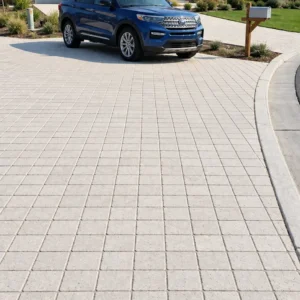
The apron does the hardest work
Most driveway complaints trace back to the same few square yards. A car rolling in a straight line does very little to a paved surface. A car turning off a road, reversing to line up with a gate, or pivoting while stationary does something quite different, and it does it in the same spot every day. Whatever the rest of the drive is made of, the apron deserves its own specification, written against the loads it actually sees rather than averaged across the whole frontage. That is a small area to upgrade and a large one to repair.
What a turning wheel actually does
A steering tire under load does not simply press down. It scrubs sideways, dragging the top of the surface across the bedding beneath it while the vertical load is still applied. Loose or shallow bedding lets individual units rotate a fraction each time, joints widen, and once a joint opens the unit next to it starts to take an edge load it was never bedded to take. The failure is progressive rather than sudden, which is why it is usually blamed on the stone instead of on the build-up.
Build-up from the bottom
An apron is a small structure, and it should be detailed like one:
- A compacted sub-base proportioned for vehicle load, not for foot traffic, carried past the edge of the paved area.
- A laying course of consistent thickness, since a variable bed is the fastest route to differential settlement.
- Rigid bedding where the turn is tight and repeated, with the detail chosen before the units are ordered.
- Positive restraint on every free edge, so the outer courses cannot migrate outward under scrub.
- A cross fall that clears water off the apron rather than holding it at the road junction.
Choosing the unit
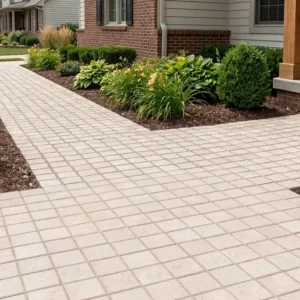
Small units win here for the same reason they win on a slope. Load spreads across many joints instead of one panel, a damaged unit can be lifted and replaced without disturbing a whole bay, and the interlocking pattern resists lateral movement in a way that a grid of large panels does not. Most of the creep and rocking that shows up in the first seasons disappears when you plan a driveway surface in cut setts around the actual turning circle rather than around the drawn rectangle. The variables that matter are narrow:
- Unit depth, set against vehicle load rather than against the depth used on the paths.
- Plan dimension, small enough that the pattern interlocks and no single unit carries a wheel alone.
- Absorption, because a dense unit holds up better under continuous salt exposure.
- Face texture, which has to keep traction when the surface is dry and dusty as well as wet.
Where a denser stone earns its place
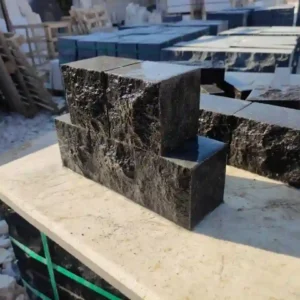
Not every part of an apron takes the same abuse. The wheel paths and the pivot point take almost all of it, and the margins take very little. One option is to specify basalt for the hardest-worked strip and keep a lighter limestone across the rest of the frontage, which gives the traffic zone a dense, dark, tight-grained surface while keeping the wider area cooler underfoot. It is a practical split rather than a decorative one, and it usually costs less than upgrading the entire drive.
Edges, falls and the road junction
The join between private ground and public road is where most aprons start to look tired.
- Set the threshold course so vehicles cross a flush or gently chamfered line rather than a lip.
- Restrain the road-side edge with a bedded curb or a cast haunch, never with jointing material alone.
- Keep runoff from the street out of the apron build-up with a defined channel or level change.
- Allow a wider unit or a soldier course at the mouth so cutting does not leave slivers where loads concentrate.
Salt, wind and what ages an apron
Bonaire sits outside the core hurricane belt, though that is not the same as untouched: Hurricane Lenny in November 1999 and Hurricane Omar in October 2008 both did real damage. Day to day, the constant north-east trade wind of around 7 m/s matters more. It deposits salt continuously, and with annual rainfall of only about 350 to 450 mm there is little natural rinsing.
- Choose low-absorption units, because salt crystallization rather than freeze-thaw is the decay mechanism here.
- Expect abrasive dust on the surface, and pick a face that keeps traction once it is dusty.
- Wash down periodically where the apron is close to the shoreline and exposed to spray.
- Keep runoff and any washings away from routes draining to the marine park, which starts at the high-water mark.
Landing the order
Getting apron material to Bonaire is straightforward on this route. A weekly service departs Port Everglades on Saturday and arrives at Kralendijk on Thursday, five days later, on a direct sailing, and the port runs continuously with a container terminal and warehousing. There is no import duty at all, and the levy that applies is ABB at 8% on the import of goods, calculated on the customs value of the goods plus insurance plus transport, so a delivered budget is easy to build honestly. Money is quoted in US dollars, official on the island since 1 January 2011. Specify the apron first and the rest of the driveway becomes a much simpler conversation.