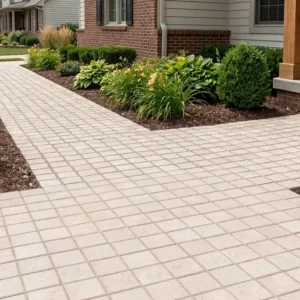
What an apron has to survive
The apron is the strip where a driveway meets the road or the gate, and it takes a kind of punishment the rest of the oprit never sees. Vehicles arrive slowly and turn hard, often at full lock while barely moving, which drives a twisting scrub straight down into the paving rather than a clean rolling load. Add braking, standing weight while a gate opens, and the grit that blows in and gets ground under a tire, and the apron becomes the part of a property where the wearing surface is genuinely working for its living. Aprons on the windward side of the island carry a second load that has nothing to do with vehicles, because near-constant trade winds out of the east and east-north-east drive salt aerosol and fine grit across the surface all year.
Why small units turn better
A turning wheel wants to lift and shift whatever it is standing on. Small units answer that better than a monolithic surface, for reasons that are mechanical rather than decorative.
- Load spreads through interlock between neighboring units instead of through one plate.
- A damaged unit lifts out and is replaced without leaving a visible patch line.
- Small formats absorb the slight settlement that follows the first wet season.
- Courses can be turned to meet a splayed entrance without an awkward cut.
Depth is the first specification
Format gets chosen for looks; depth gets chosen for duty, and on an apron duty wins. Unit depth, bedding thickness and base thickness are a single system, so raising the traffic means all three have to answer, not only the top one.
- Identify the heaviest vehicle that will actually use the apron, deliveries included.
- Match unit depth to that vehicle, not to the terrace it happens to adjoin.
- Thicken the base under any area where vehicles turn on the spot.
- Keep the laying course to an even thickness so units bed to a true plane.
Bedding: unbound, bound or concrete
There is no universal answer here, only a clear order of questions. Choosing between the three is the point at which cobble units that take wheel loads stop being a catalog decision and start being an engineering one.
- Unbound bedding over a compacted base suits light vehicle use and easy repairs.
- Bound bedding suits heavy turning where the joints have to stay closed.
- A concrete base suits commercial deliveries, or a slope that adds to the load.
- Movement joints belong wherever a rigid build-up meets a wall or gate post.
- Any bound system needs a drainage path so trapped water has somewhere to leave.
Edge restraint at the perimeter
The perimeter is the weak line, because it is the only place an interlocking surface has nothing to lock against. A wheel that crosses the outer course pushes it sideways, the joint opens, bedding material escapes, and the failure walks inward one course at a time. The answer is a restraint deeper and heavier than the paving it holds, founded into the base rather than resting on it. A restraint bedded only on top of the laying course is not a restraint at all; it is a decorative line waiting to be pushed aside by the first delivery truck. Where the apron meets a road, a planted edge or a change of level, the curbstone sizes we stock are worth checking against the depth you have chosen.
Drainage at the gate
Curacao is semi-arid, with a dry season running roughly from January to September and a wet season in October to December that can push into January. That is the reverse of the classic Caribbean pattern, and it sets a specific trap: an apron detailed for average rainfall here is detailed for almost nothing at all. Curacao also sits outside the main development region for tropical cyclones without being immune to them, and named storms have reached the island.
- Fall the apron away from the garage threshold, never toward it.
- Size the channel for a cloudburst on baked ground, not for the annual average.
- Keep an outfall that still works when wind-blown grit fills the first inch.
- Avoid detailing that lets salt water stand in a joint after a coastal blow.
Layers from Curacao’s own grades
Under any apron the bulk of the material is local. Mining Company Curacao, in business on the island since 1874, publishes base coarse at 0-50 mm, a full ladder of graded aggregate from 3-5 mm up to 25-50 mm, and presieved sand at 0-3.5 mm. Those are the sub-base, drainage and laying-course materials for the job. The imported piece is the wearing surface over the top of them, a different product category and not a replacement for anything made here. Building the base from island material and importing only the surface also keeps the freight bill honest, because the heavy tonnage never crosses a quay.
Permits, freight and delivery
An apron is construction work, and the Bouw- en Woningverordening Curacao requires a building permit before construction works are carried out; the application sits with Ruimtelijke Ordening en Planning in Scharloo, Willemstad. On the supply side, the Port of Willemstad is run by Curacao Ports Authority N.V., with cargo terminals operated under concession by Curacao Port Services, and the container terminal works around the clock with two gantry cranes, roughly 1,000 m of berth in total and a maximum depth of 12.2 m. Willemstad takes ocean freight directly, so a container of setts needs no transshipment leg to reach the island. Get the depth and the edge right, and the rest of the apron looks after itself.