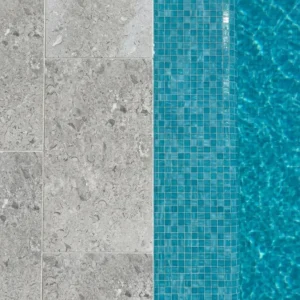
Frost Is Not the Enemy Here
Much of the published guidance on stone absorption was written for climates that freeze. Water enters the pore network, expands as it turns to ice, and works the fabric apart over repeated winters. Curacao has none of that. The island sits in a hot semi-arid band, and the agent that stresses a paving unit here is salt in solution rather than ice. Absorption still matters, and arguably matters more, but the number has to be read against a different failure mode than the one most datasheets quietly assume. A specification built around frost resistance is answering a question nobody on this island is asking.
What an Absorption Figure Actually Measures
Absorption is reported as a percentage of dry weight gained after a controlled soak. It is a proxy for how open and how connected the pore network is, and by extension how readily a unit draws in whatever is dissolved in the water reaching it.
- A low figure means fewer and finer connected pores for dissolved salt to travel into
- It tracks loosely with density, but the two are separate tests and both are worth requesting
- It says nothing about surface grip, which comes from the finish rather than the body
- It is measured on lab pieces, so ask which standard was used and how many samples were run
An Island Split by Aspect
Trade winds run out of the east and east-northeast at roughly 15 to 25 knots, near enough without pause. From February to August the southeasterlies arrive off South America and come in dry. From October to January the northeasterlies are less intense and can carry rain. The result is an island divided by aspect: the east and north coasts sit in a standing salt aerosol loaded with wind-blown grit, while the west and southwest side is calm, which is why marinas and resort frontages sit there. Aspect also sets how often a surface has to be cleaned, and the cleaning routine feeds straight back into which absorption figure is comfortable to live with. The absorption data behind these pavers should be read alongside the aspect of your own plot rather than in isolation.
Rain Here Arrives All at Once
Annual rainfall lands somewhere around 450 to 650 mm depending on which record you use, and under 700 mm on any of them. The dry stretch runs roughly January to September, with the wet months falling between October and December and sometimes reaching into January, which reverses the pattern a lot of Caribbean guidance assumes. Then there is the outlier. Hurricane Tomas dropped 265 mm on Curacao in a single day in 2010, close to half of a normal year in twenty-four hours. Baked, low-infiltration ground cannot take that, so the water moves across the surface, through the joints, and into anything it can enter.
Density, Depth and Where the Loads Sit
Density and unit depth are the second half of the specification. A denser body carries point loads with less risk of a hairline failure at a bearing point, and it gives the face something to hold onto while blown grit works at it season after season. Seismic movement sits behind all of this as a real but secondary concern; the KNMI technical report TR25-03 on seismic hazard for the Dutch Caribbean places Curacao below Sint Maarten, Saba and Sint Eustatius.
- Set depth by duty, so terraces, poolside walkways and vehicle crossings are priced separately
- Take the depth up where a drive apron carries turning loads, rather than stiffening the bed
- Ask for bulk density as its own figure, not as a sentence about the stone being dense
- Match unit size to depth, since a large thin format behaves nothing like a small thick one
Bedding on Locally Quarried Ground
Curacao supplies the layers underneath. Mining Company Curacao publishes graded material including Base coarse at 0 to 50 mm and Presieved Sand at 0 to 3.5 mm, alongside a run of aggregates and selected boulders for marine defense. Those grades are the sub-base and bedding for a job; the imported stone is the wearing course laid over them. Saying that plainly at specification stage settles who supplies what.
- Set falls first and size them for a cloudburst, not for an average month
- Choose jointing that tolerates salt and does not hold standing water
- Keep drainage exits clear of wall lines where salt tends to concentrate
- Avoid detailing that leaves a puddle sitting on the stone after a washdown
Figures Worth Asking For Before You Order
A supplier should be able to hand these across without a delay, and if they cannot, that is information in itself.
- Water absorption by weight, with the test standard named
- Bulk density, reported separately from absorption
- Flexural or breaking strength at the thickness you plan to lay
- Abrasion resistance wherever foot traffic will be heavy
- The finish applied, since it changes how the surface behaves in service
Test It on Your Own Plot
Paper figures narrow the field; a physical piece settles it. Put a sample outdoors on the aspect the job will face, leave it through a windy stretch, wet it, walk it, and clean it the way the property will really be cleaned. Salt behavior shows up faster on a coastal boundary than anywhere inland, so pick the harshest spot you have rather than the convenient one. Our Curacao stone supply notes cover the port and clearance side once the material itself is settled. Specify absorption and density together, read them against your own aspect, and the rest of the detailing gets much simpler.