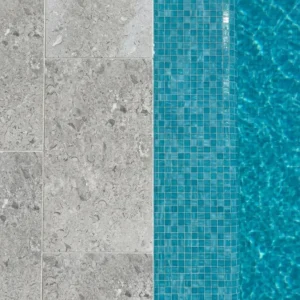
What salt air actually does
Salt arrives as aerosol, settles on every horizontal surface, and waits for moisture. Then it does three separate things. It draws water into the pore structure and dries out again, working the surface with each cycle. It attacks any ferrous metal within reach, and rust stains from a fixing are close to permanent. And it leaves a fine crystalline dust that acts as an abrasive under shoes.
None of that is dramatic in a single week. Over a couple of years the difference between a floor that was rinsed and one that was not becomes obvious from across the room. The stone itself is rarely the problem; what changes is the surface, the joints and the metal sitting in and around them.
The weekly routine
Most of the work is dilution. Salt that gets rinsed away cannot cycle, and fresh water is the whole trick. Keep the routine short enough that it actually happens.
- Sweep or vacuum first, so the abrasive dust leaves before anything gets wet.
- Rinse exposed thresholds, galleries and pool surrounds with fresh water.
- Use a pH-neutral cleaner made for natural stone, never an acidic bathroom product.
- Change the water rather than pushing a salty solution around the floor.
Sealing: what it does and what it does not
A penetrating sealer slows liquid entry and buys time to wipe a spill. It does not make stone waterproof, it does not stop salt crystallizing, and it does not remove the need to rinse. Topical coatings that sit on the surface are a poor fit for this climate, because they trap moisture, then peel in the sun and leave a floor that looks worse than an unsealed one.
Choose dense limestone tile for shore houses and a breathable penetrating sealer, then reapply on a schedule set by observation rather than by the label. Sprinkle water on a threshold: if it darkens the stone straight away, the sealer has worn through in that zone. Expect the exposed edges to need attention long before the middle of a covered room does.
The May to October pattern
Rainfall concentrates from May through October, which reshapes the calendar in a useful way. Rain rinses salt off exposed surfaces at no cost, so heavy manual rinsing matters most in the drier months. Sealing work is best scheduled when the stone can dry fully, which is easier before the wet season starts.
Deep cleaning afterward deals with the biological growth that shaded, damp corners collect through the wet months. Working to that rhythm turns upkeep into two short seasonal jobs and a light weekly habit, instead of one large restoration every few years.
After a storm
Two storms set the benchmark here: Irma crossed St. Thomas and St. John on 6 September 2017, and Maria reached St. Croix about two weeks later, with roughly 90% of buildings in the Virgin Islands damaged or destroyed. Storm work on a stone floor has its own order.
- Clear debris before anything is dragged across the surface.
- Flush the whole floor with fresh water to remove salt spray driven under cover.
- Check edge restraint and joints for movement before deciding anything is intact.
- Photograph damage before repair, because floodplain and insurance paperwork will ask.
Take the same care with the joints and the perimeter as with the stone itself. Wind-driven water gets under an edge that has lifted even slightly, and a joint opened by movement will keep taking water long after the weather has passed. Reinstating restraint properly is what stops one storm turning into a slow failure over the following seasons.
Metal, water and the stains that stay
Most of the marks that ruin a coastal floor are not the stone’s fault. They come from what is bolted to it, stood on it or poured over it, and nearly all of them are avoidable at specification stage.
- Use stainless or composite fixings throughout; plain steel bleeds rust into stone.
- Keep planters off the floor on feet, so damp does not sit under a rim for months.
- Watch furniture glides, since a worn glide exposes the metal beneath it.
- Where roof water feeds a cistern, check what any cleaning product does downstream.
That last point matters more here than on the mainland. Virgin Islands Code Title 29 section 308 ties required cistern capacity to roof area, with the requirement stepping up for taller buildings, so a cistern is written into the building rather than added to it. Your architect will have the current figure for the building.
Choosing stone that makes upkeep easy
Upkeep is decided at the specification stage, not with a mop. A tighter-grained stone in the right finish shortens every routine that follows it, for as long as the floor is there.
- Ask for absorption figures and pick the tighter-grained material for exposed zones.
- Prefer a face that hides fine dust between cleans without becoming hard to rinse.
- Buy a small reserve of the same batch and store it dry against future repairs.
- Keep the technical sheet with the house papers, so the next owner cleans it correctly.
If replacement units are ever needed, ask how we handle shipping stone to Christiansted and Frederiksted so a later batch is matched against the original. A floor rinsed often and sealed sensibly asks far less of you than one rescued after the fact.