Start With Duty Class, Not the Photograph
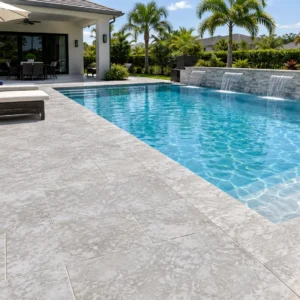
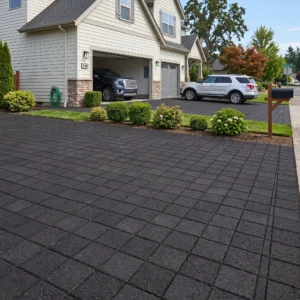
Format and depth are decided by what will walk, roll or park on the finished surface. A pool surround, a courtyard, a service apron and a driveway are four separate specifications, and the difference lives in unit depth, unit size and how the units are bedded and restrained. Choosing the picture first and the depth afterwards is how a perfectly good stone ends up failing in a duty class it was never cut for. Write the areas down with the traffic each one carries before you look at a single sample, and the rest of the specification argues itself.
Two Products From the Same Rock Family
This needs saying plainly, because the territory has a working stone industry of its own. Aggregate Inc. operates the Ham’s Bluff Quarry on St. Croix, producing bluestone basalt construction aggregates that run from DOT-spec road base to ASTM-certified material for asphalt and ready-mixed concrete, with tug-and-barge delivery to Leeward islands within roughly a two-hundred-mile radius of the quarry. That is construction aggregate. What Citadel supplies is dimension-sawn paving in calibrated sizes. In a normal build-up the two do different jobs: local aggregate and ready-mix below, sawn units as the wearing surface above. Neither replaces the other, and a specification that confuses the two produces either an over-engineered base or a surface that was never sized to be walked on.
Terraces, Courtyards and Pool Surrounds
Foot traffic is the gentlest duty class and the one where format freedom is widest. Larger modular units read calmly across an open terrace, and the real constraints are handling weight, bedding support and how the face behaves wet and barefoot.
- Keep unit size within what two people can place by hand on a steep site.
- Specify a textured face wherever the surface runs to a pool edge or a shower outfall.
- Watch absorption on any stone that will sit under standing rainwater in the wet months.
- Allow a border course so cut units do not land at the visible edge.
Driveways, Aprons and Turning Areas
Once wheels are involved the specification changes shape. Vehicle areas need greater unit depth, a stiffer build-up underneath and edge restraint that will not creep when a loaded truck turns on it. Where a dark, dense surface suits the scheme, basalt cut as architectural paving is a different product from barged construction aggregate and should be specified from its own data sheet.
- Step the unit depth up for anything a vehicle crosses, including the last few feet of a shared drive.
- Use smaller formats where vehicles turn on the spot rather than run straight.
- Detail edge restraint on every free edge, not only the ones on show.
- Carry the apron build-up continuously under the garage threshold.
- Set the falls away from the building before anyone sets out the pattern.
Small Units Where the Ground Moves
The territory sits on the North American and Caribbean plate boundary, and earthquake risk is a genuine design input rather than a footnote. The reference event is the 1867 Virgin Islands earthquake, magnitude 7.5, in the Anegada trough between St. Croix and St. Thomas. Movement tolerance is worth designing for.
- Smaller units redistribute point loads and can be lifted and reset one at a time.
- Flexible bedding absorbs small movement that a rigid bed transmits into the stone.
- Honest movement joints beat hairline cracks appearing where nobody planned them.
- Edge restraint keeps a flexible system from creeping outward over time.
Codes, ASTM and the Data Sheet
The Department of Planning and Natural Resources enforces the International Building Code 2021 and the International Residential Code 2021, alongside the 2021 Uniform Plumbing Code and the 2020 National Electrical Code. Those codes and their ASTM references are the language a specification is written in here, so the paperwork should travel with the pallet.
- Water absorption figures for the stone you are actually buying.
- Density and strength data suitable for the duty class specified.
- Slip characteristics for the finish, not for the material in general.
- Thickness tolerance, so the bedding crew knows what variation to expect.
Historic District Review Comes Before the Order
Charlotte Amalie, Christiansted, Frederiksted and Cruz Bay all contain historic districts, and the Virgin Islands Historic Preservation Commission approves construction within them, with new work expected to follow guidelines that maintain the Danish colonial character. The updated Historic Districts Guide issued by the DPNR State Historic Preservation Office with the commission addresses architectural materials, masonry, landscaping and the approval process itself. If your site sits inside one of those boundaries, the approval path shapes the material schedule, so run the paving selection past it before you commit to a format. The sequence to avoid is ordering first and seeking approval afterwards, because a consignment already on the water is an expensive thing to redesign.
Order the Duty Classes Together
Where a project has a terrace, an apron and a driveway, order the whole schedule as one lot. Shade and vein character are more consistent across a single production run, calibration is easier to hold, and one consignment means one clearance rather than three. It also lets you hold back a small reserve of each format for repairs, which is far easier than matching a run months later. Send us the areas, the traffic on each one and the build-up your engineer has drawn, and we will match depths and formats to them.