The Test That Happens Barefoot
Nobody crosses a terrace in shoes on Bequia at two in the afternoon. The real test of a paving surface here is a bare foot on the run between a shaded door and the pool edge, and that test is unforgiving. Stone tone is the first lever you have. A pale limestone reflects more of the light falling on it and takes on less of the heat that follows, while a dark surface absorbs and holds it. The difference is not subtle, and it is felt exactly where people are least willing to tolerate discomfort. That lesson usually arrives the first time a client crosses a finished terrace in July, which is far too late to change the order.
What Tone Changes, and What It Does Not
Color is doing real work here, but it is not the whole answer, and it helps to be clear about where its influence ends.
- A pale limestone reflects a large share of incoming sun instead of storing it in the surface layer.
- Mass matters too: a thicker unit warms more slowly and sheds that warmth more slowly after sundown.
- Shade beats material every time, so a pergola or a mature tree does more for comfort than any change of stone.
- Wet stone cools quickly, which is why a splash apron rarely feels like the open terrace beyond it.
- Bedding counts: a paver on a ventilated, well-drained base behaves differently from one bonded to a dark slab.
Finish Changes What Tone Promises
Two pavers cut from the same block can feel different underfoot once they leave the saw. A honed face is smooth and reads slightly darker when wet. A brushed or bush-hammered face scatters light, holds a fraction more air at the surface and usually feels kinder on a hot afternoon. Texture also breaks up glare, which matters as much as heat on a white terrace in full sun. When clients ask about light limestone underfoot in SVG, the honest answer pairs tone with finish rather than treating them as two separate decisions.
The Hours That Actually Hurt
Comfort is a timetable rather than a constant. Plan the terrace around when it will really be used.
- Late morning to mid-afternoon is when an unshaded surface is at its least forgiving.
- West-facing terraces stay warm into the evening, long after the east side has cooled off.
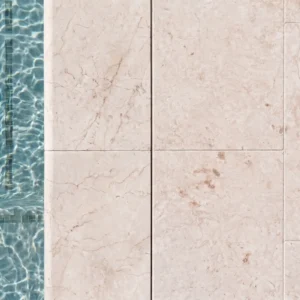
- Pool copings are used barefoot at precisely the wrong hours, so they deserve the palest, most textured option on the property.
- Covered thresholds and stair treads see traffic all day and can carry a slightly darker stone without complaint.
Glare Is the Other Half of the Problem
A very white, very smooth terrace under Caribbean sun can be genuinely hard to look at, and clients who asked for the brightest sample in the box sometimes regret it by July. The fix is not a darker stone. It is a textured face that scatters reflection, a slightly warmer tone in place of a stark white, and planting or shade structures that break one sheet of light into pieces. Sit with the sample outdoors at midday before deciding, because no interior can reproduce that light.
- Choose a warm off-white over a stark bright white on any large open area.
- Use a brushed or bush-hammered texture, which scatters reflection instead of returning it as a sheet.
- Break up the plane with planting beds, a change of format or a darker banding course.
- Save the brightest, smoothest stone for shaded loggias and covered thresholds, where glare cannot build.
Zoning a Terrace by Temperature
The most comfortable terraces in the Grenadines are not one stone laid everywhere.
- Palest and most textured at the pool edge and along every barefoot route.
- Mid-tone across the open dining terrace, where furniture and shade already break the surface up.
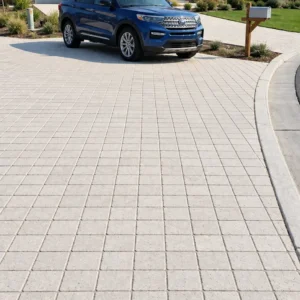
- A darker, tougher unit at the driveway and service yard, where shoes are the norm anyway.
- A change of tone at each threshold, which reads as design and works as comfort.
Most of that zoning happens inside one family of pale limestone formats we stock, varying finish and size rather than switching material at every step.
Pale Surfaces and Volcanic Ash
There is an honest caveat to pale stone in Saint Vincent and the Grenadines. Gray ash from La Soufriere, which erupted in April 2021, shows on a light surface immediately, and a very open texture will hold onto it. The answer is not to abandon the tone. It is to choose a dense, low-absorption stone with a texture that grips a foot without swallowing fine particles, and joints that can be flushed with water rather than picked clean by hand. Falls that move water off the terrace quickly help as much as the stone itself, because standing water is what carries fine particles into a joint and leaves them there. Pale stone that washes properly stays pale.
Before You Commit to a Tone
Ask for a small sample of every candidate and live with them for a week on the actual site. Wet them, dry them, walk them barefoot at midday, and look at them again in the evening light people will be sitting in. Photographs flatten tone and hide texture completely, and a screen makes every pale stone look the same. The stone that wins the barefoot test at noon is the one to buy.