Two Events That Set the Brief
Most regional paving advice is written as though hurricanes were the only hazard. Saint Vincent and the Grenadines has two reference events, and a specification answering only one of them is incomplete. Hurricane Beryl struck on 1 July 2024 as a Category 4 storm, and La Soufriere erupted in April 2021, leaving the main island under gray volcanic ash. Wind, salt, surge and ash all belong in the same brief here, and they pull the specification in the same direction. Read together, they argue for one thing: dense, low-absorption stone, textured but closed, well drained and firmly restrained at every edge.
What Beryl Actually Did
Beryl is not an anecdote. Total economic damage was assessed at about US$230.6 million, roughly 22 percent of the 2023 gross domestic product, and 56 percent of the population was affected. The Southern Grenadines took the worst of it: on Canouan, Mayreau and Union Island ninety to one hundred percent of homes were affected, Union Island alone carried an estimated US$93.9 million in damage, and Canouan saw wind, rain and storm surge together. Rebuilding is being done by people who lived through it, which is why storm detailing is treated here as a requirement rather than a preference. Specifying for that reality is a matter of respect as much as engineering.
Ash Is a Specification Problem
Volcanic ash fall is abrasive and chemically aggressive, and it has to be swept and washed off paving rather than left to weather away. That single fact rules out several surfaces that photograph well. What survives it:
- Dense, low-absorption stone that does not draw in fines or staining
- A texture that grips when wet but stays closed enough that ash does not embed
- Jointing that can be flushed clean without washing out
- Falls and outlets that carry gray sediment away instead of pooling it
- Edge details that can be brushed along rather than dug out
Very few markets ask this of a paving surface, which is why generic island specifications land badly. Raise it with your architect early, because it governs the jointing product as much as the stone.
Mapping Your Exposure Zones
Treat one site as several. A villa on an exposed Grenadine headland does not have a single exposure condition, it has four or five:
- Open seaward frontage, taking salt-laden wind and spray year round
- Pool surrounds, where treated water and salt meet the same surface
- Sheltered courtyards and arrival courts, the mildest zone on the plot
- Roof terraces and steps, where uplift and driven rain concentrate
- Main-island hillside plots, where runoff volume matters more than salt
One product across all of them is how a project ends up with a fine terrace and a failing frontage, so paving specified by exposure band is the cheaper habit. Walk each zone on a windy day and again in heavy rain before anything is finalized.
Wind, Edges and Fixings
Wind rarely lifts a bedded paving field. It lifts the loose piece at the edge and then works inward. In the Grenadines, edge restraint and fixing detail deserve as much drawing time as the pattern itself. The details that earn their keep:
- A restrained perimeter on every edge, internal ones at planting beds included
- Bedded and point-fixed units at steps, copings and exposed corners
- No loose-laid work on elevated or roof terraces
- Somewhere to store furniture, planters and pots before a warning is issued
- Fixings chosen for salt exposure rather than for unit cost
Water Has to Go Somewhere
Rain here arrives in intense bursts rather than steady drizzle. On the main island, respect the river channels: the Rabacca is a seasonal river that runs like a river only in heavy rainfall, and debris flows follow those channels. Positive falls, generous outlets and a drainage layer that keeps working when it is loaded with sediment matter more than any surface treatment. Where you can, keep paving above the line the water wants to take instead of arguing with it. A drainage brief for a Vincentian site usually covers:
- Falls set for a downpour rather than for a drizzle
- Outlets sized and sited so sediment can be cleared by hand
- Roof water separated from surface water wherever the levels allow
- Ground above a channel treated as a flood path, not a garden feature
Finish Choices Before the Season
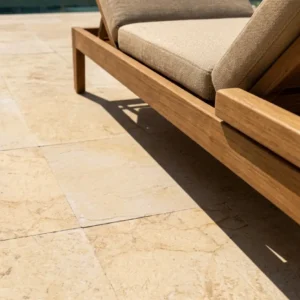
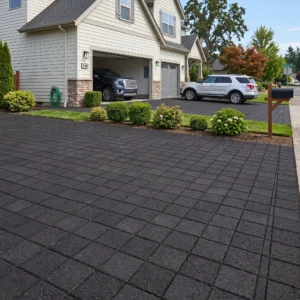
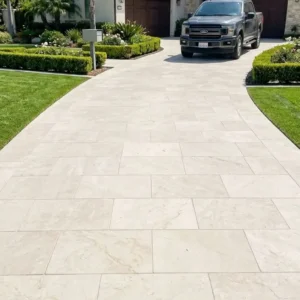
Polished faces are the wrong instinct in this climate. A honed or lightly textured face gives grip in hard rain and cleans down without holding fines, while heavily open textures collect exactly what you are trying to sweep away. Comparing textures that shed volcanic ash is worth doing with sample material in hand, in the light and the water the site actually gets. A face that reads well dry can behave completely differently under a hose.
Agree It With Your Own Team
Material choices should be settled with the project architect or engineer under the Town and Country Planning permit, and carried through to the occupancy certificate on completion. We supply technical data, absorption figures and sample material; your local team holds the code and knows the site. Give them the absorption figures, the finish samples and the pallet data, and let them place all of it inside the permit. Detail for the worst day a site will ever see and the ordinary years take care of themselves.