Start with exposure, not preference
The limestone-or-basalt question gets answered on most projects by looking at photographs. In Grenada it should be answered by looking at a map. A single island carries a sheltered Caribbean coast, a hard Atlantic coast, an interior taking about two and a half times the rainfall of the shoreline, and two sister islands with a drier climate again. Exposure varies more across thirty minutes of driving here than it does across some entire countries, and a material that performs beautifully at one end of that range will disappoint at the other. Start with where the paving sits and the shortlist writes itself.
The sheltered west coast
From Grand Anse and Morne Rouge through Point Salines, Lance aux Epines and up to the Carenage and Port Louis Marina, the water is calm, driven spray is limited and the sun is the dominant force acting on a surface.
- Heat underfoot is the leading complaint, so pale tone genuinely earns its keep.
- Salt loading is present but modest compared with the windward side.
- Glare matters on open decks, which pushes toward a lightly textured face.
- Resort and villa work dominates, so consistency across a large area is valued highly.
The Atlantic east
Grenville, Westerhall, La Sagesse and the north-east at Bathway and Levera live under a different set of forces entirely. Wind is constant, spray is driven rather than drifting, and the sea is rarely still for long.
- Salt crystallization is the aging mechanism to design against, so keep absorption low.
- Wind-blown grit abrades a surface over time, which favors a robust worked texture.
- Fixings and restraints corrode faster here, so specify them accordingly.
- Access for freshwater rinse-down matters more than it does on the leeward coast.
The rain-fed interior
Rainfall on the coastal belts sits around 1,500 mm a year. Toward the central highlands near Grand Etang it climbs toward 3,800 mm, roughly 150 inches, and the heaviest months run June through November. At that volume the paving decision becomes a drainage decision with a surface attached to it. Falls have to be generous, joints have to move water rather than hold it, and biological growth on shaded slopes is a given rather than a risk. Texture and grip outrank appearance on any interior site, and so does the quality of the base build-up beneath. A pale surface will still work well up there provided the water has somewhere to go; what fails is a smooth face laid dead level on ground that collects runoff from half a hillside.
Carriacou and Petite Martinique
The sister isles are a separate specification and a separate freight problem, and they should never be folded into a mainland scope. They receive far less rain than mainland Grenada and can face severe drought through the dry season, so the runoff and growth issues dominating the interior barely register there while sun and salt take over. Freight is the larger planning item. Tyrrel Bay is Carriacou’s only port, the Osprey carries passengers and light cargo, and pallets of stone travel on a cargo vessel such as the Dolly C or the Tyrrel Bay Express. Build that extra leg into the program from day one.
Where a dense dark unit suits the job
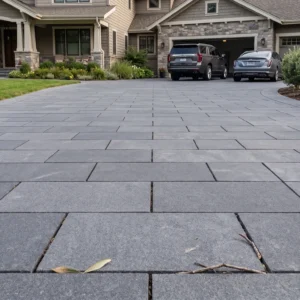
A note on terms first, because it matters here. The basalt worked at Telescope by the state-owned Gravel, Concrete and Emulsion Corporation is crushed aggregate and asphalt feedstock, the structural material beneath Grenadian roads and slabs. Imported basalt paving is a calibrated dimension-stone surface that sits on top of a base course very likely made from Telescope material. Two different products, two different jobs, and understanding how basalt units are graded makes the distinction obvious.
- Driveways, aprons and turning areas carrying vehicle loads.
- Marina and working hardscape where marks and stains are inevitable.
- Shaded courtyards where surface heat is simply not the constraint.
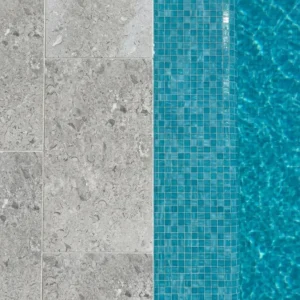
- Contrast banding and edging set against a pale field.
Where pale limestone suits the job
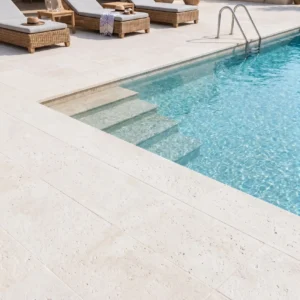
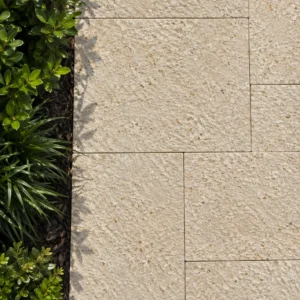
The pale option is not a default and it is not decoration. It is the right answer wherever reflected light, surface heat and barefoot use are driving the brief, which on most Grenadian resort and villa schemes covers a good deal of the plan. Reviewing pale limestone for west-coast terraces against the zones below is usually the quickest way to split a project sensibly.
- Pool decks and copings walked barefoot in the middle of the day.
- Open terraces with no overhead shade through the dry season.
- Interior floors running through to exterior surfaces on one level.
- Heritage-context work where tone must answer to existing masonry.
- Any surface where reflected light is being used to keep a space cool.
Mixing both on one site
Most well-resolved projects here use both stones rather than choosing between them. Pale limestone across the terrace and pool surround, a denser dark unit on the driveway and the service route, and a shared thickness discipline so levels meet cleanly at every junction. Grenada is also a seismically active island under continuous regional monitoring, so movement joints belong in the detail drawings as routine good practice rather than as a late addition. Agree the thickness range first, then let tone follow the exposure map, and the two materials will meet without awkward transitions or made-up details on site. Split the plan by exposure and each stone ends up doing only what it is built for.