Two products, two different jobs
There is a version of this conversation that starts badly, and it starts with an importer telling a Grenadian that the island’s own rock is not good enough. That claim is untrue and it is not the argument being made here. Grenada produces basalt of genuine quality, and the material an imported pallet of paving arrives to sit on is very often that same rock. The distinction worth drawing is not about quality at all. It is about product class: crushed aggregate and asphalt feedstock on one side, calibrated dimension stone on the other, doing two jobs that never overlap.
What the Telescope quarry produces
The country’s main quarry sits at Telescope in the parish of St Andrew, worked by the state-owned Gravel, Concrete and Emulsion Corporation, with a smaller gravel operation at Mon Rush in St George’s. The rock is basalt, described as a high-quality, durable stone used for high-strength concrete and for asphalt road surfaces. That is the structural skeleton of the island: the roads, the foundations, the concrete frames and the base courses beneath almost everything else. It is a national asset, produced for a purpose that imported dimension stone does not serve and could not replace even if somebody wanted it to.
The layers of a Grenadian terrace
Walk down through a finished terrace and the division of labor becomes obvious very quickly.
- Subgrade: the ground itself, prepared, graded and compacted on site.
- Sub-base: crushed aggregate, which on most Grenadian sites is domestically produced.
- Bedding layer: sand, screed or mortar depending on the build-up chosen.
- Wearing surface: the calibrated stone units you actually see and walk on.
- Edge restraint and drainage: curbstones, channels and falls holding the rest in place.
Most of that build-up is local work with local material. The imported elements are the wearing surface and, where specified, the cut-stone edge restraint.
Where imported dimension stone fits
Dimension stone is cut, calibrated and sorted to a consistent thickness so it can be laid to a level plane at speed by a crew who are not shimming every unit. That is a manufacturing process, not a claim of geological superiority over anything. That is also why a calibrated wearing surface layer gets specified and priced separately from everything sitting beneath it.
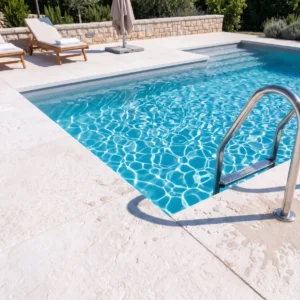
- Resort terraces and pool decks needing consistent thickness across large areas.
- Villa floors where interior and exterior surfaces are meant to run through on one level.
- Heritage-context paving where format and tone must answer to existing masonry.
- Schemes specifying a pale surface for heat, glare and reflected-light reasons.
Heritage context in St George’s
St George’s is a masonry town by law. After the fires of 1771 and 1775 a municipal requirement obliged buildings to be of brick or masonry, and the town that grew from that rule is the reason the historic district has sat on Grenada’s UNESCO Tentative List since August 2004. It is a tentative listing rather than an inscribed World Heritage Site, and that distinction matters whenever anyone writes about it. The Physical Planning Department has been developing a listing system as part of establishing a conservation zone for the town, so paving work in that area is a planning conversation before it becomes a materials conversation. Fort George and the restored Fort Frederick set the tone the rest of the district answers to.
Working with the contractor already on site
The imported-stone projects that go well here are the ones where the supplier fits into a local build program instead of trying to direct it from a distance.
- Confirm the base build-up with the contractor before format and thickness are locked.
- Deliver in sequence with the site program rather than in one drop that blocks the yard.
- Agree who receives, checks and stores the pallets, and exactly where they go.
- Leave cutting and setting-out to the crew who know the ground and the falls.
The import stack, plainly stated
Grenada is a full CARICOM member, so extra-regional stone pays the Common External Tariff rate applying to its code, assessed on the CIF value. Planning consent sits under the Physical Planning and Development Control Act No. 25 of 2002, with later reform in 2016; your planning consultant will confirm which provisions govern your particular site.
- Duty is calculated on CIF, then VAT at the standard rate of 15% applies to CIF plus duty.
- A Customs Service Charge applies as well; confirm the current rate with your broker before budgeting.
- Declarations are lodged electronically through ASYCUDA World on the customs entry form.
- A licensed broker is not strictly mandatory if you are registered as a declarant, though most first-time importers use one.
- Domestic quotes are usually in East Caribbean dollars while larger resort contracts are often written in US dollars.
If you would rather have a single point of contact for quoting, freight and clearance, that is what our Grenada project supply desk handles.
A sensible way to start
Start with the project rather than the pallet. Confirm what the local base build-up will be, decide which surfaces genuinely warrant calibrated stone, and price only those. Bring the contractor into the specification early so the imported layer arrives to a base already prepared to receive it, at the moment the program needs it. The sub-base under your imported stone terrace is very likely Grenadian basalt, and that is exactly how it should be.