Wet, Barefoot and in a Hurry
Design the pool surround for the worst realistic moment, not the calm one. That moment is a child running from the water to a towel, on a wet surface, with sunscreen on their feet, at an angle nobody drew on the plan. Everything about grip specification in the Turks and Caicos Islands follows from picturing that and working backwards.
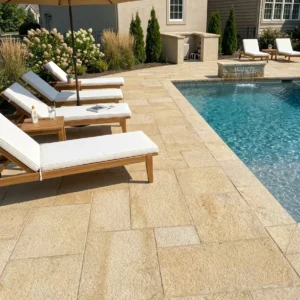
Villas, condo-resorts and beach clubs on Providenciales carry most of this risk, and the surfaces around them are working hard every day of the season. A resort deck sees far more wet crossings than a private patio ever will, which is why grip here is a specification issue rather than a preference.
What Grip Actually Comes From
Slip resistance is not a single property of a stone. It is the result of several things stacked together, and weakening any one of them undoes the others.
- The worked texture of the face, which gives a wet foot something to key against.
- The natural grain of the material, since some stones hold micro-texture better than others.
- Joint width and profile, which break up long slick runs and give water somewhere to go.
- Falls and drainage, because a surface that never puddles is safer than one relying on texture alone.
- Contamination, since sunscreen and biological film cancel out texture faster than wear does.
Finishes That Work Around Water
The choice is between finishes that open the face and finishes that close it. Brushed and bush-hammered surfaces open it, creating a shallow relief that stays effective when wet and reads as a soft, matte texture rather than a rough one. Sandblasted and flamed treatments do similar work with a different character. Honed and polished faces close the surface, which makes them easy to clean and comfortable to sit on but poor company for a wet foot on a slope.
Most island pool decks want a moderately opened face across the walking area, with the smoother treatments reserved for shaded seating, indoor thresholds and vertical work. Look at brushed and bush-hammered faces compared side by side before deciding, because photographs flatten the difference completely.
The Coping Is a Different Problem
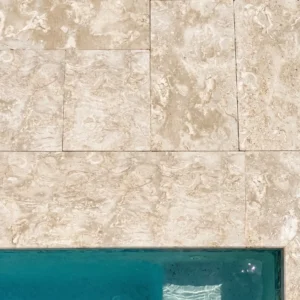
The unit at the water’s edge does a job no other paver does. It is permanently wet, it is gripped by hands as well as walked on, and its edge profile decides whether a swimmer pulling themselves out scrapes a forearm. A bullnose or a softly eased arris is standard for that reason, and the top face wants the most textured finish on the whole deck.
Set the coping so water runs away from the deck rather than back across it, and give the joint behind it enough width to drain rather than trapping a permanent damp line that grows algae.
- Specify the most textured finish on the project for the coping top face.
- Ease or bullnose the pool-side edge so hands and forearms are not scraped.
- Fall the coping outward and away from the deck, never back toward the walking surface.
- Bed and bond the whole coping run; a loose unit at the water edge is a hazard.
Salt Water, Pools and Splash Zones
Salt is already the governing exposure across these islands, and a salt-chlorinated pool concentrates it further at exactly the point people touch.
- Splash zones dry repeatedly through the day, so salt deposits and recrystallizes at the surface.
- A denser, lower-absorption stone limits how far that solution travels into the unit.
- Stainless fixings only around water; cast zinc alloys have no business near a pool here.
- Fresh-water rinsing of coping and the first course removes the salt load before it builds.
Falls, Drainage and Standing Water
The islands take about forty-three inches of rain a year and it lands in short, heavy periods rather than spreading itself out. A deck sized for the annual average will flood; one sized for the burst will not. Because the underlying platform drains poorly, the paving has to move the water rather than assume the ground will take it.
Falls should carry water away from the building and away from the pool edge, into channels or gullies that can be lifted and cleared by hand. Where a deck sits low, plan for surge as well as rainfall and keep the build-up bonded and restrained rather than dry laid.
Cleaning Without Polishing the Grip Away
Grip is lost through maintenance more often than through wear. A well-specified textured deck can be turned slick within two seasons by the wrong routine, and nobody notices until somebody falls.
- Rinse with fresh water regularly; it is the single most useful habit on a salt-air site.
- Avoid film-forming sealers, which bridge across the texture and leave a smooth skin.
- Treat biological growth in shaded, damp corners early rather than scrubbing it later.
- Keep sunscreen residue off the stone near loungers, since it is the classic hidden slip cause.
- Retain an offcut of the original as a reference for how the surface should feel.
Specifying the right unit in the first place makes all of that easier, and the textured limestone for wet decks we hold is listed with the finish stated for every format.
Check It Before the Guests Do
Before handover, walk the deck wet and barefoot yourself, including the fall lines and the step nosings, and do it at the time of day when the sun is lowest and the surface is still damp. Ask the housekeeping team to do the same thing a season later. A pool surround is only as safe as its wettest square foot on its busiest afternoon.