Why absorption comes first on a Jamaican site
Buyers usually open with hardness. On this island hardness is the second question. The first is how much water a paving stone takes in, how fast it gives that water back, and what travels in and out with it. Jamaica soaks paving three different ways: orographic rain that piles against the Blue Mountains and empties over the eastern parishes, salt-laden air that never really stops along the north coast, and the sheer volume a tropical system drops in a few hours. Beryl made that last point on the south coast in July 2024. Absorption decides how a terrace looks once all three have had a turn.
Reading a test report without guessing
A serious supplier hands over numbers, not adjectives. Water absorption is reported as a percentage of dry weight, density as mass per unit volume, and both come from a laboratory sample rather than a showroom impression. Ask for the report before the pallet, and read the whole page rather than the headline figure.
- Water absorption by weight, with the test method named on the report itself.
- Bulk density, which tells you how much stone is actually inside the unit.
- Compressive strength dry and after saturation, since the wet figure is the one Jamaica tests.
- Abrasion resistance, which matters far more on a hotel walkway than on a private verandah.
One island, several rainfall regimes
Portland and St. Mary catch rain that Kingston never sees. The capital sits in a rain shadow and swings between hard dry spells and sudden downpours, and that swing is harder on stone than steady wet weather. A porous unit fills during the storm, then dries quickly under strong sun, and salts dissolved in the water crystallize inside the pore structure as the moisture leaves. Repeat the cycle for a few seasons and the surface begins to powder at the arrises. A denser stone with lower absorption simply has less room for any of that to happen in.
What salt air does inside the pores
Along the north-coast belt from Montego Bay through Rose Hall to Ocho Rios, salt arrives on the breeze whether or not the sea is in view. It lands, dissolves in dew or rain, wicks into the stone and stays there. The damage is mechanical rather than chemical, and it is governed almost entirely by how open the pore network is.
- Lower absorption means less salt held inside the stone between rinses.
- Tighter pores slow the wicking that carries salt below the surface.
- Fresh-water rinsing works, but only if the stone releases what it took in.
- Joints and bedding hold salt too, so mortar and sand specification matters as much as the paver.
- Shaded areas dry slowly and hold salt far longer than open terraces do.
Density, thickness and Jamaican duty cycles
Density and thickness do different jobs and people confuse them constantly. Density is a property of the stone; thickness is a decision you make about the unit. A dense stone in a thin format still cracks under a delivery van. Kingston town houses, apartment courts and commercial forecourts run genuine vehicle traffic across surfaces that were drawn as patios, and resort service routes carry laundry carts and beverage trolleys all day long. Our limestone paving stock for Jamaica is cut to project thickness rather than to one standard section.
- Foot-traffic terraces and verandahs: standard exterior thickness on a well-compacted base.
- Hotel back-of-house and service runs: step up a thickness and tighten the joint.
- Driveways and anything a vehicle touches: heaviest section, full bedding, no shortcuts.
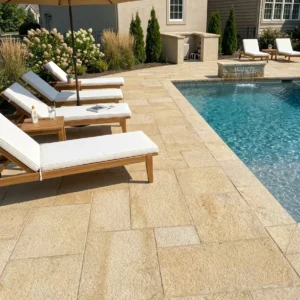
- Pool surrounds: thickness driven by the coping detail, not only by the field.
Where the national code sits in this conversation
The Building Act 2018 came into operation on 15 January 2019 and adopts the National Building Code of Jamaica, published through the Bureau of Standards Jamaica. After Hurricane Gilbert in 1988 the design wind speed was raised from 120 mph to 150 mph, and the country now holds national mapping of seismic, wind-speed, rainfall, flood-plain and land-slippage hazards. Paving is rarely the structural item in that discussion, but drainage, retention and surface runoff on sloping ground certainly are, and your absorption figure feeds straight into how a designer handles water at grade.
Landed cost is why testing pays for itself
Stone arriving at Kingston Freeport Terminal or at Montego Bay carries more than freight. Several charges stack on the CIF value through the Jamaica Customs Agency, and each one applies to the wrong stone just as willingly as to the right one.
- Import duty, commonly 20 percent under the CARICOM Common External Tariff.
- General Consumption Tax at 15 percent on the landed value.
- An environmental levy of 0.5 percent plus a Standards Compliance Fee of 0.3 percent.
- A Customs Administrative Fee, payable alongside everything above.
Confirm the current rates with your broker before you fix a budget. The logic is blunt: everything you land, you paid to land, so landing the wrong absorption figure costs twice. Our Jamaica stone supply desk quotes on delivered reality rather than on a list price.
How to put all of this on the order
Write the requirement instead of the adjective. State a maximum water absorption, a minimum density, thickness by area, the finish per zone, and the test report you expect to receive alongside the quote. Order a small sample first, leave it outdoors for a few weeks in the same exposure the project will face, and rinse it the way the maintenance team actually will. Send us the exposure, the traffic and the drainage plan, and we will quote stone whose numbers match the site rather than the showroom.