Thickness Follows Duty, Not Preference
Ask three contractors in Barbados what thickness a paver should be and you will get three answers, all of them correct for a different job. Thickness is the structural response to what will roll, park or stand on the surface, and to what sits underneath it. A shaded terrace at a west coast villa and a turning circle that takes a water truck twice a week are not the same problem. Specify them with the same unit and you overpay on one while shortening the life of the other. The useful habit is to draw the traffic before you draw the paving.
The Three Working Thicknesses
Most residential and light commercial work on the island resolves into three bands. Treat them as starting points to confirm with your engineer or mason rather than as a substitute for a site assessment.
- 30mm: foot traffic only. Terraces, poolside walkways, veranda floors and garden paths on a bound or properly consolidated bed.
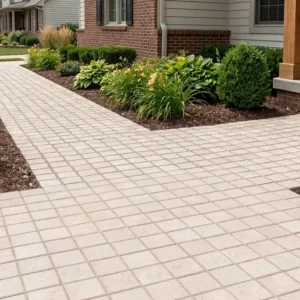
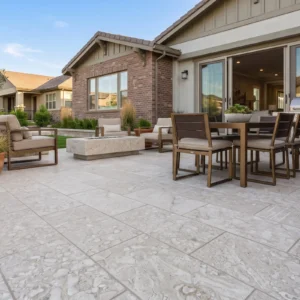
- 50mm: the general-purpose thickness. Patios carrying furniture, courtyards, entrance aprons and occasional light vehicle crossings.
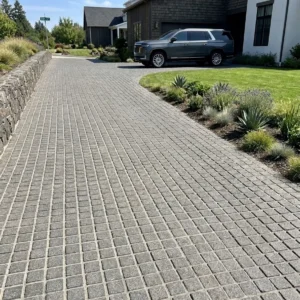
- 60mm: driveways, parking bays, service yards and any run a delivery van, mixer or water truck will use regularly.
- Above 60mm: commercial gate aprons and heavy turning circles, though a stronger sub-base usually buys more than thicker stone alone.
- Mixed layouts: one thickness per zone, with the change hidden at a joint line, channel or planting edge.
What Sits Under the Slab on a Coral Island
Barbados is a limestone cap raised out of the Atlantic, and that geology is generous to paving. Coral limestone drains, and free-draining ground is kind to a bedded surface. The natural cap, however, is rarely what a new yard is actually built on, and the layer you are truly bedding onto is usually one of these.
- Undisturbed coral limestone, free draining and forgiving, but worth proving rather than assuming.
- Cut and fill on a hillside plot, or imported marl, which want compacting in layers rather than tipping and leveling.
- Loose backfill around a fresh foundation, the youngest ground on the property and the first to move.
- Old topsoil and former garden beds, which belong off site rather than under a hard surface.
Consolidation decides the outcome: a 60mm paver over uncompacted fill will still settle, while a 30mm unit over a correctly prepared bed can outlast it by years. Test what is genuinely under your finished levels before buying thickness to compensate for it.
Driveways Where 60mm Earns Its Place
Vehicle loads are point loads and they concentrate at predictable spots, which is where failures start.
- The apron at the parish road edge, where wheels turn under full load and shear the joint.
- Wheel tracks on a climbing drive, common on hillside plots above the coast road.
- Wherever a water truck or concrete mixer parks to discharge.
- Gate thresholds, where the surface is interrupted and the edge is exposed on both sides.
Where budget is tight, upgrading only those zones and running a lighter unit elsewhere is a sensible compromise. Our driveway and terrace paving units are quoted by thickness band so that split prices cleanly.
Terraces, Pool Surrounds and Shaded Floors
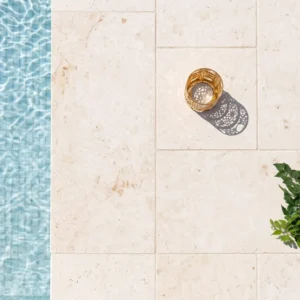
Once vehicle loading disappears, comfort takes over the specification. Thinner units are lighter to handle down narrow access, easier to cut around a curved pool edge and quicker to lay across a large floor. What matters instead is underfoot temperature, grip when wet and how the surface meets the door line. Barbadian houses are built open to the trade winds, with deep verandas and louvered openings, so a single material often crosses from shade into full sun within three steps. Judge the surface in both conditions on the same afternoon before you commit an order. Pool coping is a separate decision from the field paving behind it, and it usually wants the heavier profile.
Bedding, Joints and Edge Restraint
Thickness only performs if the detailing around it performs too.
- Match bedding method to duty: bound beds for vehicle areas, sand or screed beds for pedestrian floors.
- Restrain every free edge. Unrestrained perimeters are the single most common cause of creeping joints.
- Keep falls generous. Heavy rainfall bursts want to leave the surface fast, not pond at a threshold.
- Plan joint width with the cut tolerance of the stone, not with an idealized drawing dimension.
- Detail the transition where paving meets a curb line or garden wall so neither undermines the other.
Ordering Thickness Against a Container
Thickness drives weight, weight drives freight, and freight is a real share of the landed figure on any island order. Moving an entire scheme up a band because one zone needs it can add tonnage you never use. Splitting the order by zone usually costs less overall, even after the extra handling.
- Order the wastage allowance in the same band as the area it serves.
- Confirm pallet weights against gate width, turning space and any staging point a hillside site needs.
- Fix the format mix before packing, because a supplementary order here is a second voyage.
- Ask where surface water will go, since on-lot storage under the General Development Order shapes the falls.
Proving the Choice on Site
No table settles a specification. Get a small sample of the cut limestone paving units you are considering, wet it, walk it barefoot at midday and set it beside the coral stone already on the property so the two read as companions rather than competitors. Coral limestone has built this island for three centuries, and imported stone should join that conversation politely. Decide thickness by zone, prove the surface by sample, and the rest of the specification writes itself.