South of the airport, Bonaire flattens into one of the Caribbean’s strangest and most beautiful landscapes: the salt south. Solar salt pans spread in pink and rose sheets to the horizon, white salt pyramids rise beside the loading pier, flamingos feed in the shallows of a sanctuary they have used for generations, and along the shore road stand the small stone slave huts – preserved, deliberately, as memory. Building anywhere near this coast means building beside working industry, protected nature and sober history at once, and the brief deserves the care this guide gives it.
Reading the South
The salt south is three overlapping territories. The working salt concession, where solar evaporation runs as it has industrially for decades and the pans’ colors shift with the brine’s salinity. The sanctuary, where one of the region’s important flamingo breeding grounds enjoys strict protection – approached by nobody, enjoyed from a respectful distance by everybody. And the heritage shore, where the huts and the colored obelisks that once signaled ships stand as the island’s memorial to the enslaved people who worked this coast. Private building threads between the three, mostly along the leeward road north of the pans, and its manners are set by all of them.
The Heritage Shore, Handled Rightly
The slave huts are not scenery; they are memorial ground, maintained so the island does not forget what the salt once cost. Building culture near them follows suit:
- The huts and their surrounds are left entirely alone – no borrowing of the form, no imitation vernacular, no encroachment.
- New work nearby stays low, quiet and set back; this stretch of coast is not a design opportunity.
- Visitors’ access to the memorial sites stays open and unobstructed by any private works.
- The history is learned before the lot is bought – owners who understand the coast build better on it.
protected-heritage ground rules frames the general principle – the past is honored, never appropriated – and the salt south applies it with particular gravity.
Flamingo Manners
The sanctuary’s rules are simple – no approach, no drones, no disturbance – and the building corollaries are practical: works near the southern wetlands schedule noisy phases away from breeding sensitivities where guidance asks, site lighting stays low and warm because the birds navigate by night skies older than the island’s electricity, and drainage plans never touch the hydrology of pans and ponds whose salinity is the whole point. The reward is living beside one of the Caribbean’s great natural spectacles: pink clouds of birds against pink water, visible from a respectful terrace built by someone who understood the assignment.
Building on the Flat
The south is Bonaire at its most exposed – sea on one side, pans on the other, no terrain to hide behind and the trade wind running unbroken:
- Wind detailing leads: fixed copings, mass over lightness, engineered shade because no hill provides any.
- Salt arrives from two directions – sea spray and pan haze – so low-absorption stone and rinse routines run at full specification.
- The flat ground drains slowly in the late-year rains; paving falls and soakaways are designed, not assumed.
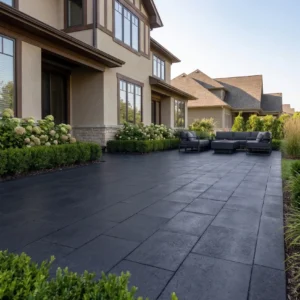
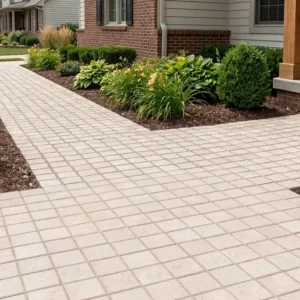
- Pale stone earns double duty, holding the heat down and matching a landscape of white salt and bleached coral.
The Southern Villa Register
Belnem and the lots along the southern leeward road are the district’s residential face – villas minutes from the island’s most famous dive entries, with the pans’ pink horizon as their inland view. The register is the island’s standard villa brief with the south’s exposures dialled up: dive-ready surfaces and rinse yards, terraces engineered for wind, and the landscape logic of the arid island applied without irrigation fantasies. What the south adds is light – the double reflection off sea and salt gives the district the island’s most theatrical evenings, and terraces are oriented to collect them.
Salt Light and the Palette
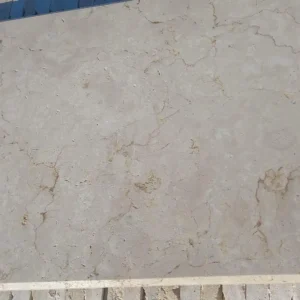
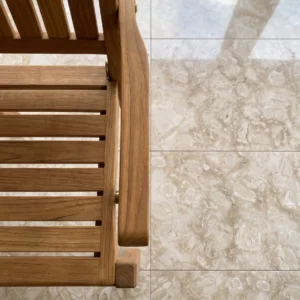
Designers who work the south learn its palette quickly: white salt, pink brine, turquoise shallows, bleached timber, the rust of the old obelisks. Pale limestone sits inside that register as if commissioned for it – and the practical specification agrees with the aesthetic one, since light tones handle the district’s doubled glare and heat better than anything darker. The south is the rare place where the romantic choice and the engineering choice are the same stone, and the properties that lean into the landscape’s own colors photograph like they were always there.
The Working Neighbor
The salt operation is live industry – trucks serve the pans, the pier loads bulk carriers, and the concession’s boundaries are working lines rather than park edges. Building nearby carries the usual industrial-neighbor courtesies: access roads shared with salt traffic are respected, works traffic keeps clear of operational movements, and the operation’s dust and haze are accepted as the district’s weather rather than grounds for complaint. The pans were here first, they made the district’s history and its horizon, and the properties that thrive beside them treat the working landscape as the amenity it genuinely is.
The Coast That Asks for Manners
The salt south rewards builders the way the whole island does – proportionally to their respect. Honor the memorial shore, keep faith with the sanctuary, engineer for the wind and the doubled salt, and the district returns the Caribbean’s strangest, most beautiful horizon. The dry-flat parallel one latitude north is mapped in another dry-flat coastal brief, and the two districts would recognize each other instantly. Build the flamingo coast with manners and pale stone, and the pink horizon does the rest – it always has.
The Kite Coast
The south’s newest economy rides its oldest asset – the unbroken trade wind. The kiteboarding beaches of the southwest shore have grown a small, young, international scene, and the properties serving it borrow from both the dive brief and the wind-sport playbook.
- Kit yards mirror the dive rinse yard: textured stone floors, center drains, fresh-water wash points for lines and bars.
- Storage walls face away from the wind – a launched kite in a staging area is everyone’s bad afternoon.
- Vehicle courts work hard: the kite crowd travels by pickup, and gravel-with-stone-edging aprons take the daily churn gracefully.
- Shade structures are engineered like the wind-coast’s – mass, fixings and lees, because the resource that draws the guests also tests the premises.
The kite coast rounds out the south’s portrait: working salt, protected birds, memorial shore, dive entries, and now a windsport fringe – five economies on one flat coastline, each with its manners. Stone serves all five the same way: dense, pale, textured, drained and specified once, for a district where the wind never takes a season off.
A working saltworks that is also a Ramsar site
The south of the island holds an unusual arrangement. The Pekelmeer Ramsar site was designated on 23 May 1980 and covers 1,612 hectares of shallow hypersaline lagoon with saltpans and dikes, and it hosts one of the most important nesting colonies of Caribbean flamingo anywhere in the region, alongside nesting sea turtles, with a 2019 extension bringing fringing reef under protection too. Industrial salt production and an internationally listed wetland occupy the same ground. Anything built nearby inherits both sets of expectations at once.
- Assume the site is watched, by the operator and by conservation bodies
- Keep works well back from dike edges and open water
- No runoff, slurry or wash water routed toward the lagoon system
- Noise and lighting controlled during flamingo nesting periods
- Access routes fixed on a drawing rather than chosen by a driver
Hypersaline air is a material test
Salt concentration here is not ordinary coastal exposure. Crystalline salt settles on every surface, works into joints, and drives corrosion faster than almost any other Caribbean setting. The Natural Stone Institute overview of limestone and travertine is the useful check, because absorption and density vary widely within one commercial name and in this environment a porous unit takes salt in and holds it.
- Low-absorption stone throughout, without exception
- Non-ferrous fixings sized for a hypersaline atmosphere
- Joints designed to be raked and refilled rather than sealed shut
- A rinse regime written into the maintenance plan from day one
Choosing salt south stone for the flamingo coast
The southern brief rewards restraint above everything. Low structures, pale surfaces, minimal lighting, nothing that reflects or glares across open water, and a construction method that leaves no trace once the works are finished.
- Low profile construction that does not break the horizon
- Matte finishes that avoid glare across the pans
- Granular bedding that can be removed cleanly if a use changes
- Full reinstatement of every temporary access route
Our Bonaire stone supply guide sets out the formats, finishes and lead times that suit this island. Down here the birds were the tenants first, and everything else is building beside them.