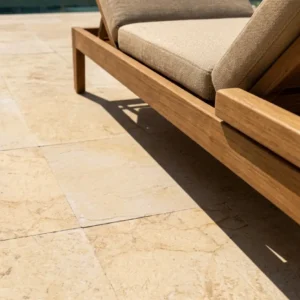
The postcards sell green, but St. Barths is a dry island – semi-arid slopes of cactus and scrub, no rivers, salt ponds where valleys meet the sea, and a horticultural tradition built on what survives: lataniers, frangipani, bougainvillea, aloe. The island’s best gardens have stopped fighting that truth and started designing with it, and the result is a distinctive register – the dry garden – where stone carries the structure and planting provides the punctuation. It is the most honest landscape style the island has, and the most durable.
The Water Budget
Every St. Barths garden runs on a water budget – cistern rain, desalinated supply, or both, all of it costed – and the dry garden is the style that respects the arithmetic. Lawns are the first casualty and no loss: they photograph poorly against this light anyway. In their place, the budget flows to a few theatrical moments – a green courtyard wall, a shaded fern corner – while the garden’s body works in stone, gravel and drought-schooled planting that asks for water only in its establishment year.
Stone as the Garden’s Skeleton
With turf retired, hard landscape does the spatial work:
- Paths define the garden’s circulation and its geometry – generous, textured, pale against the planting’s grays and greens.
- Low walls make rooms of open slope, doubling as seating and as the windbreaks every exposed garden needs.
- Gravel courts between stone edges carry the Mediterranean register the island’s climate genuinely earns.
- Steps stitch the terraced levels, in the consistent geometry that makes a hillside walkable at night.
the dry north’s landscape logic works the same hardscape-carries-the-garden principle in another low-rain economy, and the transfer is direct.
The Native Palette
The planting that belongs here is the planting that was always here: latanier palms – the island’s own, woven into its craft history – sea grape at the salt line, frangipani for scent and shade, agave and aloe for sculpture, bougainvillea wherever a wall wants color. Against pale limestone the palette is spectacular precisely because it is spare: silver-greens and sun colors on white stone is the island’s natural graphic, and gardens that trust it outlast every imported fashion.
Shade as Infrastructure
In a dry climate shade is not an amenity; it is infrastructure, and the garden plan engineers it: pergolas casting walkable shadow on stone paths, trees positioned where afternoon terraces need them a decade hence, wall heights tuned so seating stays usable through the hot hours. Stone and shade work as a system – pale surfaces reflect what shade cannot block, and the combination keeps outdoor rooms in service through hours that defeat darker, more exposed designs.
When the Water Does Come
Dry islands rain rarely but hard, and the dry garden’s quiet test is the cloudburst: gravel courts that drain where lawns would flood, paths laid to falls that route storm water to planted ground and cistern feeds, walls with weeps that pass the surge instead of holding it. The style’s deep logic shows here – a garden built on stone and gravel treats a violent shower as a resupply event, drinks what it can store, and is walkable again in minutes.
The Light-Touch Maintenance Deal
The dry garden’s closing argument is its upkeep: no irrigation network to nurse, no mowing calendar, planting that shrugs the dry season by design. The stone asks for its standard island regime – rinse, sweep, the occasional gentle wash – and the garden’s working year is measured in days of labor, not weeks. For rental villas the arithmetic is decisive: the landscape photographs sculptural, survives neglect between managements, and never bills the owner for staying alive.
Gravel Craft
The gravel court looks like the dry garden’s simplest element and is quietly its most technical. The craft runs in layers: a compacted base graded to the same falls as any pavement, a geotextile that keeps the gravel honest and the weeds philosophical, stone edge restraints that hold the field’s geometry against feet and rakes, and the gravel itself chosen for the walk – rounded for bare feet near pools, angular where it must lock under furniture, always in tones that hold the pale register against the planting. Depth discipline matters: too shallow shows the membrane in a season, too deep swallows ankles and chair legs alike. Maintenance is a rake and an occasional top-up, but only if the edges hold – a gravel court without stone restraint migrates into the planting and the lane, one footstep at a time. Done properly the court is the garden’s Mediterranean heart: crunching underfoot, draining any cloudburst instantly, and framing every planted moment like the gallery floor it effectively is.
The Honest Garden
The dry garden is St. Barths agreeing with itself – the island’s real climate, native palette and stone craft in one register. For the opposite extreme, the wet-forest counterpoint shows what stone does where water is the surplus rather than the budget. Build the skeleton in stone, spend the water on theater, and a St. Barths garden stays beautiful on the island’s own terms – which were always the best terms available.
The Pot Garden
The dry garden’s flexible layer is its pots – the oversized terracotta and stone planters that move color and shade around the composition as seasons and parties demand – and pots on stone have their own quiet engineering.
- Feet under every planter: trapped moisture rings a pale terrace permanently, and the fix costs nothing at placement time.
- Drainage saucers or gravel pockets catch the watering overflow the terrace should never absorb.
- The big pots sit on the structure’s strong lines – over walls and beams, not mid-span on suspended terraces.
- A pot-scale watering rhythm respects the island’s budget: drip lines threaded discreetly beat the daily hose.
Compositionally the pots are the garden’s punctuation – a flowering frangipani in a great jar against a pale wall does the work of a whole border – and their mobility keeps the design alive year to year. The stone’s job is to host them without recording them, which the feet-and-drainage discipline guarantees from the first day.
A small island with no rivers to spare
Water here is manufactured or caught, not drawn from a landscape that has plenty. The IEDOM territorial report describes a territory of roughly 21 square kilometers and about 9,600 residents supporting a very high value tourism economy, which puts real pressure on supply during the season. A garden designed to be irrigated into looking lush is a garden that competes with the island for a scarce resource every dry month. A garden designed for the actual rainfall simply does not.
- Planting chosen for the dry months rather than the wet ones
- Paved areas used as catchment where the water can be stored
- Irrigation treated as establishment support, not permanent life support
- Gravel and mulch used to hold what moisture the ground does get
- Cistern capacity checked against the driest year, not the average
Dry gardens are built from hard materials
Take the irrigation away and the structure has to come from somewhere else, which in practice means stone: terraces, gravel beds, low dry walls, steps and the shadows they cast. That puts unusual weight on material selection. The Natural Stone Institute overview of limestone and travertine shows how far density, absorption and finish range inside one commercial name, and in strong sun those properties decide surface temperature, glare and whether a pale stone stains where the little irrigation you do run touches it.
- Light tones to keep surface temperature down in open positions
- Low absorption where irrigation water will reach the stone
- Gravel sizes chosen so they stay put on a slope
- Dry walls detailed to drain, since the rain that comes arrives at once
Choosing dry garden stone for a semi-arid island
The gardens that look best here in April are the ones that were never asked to look like somewhere wetter. Structure, shade, texture and restraint do the work, and the planting is chosen to agree with the climate rather than argue with it.
- Structure from stone and level change rather than from dense planting
- Shade planned as part of the garden, not added afterward
- Storm drainage sized for the intense event despite the dry average
- A maintenance plan measured in hours a month, not days a week
Our St Barths stone supply guide sets out the formats, finishes and lead times that suit this island. The most convincing garden on a dry island is the one that never looks thirsty.