Belize builds three different kinds of pool, and each asks something different of its stone. On the cayes, the pool is a reef-view stage: an infinity edge aimed at turquoise, read from a hammock at noon. On the mainland coast it is a family workhorse, filled with children by ten in the morning. Inland, it is a plunge pool in the green – a cool rectangle beside a river valley where the water is for recovery, not display. One country, three briefs, and the terrace specification shifts with each.
The Caye Register: Barefoot at Noon
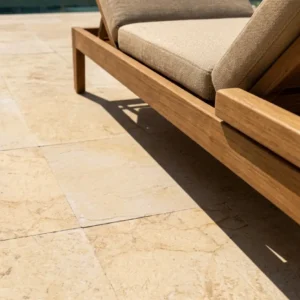
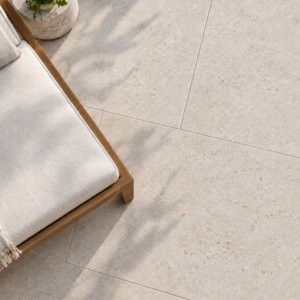
A caye pool deck lives under full sun on islands with little shade and steady trade wind. The stone question is temperature first: a light-toned limestone reflects rather than absorbs, and the difference underfoot at midday decides whether the deck is used or crossed at a run. Pale surfaces also hold the caye palette – white sand, whitewashed rail, turquoise water – which is why the register barely varies from Ambergris to the smaller islands. the pool coping decision guide from another low island walks the edge-profile choice in detail, and nearly all of it transfers to Belize directly.
The Coast Register: The Working Pool
Mainland coastal pools at Placencia, Hopkins and the Belize District villas work harder and are forgiven less. Design for the family case:
- Choose a finish with genuine slip resistance wet – honed-and-textured over polished, every time.
- Round or bullnose every child-height edge; sharp arrises and wet feet meet eventually.
- Size the terrace for furniture plus circulation – a pool surround that fits four loungers but no walking line stays crowded forever.
- Slope away from the pool shell so wash water and rain leave without crossing the coping.
The Jungle Register: The Cool Rectangle
Inland pools in Cayo and the foothills sit in shade for part of the day and in humidity all year. Here the enemy is not heat but biology: algae films on any surface that stays damp, and a terrace under trees collects leaf litter that stains if it lies. The answer is texture and maintenance rhythm – a brushed surface that keeps grip even filmed, laid to falls that dry fast, swept on a schedule the lodge or household actually keeps.
Salt Systems, Fresh Systems and the Stone
Many Belize pools run saltwater chlorination, and salt spray plus splash is a real service condition for the coping and the first meter of terrace. A dense, low-absorption limestone handles it; a porous softer stone drinks brine and gives up its surface early. Ask for the absorption figure before committing, and rinse the splash zone with fresh water as part of normal pool care – the cheapest protection there is.
Getting the Stone to the Pool
Caye pools add a freight leg: pallets ride the barge from Belize City, then a cart or small loader moves them the last hundred meters. Order everything for the pool – coping, terrace field, steps, spare pieces – as one consignment so a single clearance and one barge slot covers the job. Mainland pools take direct delivery by road, which is simpler but deserves the same one-order discipline.
A Specification That Survives the Brief
Across all three registers the same skeleton holds:
- Light tone for heat, texture for grip, density for salt – in that order of argument.
- Coping first: profile, overhang and drip groove decide how the pool reads and how the shell stays dry.
- One material family across coping, terrace and steps – visual calm and one maintenance regime.
- Attic stock: five percent spare, stored flat and dry, turns future repairs into afternoons.
Reading the Three Registers Together
The pleasure of Belize pool work is that the country contains the whole spectrum – a designer can study the reef stage, the family workhorse and the jungle plunge inside one week of site visits. Owners planning any of the three will find island pool terraces done properly a useful cross-check from a market that has refined the same trade-offs for decades. Specify the register honestly and the pool terrace serves for twenty years; borrow the wrong one and it fights the household from the first season.
The Evening Terrace: Lighting and the Second Shift
Belize pools work a second shift. The heat empties them at midday and refills them at five, and the terrace that serves drinks at dusk needs planning the daytime version never asked for: low-glare lighting washed across stone rather than glaring off water, step edges lit as a courtesy and an insurance policy, and a surface texture that stays trustworthy under bare wet feet in half-light. Light-toned limestone earns its keep twice here – it returns lamplight softly and keeps the terrace legible after the quick tropical sunset.
- Run lighting conduit before the paving is bedded, on the same drawing as the drainage falls.
- Light the water and the steps, not the seating – faces stay comfortable, edges stay visible.
- Choose warm-temperature fittings; cold light turns pale stone clinical after dark.
- Keep fittings serviceable without lifting stone – surface-mounted or sleeve-set, never buried.
The second shift is where owners actually live with their pools – the swim before dinner, the long table afterwards, the last conversation at the water’s edge. A terrace wired and detailed for it at the drawing stage costs almost nothing extra; the same capability retrofitted through finished paving costs triple and shows every scar. Plan the dusk hours with the same seriousness as the noon ones and the pool earns its keep around the clock.
Friction is the one number worth proving
Around water every other decision is preference and this one is measurable. The work behind frictional testing of natural stone walking surfaces sets out the ANSI A326.3 method, tested wet with a tribometer, and a benchmark dynamic coefficient of friction of at least 0.42 for level interior floors expected to be walked on wet. A tropical pool deck is a harder case than that reference describes: it carries sunscreen, sand, rain and bare feet, often on a slight fall toward a drain. The sensible response is to test the finish actually being supplied and to specify with margin rather than trust a family name on a sample board.
- Wet values requested on the exact finish and batch being shipped
- Extra margin on steps, ramps and the approach from the house
- One texture held across deck, coping and surround so grip never changes
- Retesting if the finish or supplier changes late in the program
- The test record kept on file, because grip is the claim worth proving
Three settings, three drainage problems
A caye deck, a coastal family pool and a jungle plunge terrace are not variations on one brief. On a caye the substrate is sand over rubble with the water table close beneath, so the build-up has to tolerate movement. On the coast the issue is salt and constant use. In the interior it is volume: rain arrives in quantity, the forest keeps everything damp, and biological growth changes the friction of a surface long before it changes its appearance.
- Caye decks built flexible, with permeable joints and continuous edge restraint
- Coastal decks detailed for salt, glare and heavy family use
- Jungle terraces drained for volume and specified for slow drying
- Cleaning intervals set by setting, not copied across the country
The reef sets the runoff rule
Anywhere near the coast the discharge question is not academic. The Belize Barrier Reef Reserve System was inscribed by UNESCO in 1996 across roughly 96,300 hectares and seven protected areas, holding the largest barrier reef in the northern hemisphere along with atolls, mangrove forest, lagoons and estuaries that support over five hundred fish species and sixty-five corals. Pool backwash, cleaning chemistry and construction silt all have somewhere to go, and on a narrow island that somewhere is close.
- Backwash routed to a soakaway or holding tank, never toward open water
- Cleaning products chosen for what happens after they leave the deck
- Silt captured during works, with cutting kept back from the shore
- Overflow designed for a heavy storm rather than a normal week
Choosing pool terrace stone in Belize for the setting you have
Test the finish wet, drain for the local extreme, restrain the coping mechanically, and keep a documented surplus on the property so a chipped unit never waits on a sailing. Our Belize stone supply guide sets out the formats, finishes and lead times that suit this country. A deck is judged barefoot and wet, which is the only condition worth designing for.