Puerto Rico’s most common address is the urbanización: the mid-century planned subdivisions that housed the island’s great modernization — flat-roofed concrete houses on gridded streets, marquesinas sheltering the family car, rejas worked like signatures — and their renewal is the island’s biggest quiet construction market. These houses were built stubborn; their next century is being specified now, family by family. Here is the urbanización’s guide.
The concrete inheritance
The type’s virtue is its bones: reinforced-concrete walls and roofs that shrugged decades of storms — María’s survey made the point island-wide — on plans generous enough to renew rather than replace. The renovation-island logic lives here: sound structure taking new finish layers, the terrace and marquesina — the outdoor rooms — transformed in stone over existing slabs, and the family’s investment going to what it touches daily rather than to demolition’s waste.
The marquesina’s second life
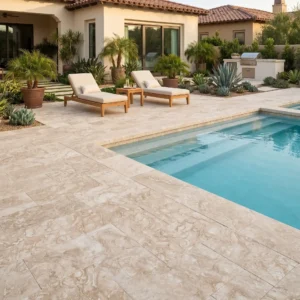
The carport is the type’s secret room: half the island’s parties happen under the marquesina, and its renewal is the renovation market’s signature move — the cracked slab re-surfaced in stone that mops clean after the lechón, the gathering-court logic applied to a roofed room the house already owned, lighting and fans making it the true summer living room, and the threshold to the yard rebuilt level for the abuela the parties orbit. The domino table’s sacred flatness, this library notes, is a specification item on every island.
- Existing slab surveyed for level, falls and cracking before anything is bonded
- Overlay thickness chosen so door thresholds still work afterward
- Movement in the old slab allowed to continue, not bridged rigidly
- Edges detailed so the new surface does not look applied
Rejas, walls and the street face
The urbanización’s streetscape is its ironwork and low walls, and renewal keeps the language while upgrading the fabric: boundary walls re-capped and re-rendered on sound cores, gate piers rebuilt where decades leaned them, the rejas’ craft honored — the type’s decorative iron is regional folk art — and driveways re-laid on the vehicle-honest thickness rules. The street’s pride runs collective: blocks renew in visible waves, neighbors borrow finishes that worked, and the staged-upgrade culture does its patient island work in Spanish.
The flat roof’s promise
The type’s unclaimed square meters sit overhead: flat concrete roofs that the energy era is colonizing with panels, and that ambitious renewals convert to roof terraces — the rooftop-dividend logic at house scale: structure verified, waterproofing renewed first, pale stone at reflective duty over the membrane, and parapet honesty for wind and children both. A roof terrace over a solar array over a concrete house is the urbanización’s next-century form arriving early.
- Reinforcement cover checked wherever the concrete is exposed to salt air
- Repairs to the substrate completed before the finish is ordered
- Waterproofing renewed where a terrace sits over occupied space
- Roof drainage corrected first, since most slab damage starts there
Water, heat and the retrofit list
The renewals run a practical curriculum: cisterns joining the storage wisdom as outage insurance, pale surfaces and planted shade fighting the heat the type’s concrete banks, drainage renewed where decades of paving crept over the original falls, and the retrofit-ladder instincts applied at family budget: shutters serviced, roof fixings audited, the yard’s debris discipline adopted. None of it is glamorous; all of it compounds into the type’s stubborn promise kept for another generation.
Specifying the renewal
The urbanización kit is family-scale honesty: stone surfaces over sound slabs, marquesina and yard packages, wall caps and driveway grades, staged orders batch-recorded across the years of saving — served at domestic rhythm and household quantities from the island supply page. These houses raised the island’s modern generations and never fell down doing it; their renewal, laid one good weekend at a time, is the island’s most democratic stonework — and its most loved.
The maestro de obra: hiring the island’s renovation craft
Most urbanización renewals are not run by general contractors with glossy proposals; they are run by the maestro de obra — the master builder whose crew does masonry, tile, plumbing and whatever else the job needs, whose reputation travels the neighborhood by word of mouth, and whose relationship with a family often spans decades and three houses. Understanding how this market actually works is the difference between a smooth renovation and an expensive education.
The relationship runs on trust and repetition rather than paperwork, which cuts both ways. The good maestro brings genuine craft, honest pricing and the ability to solve a problem the drawings never anticipated; the arrangement’s weakness is documentation, and the owner’s job is supplying what the tradition does not — a written scope, agreed stages and payments, and materials specified precisely enough that substitution is a decision rather than a surprise. Stone helps here more than most materials: samples approved before delivery leave no ambiguity, batch records travel with the pallet, and the staged-renewal rhythm suits a crew that returns next year for the next phase. Permits deserve the same clarity, agreed at the outset rather than discovered mid-works.
The cultural counsel is worth stating plainly, because newcomers get it wrong: this is a market where being known matters. The neighbor’s recommendation is better diligence than any directory, the crew that did the block’s three best marquesinas is findable by walking the street, and the family that treats its maestro as a long relationship — paid fairly, on time, with coffee — gets first call when the next hurricane makes everyone need a builder at once. The island’s renovation economy runs on those relationships; the materials are the easy part.
A housing stock being renewed, not replaced
The arithmetic favors renovation. The Census Bureau figures for Puerto Rico record around 1.29 million households and a population near 3.2 million, with density down from about 1,088 people per square mile in 2010 to roughly 960 in 2020. Fewer people are living in a housing stock that was largely built at speed decades ago. The consequence on the ground is a market that upgrades what exists rather than starting again, one carport, one terrace and one facade at a time.
- Assume the structure stays and the finishes change
- Budget for substrate repair before choosing a surface
- Phase work so a family can stay in the house throughout
- Choose details that a later owner can extend without matching problems
Working over concrete that is already there
Almost every project here is an overlay, and overlays fail for installation reasons rather than material ones. Guidance on detailing natural stone paving for lasting durability is direct about this: method matters as much as the stone, and mortar-set, sand-set and pedestal systems all suit different conditions. Over an existing slab of unknown history, the safest choices are the ones that stay independent of the substrate or can be lifted without destroying it.
- Uncoupling or independent build-ups over slabs with a movement history
- Pedestals where levels allow and drainage has to stay accessible
- Bonded systems only where the substrate has been properly assessed
- A documented method for lifting one unit without disturbing the field
The carport is the front door
In this housing type the covered vehicle space is the real entrance, the shaded sitting area and the working yard all at once. It takes tire scrub, dropped tools, oil, rain blown sideways and daily foot traffic, and it is the first thing a visitor sees. It deserves the thickest section on the property and the most stain-tolerant finish.
- Units and bedding rated for vehicle loading, not patio loading
- Stain-tolerant finishes where a vehicle stands every day
- Falls that take water to the street rather than to the threshold
- A hard-wearing transition strip where paving meets the road
Choosing suburban renewal stone for a mid-century house
The best results here come from fixing the boring things first, then applying a restrained surface that can be maintained by the household that lives with it. Our Puerto Rico stone supply guide sets out the formats, finishes and lead times that suit this island. These houses were built to last; the second life is mostly a question of what they are wearing.