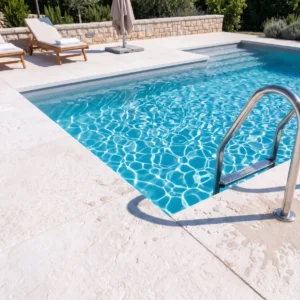
Bermuda swims on a different calendar: the Atlantic island’s subtropical seasons deliver glorious pool weather from May to October, then a genuine winter shoulder — sixty-degree days, brisk northerlies, water that empties the deck without heating — and the Bermuda pool terrace is engineered around the question the Caribbean never asks: how does the outdoor investment earn in November? Here is the four-season swim-court guide.
The heating arithmetic
The island’s better pools run heated — heat pumps stretching the season to ten months, solar arrays on the famous white roofs pre-warming supply, covers cutting the loss the winter wind levies — and the terrace design completes the system: windbreak walls on the seasonal-terrace craft turning brisk days usable, stone surfaces banking noon sun for barefoot evenings, and the sheltered-court logic the walled-lee tradition teaches, re-aimed at a colder enemy. The pool that swims in February is a composition, not just a heater.
Stone for a four-season deck
Bermuda’s deck specification adds winter to the cluster’s law: dense low-absorption stone rated for the freeze the island almost never sees but the specification respects anyway, textures gripping under winter-rain slick as surely as summer splash, pale surfaces on the coral-limestone register that flatter the island’s pastel architecture, and copings eased for the wetsuit season’s haul-outs as much as the summer’s cannonballs. Salt runs year-round: the Atlantic’s spray reaches every parish, and marine-grade fixings are island code.
- Choose the lowest absorption available, since a wet winter keeps the deck saturated for weeks.
- Avoid porous material anywhere the deck stays damp under low winter sun.
- Specify jointing that tolerates repeated wetting without breaking down.
- Test the delivered finish rather than accepting a description of the stone family.
The walled-garden setting
The Bermuda pool lives inside the island’s signature landscape — walled gardens, clipped hedges, the moongate tradition framing arrivals — and the terrace composes to the register: stone walls holding the wind out and the microclimate in, planting beds softening the enclosure, and the pool court reading as garden room rather than resort deck. The island’s privacy culture reinforces the walls; the understatement instinct governs what shows above them.
Entertaining through the shoulder
The terrace’s winter shift is social rather than aquatic: fire tables and heat lamps extending evenings, covered loggias on the outdoor-dining craft keeping the drizzle honest, sun-trap corners engineered for January lunch, and lighting on the warm-register discipline compensating for the early dark. The four-season terrace earns across the calendar the way the island’s hospitality does — differently by month, continuously by year.
Storm-season honesty
Unlike the southern islands’ latitude dividend, Bermuda sits in the storm track and builds accordingly: pool furniture with a hurricane plan, pergolas and shade structures engineered to the island’s wind code, equipment pads and enclosures sited to survive, and the deck itself — stone’s quiet advantage — the one element that needs no boarding, no strapping, no post-storm replacement. The island’s weather craft extends to the pool court: build for the storm you’ll eventually meet.
- Restrain every free edge mechanically rather than relying on mortar alone.
- Fix loose furniture storage into the design so a terrace clears in under an hour.
- Use heavier units on exposed corners where uplift concentrates.
- Detail the pool surround so debris can be cleared quickly after a storm.
Specifying the year-round court
The Bermuda swim-court kit reads like the cluster’s with a sweater packed: dense pale stone at four-season ratings, marine fixings throughout, drainage for the island’s generous rain — the same rain the roofs harvest — and the composition disciplines that make winter usable and summer superb. The island supply guide serves the calendar honestly: materials specified for the Atlantic’s full year, and counsel that starts where Bermuda’s pools do — with the November question answered before the first unit ships.
The hot-cold circuit: spa water in a real winter
Bermuda’s genuine winter makes the spa tub a different proposition than the tropics’ decorative bubble: here the hot soak earns its keep for months, and the pool court that includes one becomes a two-temperature circuit the shoulder season lives in. The design rules borrow from colder traditions. The tub sits in the wind shelter’s deepest corner — steam and a north breeze are poor company — within a dash of the pool for the brave and the house for the sensible, on stone that handles the splash-and-freeze-adjacent margin: dense, textured underfoot, falls carrying the overflow away before the rare cold snap finds it. The circuit’s choreography gets drawn like plumbing: tub to pool, tub to towel store, tub to door, each leg short, grippy and lit for the January evening the whole installation exists for.
The services follow the island’s rules: equipment housed with the pool plant behind acoustic mass — a spa blower against a bedroom wall ends marriages — covers as non-negotiable as the pool’s for the same evaporative reasons, and the electrical work documented to the standard the insurance culture expects. Stone’s thermal honesty is the luxury layer: a deck warmed by the afternoon holds its comfort into the soak hour, and coping wide enough to sit on turns the tub’s edge into the winter terrace’s social bench.
Hoteliers learned the arithmetic first — the heated circuit extends the outdoor season by months and the guest review says so — and the residential version repays identically: the court that offers hot water in February is used in February, and the four-season promise stops being brochure language. The pool answers the summer; the spa answers the rest; and the stone between them, warm-toned and sure-footed, is what makes the circuit a habit rather than an event.
Why a Bermudian pool deck is not a Caribbean one
Heating a pool changes the whole calculation, because it turns a summer amenity into a year-round one in a climate that has a genuine winter. Records from the Bermuda Weather Service show August running to an average maximum near 30.0 degrees Celsius with sea surface temperature around 29.7, and the cool season falling well below that. A heated pool means people walk that deck barefoot in February, on a surface that has been damp for days.
- Specify for a deck that is used in every month rather than for a summer season.
- Expect prolonged damp rather than rapid drying, which changes what stays clean.
- Design the shelter for wind, since a heated pool on an exposed terrace still feels cold.
- Keep a warm-toned surface, because pale flat stone reads cold under low winter light.
- Assume algal film in the cool months and choose a finish that stays safe with it.
The slip number that matters most here
Wet feet on a damp deck in cool weather is the hardest combination a pool surround faces anywhere. Guidance from Use Natural Stone on frictional testing identifies ANSI A326.3 as the method and a dynamic coefficient of friction of 0.42 as the benchmark for level interior surfaces expected to be walked on wet, notes that no published exterior threshold exists, and records that polished finishes generally fail the wet test. On a year-round heated pool that is the governing constraint, not a footnote.
- Specify a textured finish and keep polished material out of the pool area entirely.
- Treat 0.42 as a floor and aim above it wherever the deck falls toward the water.
- Carry one texture through deck, steps and the route back to the house.
- Retest after a couple of winters, since film and cleaning both move the number.
Coping that works in two very different seasons
The coping is the one surface hands and forearms meet constantly, and on Bermuda it has to be comfortable in August heat and tolerable in February damp. Absorption governs both: the lower it is, the less the stone holds water through a wet winter and the less it stains, moves or spalls. The profile matters equally, because this is the edge a swimmer pulls against in every month of the year.
- Specify low absorption for coping even where the wider deck uses something more porous.
- Choose a rounded or softly eased profile so nobody meets a sharp arris.
- Keep the coping joints tight and flexible, since this line moves with the pool shell.
- Match batch across the whole run, because a tonal step reads instantly along a straight edge.
A heated pool terrace that works when winter bites
Year-round swimming is the point of heating a pool, and the deck has to keep up. Low absorption for a long damp season, a textured finish that passes the wet test, wind shelter rather than sun shade as the winter priority, and warm-toned material that still looks alive in February light. Our Bermuda stone supply guide sets out the formats, finishes and lead times that suit this island. A heated pool is only as good as the twenty feet of terrace around it, and on this island that terrace works twelve months a year.