Aruba’s second city rewrote its story in color: San Nicolas, the refinery town the industry left behind, reborn as the Caribbean’s street-art capital — international murals claiming whole facades, an art-walk economy drawing visitors down-island, festivals and galleries seeding a creative district where heritage industry meets contemporary canvas. The renaissance runs on its ground plane as much as its walls, and the district’s stone craft carries a distinctive brief: serve the art, honor the industrial bones, host the growing crowds. Here is the capital-of-color guide.
The mural district’s ground rules
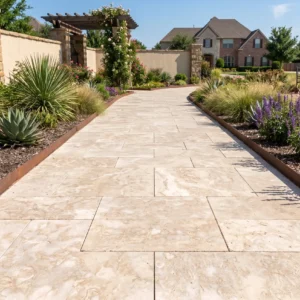
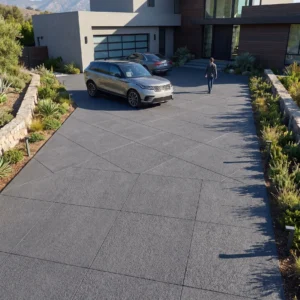
Street art commandeers the vertical, and the horizontal answers with the vase discipline at gallery intensity: ground surfaces in warm neutrals that let saturated walls detonate, low-sheen finishes refusing to compete with painted light, and viewing geometry built into the streetscape — standback zones where murals read whole, photo-stop widenings that keep the art-walk flowing, and sightline courtesy in every street-furniture decision. The district’s floor is the gallery’s polished concrete equivalent, rendered in island stone.
Art-walk infrastructure
The mural circuit processes visitors on foot through working streets, and the crowd-and-wayfinding craft serves the flow: continuous accessible surfaces linking the anchor works, tonal banding steering the walk without signage clutter, shaded rest stations on seat-height walls timed to the tropical stroll, and the cruise-day arithmetic scaled to excursion-van pulses. Festival overlays add the event-infrastructure layer: dressed power for projection nights and paint jams, plaza surfaces rated for stage and crowd, wash-down serviceability after celebration.
- Keep the walking surface visually quiet so the painted walls remain the only event.
- Widen the pavement where a mural draws people to stop, since a crowd forms at every good one.
- Provide shade along the route rather than only at the destinations.
- Use paving pattern to guide direction instead of adding signage that competes with the art.
Industrial-heritage honesty
San Nicolas wears its refinery century visibly — worker-cottage streets, industrial structures, the harbor’s working scars — and the renaissance’s design wisdom keeps the bones honest: adaptive projects on the patina-respect principles where industrial fabric converts to studios and venues, new insertions reading contemporary rather than costume, and the district’s gritty-authentic register protected from over-polish — the art needs its industrial canvas, and ground treatments stay working-class honest: robust, repairable, unprecious.
Creative-economy premises
The district’s galleries, studios and venues run hospitality’s duty in bohemian dress: studio floors on working-grade honesty where paint and fabrication live, gallery courts hosting openings on the event-hospitality rules, café-and-bar spillover claiming pavement graciously, and the communal-register instincts serving artist residencies and collective spaces. The specification stays district-true: durable, forgiving, better with wear.
Carnival’s home ground
San Nicolas holds Aruba’s carnival soul — the season’s parades and jump-ups claim its main street as ancestral route — and the district’s surfaces carry the event-day specification as cultural infrastructure: parade-route paving rated for float axles and dancing thousands, staging courts at the marshalling grounds, power and barrier infrastructure dressed into the streetscape, and the post-festival reset rhythm a carnival capital rehearses annually. The renaissance and the tradition share the same floor; it is built for both.
- Design the street to work as an event space several times a year, not only as a thoroughfare.
- Keep the surface flush across the full width so a crowd can spread without tripping.
- Detail service covers to sit level, because they are the trip hazard people find at night.
- Choose a finish that survives dancing feet and spilled drinks without staining permanently.
Joining the renaissance
District projects join a community-led revival with its own governance of taste — mural curation, festival committees, the neighborhood’s pride in its second act — and the community-manner rules apply at creative-district pitch: local hands hired, industrial memory respected, art logistics accommodated (scissor-lifts and paint crews are the district’s delivery traffic), and ground contributions that serve the collective canvas. The island supply guide outfits the register in its working palette — neutral, robust, renaissance-ready — because the capital of color needs its floor to know exactly what it is: the stage, never the show.
Paint on stone: keeping the gallery’s floor clean
An open-air art capital has an occupational hazard: paint travels. Sanctioned murals drip and overspray during production weeks, festival paint jams are gloriously messy by design, and the occasional unsanctioned tag tests the district’s response time — so San Nicolas’s ground craft includes a cleaning doctrine the vase-discipline floor depends on. Prevention leads: production zones sheet and board the pavement as studio etiquette, the district’s event kit includes floor protection as standard, and the working surfaces nearest the walls run the forgiving end of the register — dense, low-porosity stone that releases mistakes. Response follows fast: fresh acrylic lifts from sealed stone with patience and the right solvents, aged paint calls for poultice work or careful mechanical cleaning, and the district’s maintenance culture treats a tag on the public floor like the hospitality trade treats a spill — gone before it normalizes.
The specification choices carry the doctrine. Where paint exposure is routine — below sanctioned walls, in the jam zones — sacrificial sealers earn their renewal cycle by making every cleanup a wipe instead of a project; textured surfaces hide the microscopic history no cleaning fully erases; and the warm neutral palette forgives the faint ghosts that a decade of art production leaves in any honest floor. The unsanctioned question stays communal: the district’s standing answer — walls are curated, floors are neutral — holds because response is quick and the mural program gives ambition a legitimate wall.
The balance is the district’s own: a floor precious enough to frame world-class art and robust enough to survive its production. Stone holds that balance better than any alternative — cleanable, renewable, patient — and the capital of color stays presentable the way every gallery does: by cleaning professionally, immediately, and without drama.
San Nicolas has its own designation
The regeneration of San Nicolas is backed by planning policy rather than by enthusiasm alone. The Ruimtelijk Ontwikkelingsplan met Voorschriften gives San Nicolas Center its own designation focused on cultural heritage and mixed use, alongside a separate Oranjestad Center designation for transformative mixed-use development, and it names protection of the cultural heritage of the territory among the plan goals. Height in the downtown cores can reach seven building layers where the standard elsewhere is two. That is a deliberate framework for a working town becoming a cultural destination.
- Read the cultural heritage designation as a real constraint on how the ground plane is treated.
- Expect mixed use, which means the street carries deliveries, residents and visitors at different hours.
- Design for a town that is still lived in rather than for a visitor attraction.
- Keep interventions reversible where the character of a building or frontage is the asset.
- Coordinate with the wider streetscape, since the district is assessed as a whole rather than plot by plot.
Bedding a street that hosts crowds
An art district street is walked far more heavily than an ordinary one, and it is walked slowly, in groups, with people stopping without warning. The overview from Use Natural Stone on paving detailing sets out mortar-set over a rigid base, sand-set over compacted aggregate and pedestal-set over structure. On a public street carrying occasional vehicles and regular crowds, a zoned hybrid usually wins.
- Mortar-set the vehicle line and the service route where loading is regular.
- Sand-set the wider pedestrian field so sections can be lifted for utility work overnight.
- Set the zone boundaries on visible lines so a future repair looks intentional.
- Restrain every edge properly, because a crowd surface with a loose edge migrates within a year.
Letting the walls do the talking
The single most common mistake in a mural district is a ground plane that competes. Strong color underfoot, busy patterning or high contrast all pull attention downward and flatten the very thing visitors came to see. The correct move is restraint: one tone, one texture, generous format, and interest supplied by scale rather than by decoration.
- Keep the paving low in chroma so photographs of the murals are not undermined by the ground.
- Choose a matte finish, since a reflective surface throws light back onto the painted wall.
- Use generous formats that stay legible when the street is full of people.
- Reserve any pattern for wayfinding, and keep even that subordinate to the art.
Street art district stone that stays out of the way
San Nicolas works because the walls are extraordinary and everything else is calm. A quiet, matte, generously scaled ground plane, zoned so it can be lifted and reinstated without scarring, and detailed to handle a crowd that stops every twenty meters. Our Aruba stone supply guide sets out the formats, finishes and lead times that suit this island. The best compliment a mural district floor can earn is that nobody remembers looking at it.