Every BVI gardener eventually meets the territory’s oldest landscaping force: the free-ranging goats (and their donkey and chicken colleagues) whose grazing rights predate every deed, whose appetite curates hillsides daily, and whose opinion of your new planting arrives within the week. The goat question is real garden design input across the territory’s open country — and stone is the answer’s backbone: the framework grazing cannot eat. Here is the grazing-proof garden guide, written with respect for the adversary.
Knowing the adversary
Territory goats are professionals: agile beyond fencing assumptions, unbothered by most “deer-proof” planting lists (tropical goats read those lists as menus), organized in routes that patrol daily, and legally traditional — free grazing is heritage in much of the territory, and the garden’s job is coexistence, not complaint. The design translation: assume access unless genuinely excluded, plant as if everything reachable is offered, and build the garden’s permanent structure in materials with no nutritional ambiguity — which is where stone earns its starring role.
Stone as the uneatable garden
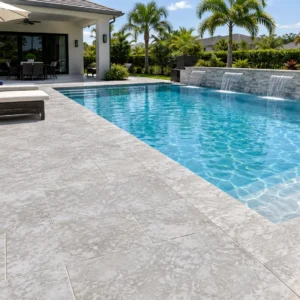
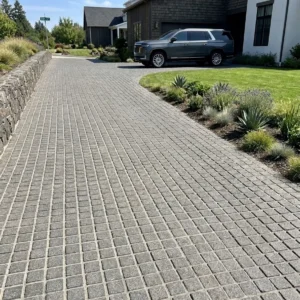
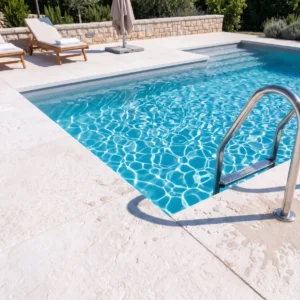
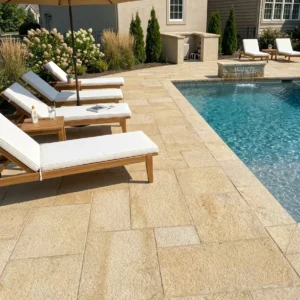
The grazing-proof composition inverts planting-led design: hardscape carries the beauty burden — sculptural walls and seat-height terraces, gravel courts and pale paths composing against the territory’s greens, the graphic-restraint principles deployed against a different desert-maker — while planting concentrates where protection is real. The palette that survives open country reads distinctively: aloes and agaves whose armament goats respect, oleander and neem the professionals decline, fragrant survivors like lemongrass in massed drifts, and the great trees — tamarind, turpentine, seagrape — pruned high past browsing reach.
- Lead with paving, gravel and masonry, and treat planting as the accent rather than the structure.
- Choose species that recover from browsing instead of ones that are simply eaten to the ground.
- Raise anything vulnerable into planters with a lip above comfortable reach.
- Accept that an unfenced garden is a shared garden and design for that from the start.
Exclusion done properly
Where gardens demand tenderness — vegetables, orchids, the soft tropical palette — exclusion is engineering: walls at goat-honest heights on the proper-masonry craft (climbing is the adversary’s hobby; footholds are design errors), gates that self-close against the patrol’s patience, cattle-grid thresholds at drive entries where walls cannot run, and the courtyard strategy above all — the walled-garden tradition rediscovering its original purpose: paradise defined by what it keeps out. The enclosed court becomes the property’s soft heart; the open country stays stone-boned and armament-planted.
The grazed-commons aesthetic
Beyond the walls, wisdom embraces the adversary’s landscaping: goat-cropped hillsides as the territory’s natural parkland — open sightlines, fire-load managed by appetite, the pastoral character that photographs as heritage because it is. Properties can compose with it: boundary stones and cairns marking lines the commons respect visually, specimen trees boxed in stone guards through establishment, seating placed for the evening view of the herds working the hill, and the framework-first philosophy letting managed wildness read as intention.
Water points and the diplomatic garden
Dry-season water is the territory’s grazing currency, and garden features negotiate: open water invites the patrol (ponds and rills belong inside exclusion), drippers and sealed systems serve planting without posting invitations, and some properties practice deliberate diplomacy — a trough at the boundary’s far corner buying peace for the near garden, the oldest protection racket in pastoral history, paid gladly. Storm-season notes echo the territory drills: grazing pressure spikes after storms strip browse, and post-hurricane gardens need their exclusions inspected before their plantings.
- Keep water features within a walled or gated zone rather than in the open landscape.
- Use flush rills and shallow channels where enclosure is not possible.
- Avoid soft margins, since livestock will find and destroy a planted pond edge quickly.
- Detail hard edges that tolerate hooves without crumbling into the water.
Coexistence, composed
The goat-wise garden ends as the territory’s most honest landscape: stone bones nothing can eat, armament planting where the commons runs, walled tenderness where it cannot, and the grazed hills beyond as borrowed parkland. The territory supply guide outfits the strategy — walls, courts, guards and frameworks — with materials the adversary has never once digested. Build for the goats honestly, and the garden thrives amid them; ignore them, and the territory’s oldest force will landscape for you, weekly, for free.
The herd has owners: the social contract behind the fence
Every goat on the commons belongs to somebody, and the garden strategies that last are negotiated as much as built. The territory’s grazing culture is old, legal in its customary lanes, and administered through relationships: knowing whose animals walk your ridge, greeting the owner before complaining about the herd, and understanding that the fence conversation goes better over a shared drink than through a lawyer’s letter. The practical etiquette is settled: fencing your own ground is your right and expected; blocking a customary route through it wants a conversation and usually a workable compromise — a stile here, a gap rehung there; and damage disputes resolve by the village’s arithmetic, which values the relationship above the roses. Newcomers who learn the system inherit its protections: the herd owner who knows you steers the animals elsewhere, and the village that considers you reasonable mentions when a new herd starts working your road.
The build sequence respects the same sociology. Walls and gates go in early — before planting investment, and before the herd learns the plot as pasture, because animals unlearn slowly and their owners defend precedent. Construction crews leave gates closed as religion; the site that lets the herd through a half-built boundary has recruited its own pest. And the finished garden’s diplomacy endures: water points outside the wall keep animals from testing it, the grazed commons beyond is treated as the landscape amenity it honestly is, and the household’s standing in the village — the real fence — is maintained with the same care as the stone one.
The deeper reading suits the territory: land here carries overlapping uses and long memories, and the garden that thrives is the one whose owners understood they were joining a system, not conquering one. Build the wall well, greet the herdsman warmly, and both will keep your garden — one physically, one socially, both permanently.
The dry months a stone garden is really for
A hardscape-led garden is not only a defense against livestock, it is a sensible answer to the local rainfall pattern. The regional climate profile for the territory records an annual average near 1,150 mm but distributes it very unevenly: March averages 46.0 mm, February 52.6 mm and June 60.2 mm, against 152.9 mm in September and 163.1 mm in November. A planting-led garden has to be irrigated through the dry months on an island where water is collected, not piped from a river.
- Design for the March condition rather than the November one, because that is when a garden looks worst.
- Use paving and gravel to reduce irrigated area without reducing usable space.
- Group the few thirsty plants together so irrigation is concentrated rather than spread thin.
- Mulch heavily around anything planted, since evaporation does more damage than heat does.
- Size cistern draw for the dry season, not the annual average, when planning any irrigation at all.
Choosing stone that lives outdoors unprotected
Garden stone gets no shelter, no regular cleaning and no sympathy. The reference from the Natural Stone Institute on limestone gives the properties that decide how it ages: absorption ranges from below one percent to above ten across the family, dolomitic varieties are denser with lower absorption and better abrasion resistance, and all limestones are vulnerable to acids. In a garden that also sees animal traffic, abrasion resistance and low absorption are the two figures that matter most.
- Pick the denser end of the family for paths that take hooves as well as feet.
- Keep absorption low where paving sits under planting and stays damp for long periods.
- Avoid acidic cleaning products entirely, since one wrong wash marks a terrace permanently.
- Choose a texture that stays safe when covered in a thin film of dust and dry grass.
Walls, gates and the honest boundary
Every serious garden in the Virgin Islands eventually admits that it needs a boundary. The question is only whether that boundary is designed or improvised. A proper wall with a proper gate is cheaper over ten years than repeatedly replacing planting, and it creates the sheltered microclimate that lets a garden be more than gravel.
- Build the enclosure first and plant afterward, rather than the reverse.
- Make gates self-closing, because a garden is only protected as often as the gate is shut.
- Take walls to a height that discourages jumping rather than one that merely marks a line.
- Use the wall to create shelter and shade, so it earns its cost twice.
Goat proof garden design that still feels like a garden
The trick is not to build a fortress. It is to lead with structure, keep the planted area small, sheltered and properly enclosed, and let the paving do the work that planting would do somewhere with more rain and fewer visitors. Our British Virgin Islands stone guide sets out the formats, finishes and lead times that suit this territory. A garden that survives both the dry season and the neighborhood herd is the one that was designed for them from the beginning.