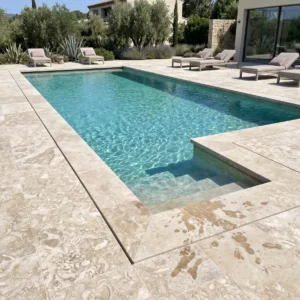
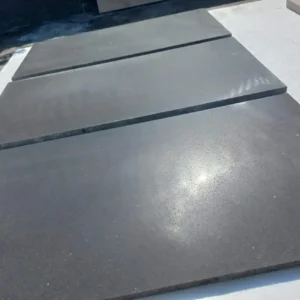
Every Cayman building conversation eventually touches the ground the island stands on. Ironshore — the razor-edged, weathered limestone that rings the coast — is Grand Cayman’s signature rock, the local quarries work the island’s stone daily, and buyers reasonably ask why a limestone island imports limestone floors. The answer respects both sides of the comparison, and knowing it makes every subsequent specification decision easier. Here is the honest ledger.
What the island’s own stone does brilliantly
Local rock is Cayman construction’s backbone: quarried aggregate feeds the island’s concrete, fill shapes its sites, and crushed stone builds the roads and pads everything stands on. Ironshore itself, left in place, is the coast’s armor — a natural revetment that absorbs sea energy no engineered wall matches at its price, which is to say free and already installed. In landscape design, native rock reads authentically Caymanian in rugged garden features and shoreline settings where its dramatic texture is the point. None of this is faint praise; the island literally could not build without its own stone.
- Quarried aggregate feeding the island concrete supply.
- Fill shaping sites and building the pads everything else stands on.
- Crushed stone forming the road base across all three islands.
- Ironshore left in place as natural coastal armor, absorbing sea energy.
- Native rock anchoring rugged planting and rockery work.
What it cannot become
What the local industry does not produce is calibrated dimension flooring, and the reasons are material as much as industrial. Weathered surface rock is irregular, sharp and voided — magnificent as texture, impossible as a barefoot deck. Quarried local stone serves crushing and fill; converting it to factory-flat, thickness-calibrated, surface-finished terrace stone would require a manufacturing chain the island’s scale cannot justify — and the result would still carry the higher absorption of young coastal limestone, exactly the property salt air punishes. The gap is not a failure; it is a specialization, and every limestone island in the cluster — Jamaica’s version of the story included — runs the same economics.
What imports supply
Imported paving-grade limestone arrives as the finished half of the partnership: dense and low-absorption against salt, calibrated flat for lippage-free floors, finished in controlled textures from honed interior silk to bush-hammered pool-deck grip, and light-toned to shed the heat Caribbean floors must shed. It comes with the paperwork Cayman’s market expects — datasheets, slip values, batch records — and in the cut formats a project actually needs: field stone, copings, treads, sills and specials from one batch. The import is not replacing local stone; it is completing what local stone starts.
The partnership on a real site
Walk a well-built Cayman property and the division is everywhere: local aggregate in the structure and site works, native rock holding the shoreline and anchoring rugged planting, imported stone on every surface people touch — terraces, pool surrounds, steps and interior floors. The junctions get the drawn details every two-material meeting deserves, and the visual conversation flatters both: pale calibrated planes floating above dark rugged coast is, in effect, the island’s own geology composed. Specify each material where its nature already put it, and the property looks inevitable.
- Local aggregate in the structure, bases and site works.
- Native rock holding the shoreline and framing planting.
- Imported dimension stone on every surface people actually touch.
- Drawn details at each junction, since the two materials never move together.
- Movement joints where new paving abuts natural or placed rock.
Cost, compared honestly
The comparison buyers actually want runs landed imported stone against alternative finished surfaces — not against local rock, which is not offered for the application. Against stamped concrete, tile systems and composite decking, imported stone carries a higher first cost and the region’s flattest maintenance curve: no refinishing cycle, no replacement calendar, repairs by the unit from attic stock. The ten-year ledger reads the same on Cayman as everywhere else, with the island’s professional buyers uncommonly quick to run it. Duty belongs in the arithmetic — priced early through the broker — and even carrying it, the decade math favors the surface that never asks for a second purchase.
The specification that follows
The practical conclusion writes itself into every quote: structure and shoreline to the island’s own stone, finished surfaces to calibrated imports, junctions drawn, batches controlled, documentation complete. It is the least controversial specification in Caymanian construction precisely because it follows the geology instead of arguing with it. The George Town ordering hub prices the imported half in one itemized conversation — and respects the local half enough never to pretend to replace it.
A one-day field study: reading both stones around the island
The two-stone argument settles fastest in person, and Grand Cayman offers the seminar free to anyone with a morning to spend. Start at any ironshore stretch — South Sound’s margins or the blowholes coast eastward — and give the native rock its due attention: run a careful hand over the razored surface, watch how storm swell breaks its energy against the pitted mass, and notice that nothing about it could ever be walked barefoot or laid flat. This is magnificent material doing exactly what geology shaped it for — armoring a coastline — and no calibrated import will ever do that job. Continue past any construction site and read the second local role: crushed aggregate in the mixers, fill grading the pads, the island’s own stone disappearing structurally into everything built on it.
Then finish the study where finished surfaces live: an afternoon hour at any well-built Seven Mile amenity deck or established villa terrace, reading the imported half — calibrated units lying flat across long sightlines, coping lines running true against pool water, textured finishes gripping wet feet at the steps, pale tone holding walkable temperature in full sun. Touch the arris of a cut edge; look down a forty-meter joint line; stand barefoot in the two o’clock heat. The comparison completes itself without argument: two stones, two jobs, no overlap and no competition. Buyers who take the field day stop asking which stone is better and start specifying like the island builds — native rock where mass and armor matter, imported calibration where people live — which was always the only question worth settling.
The properties that separate the two
The honest comparison is not local against imported as a loyalty question; it is which material meets the performance envelope for a given job. Those properties are measurable, and the Natural Stone Institute publishes the scope of methods used in dimension stone testing.
- ASTM C97 for absorption and density, which decides salt behavior and staining.
- ASTM C170 for compressive strength, relevant under vehicles and plant.
- ASTM C880 for flexural strength, governing treads, coping and unsupported spans.
- ASTM C1353 for abrasion resistance, the honest predictor of wear on a busy floor.
- ANSI A326.3 for slip resistance, tested on the finish specified rather than a sample of another.
Why limestone is not one material
Both sides of this comparison are limestone, which is exactly why the family range matters more than the geography. The Natural Stone Institute records that limestone absorption runs from below one percent to above ten, and that dolomitic varieties generally show higher density, lower absorption, greater strength and better abrasion resistance.
- Low-absorption dolomitic stone for pool surrounds, terraces and anywhere salt reaches.
- More open, softer varieties reserved for sheltered interior work where texture is the point.
- Acid sensitivity respected across the whole family, since carbonate stone reacts to mild acids.
- Calibrated thickness requested for large formats, so bedding does not absorb variation.
- A stated absorption figure for the delivered batch rather than a brochure range.
Detailing where imported meets native
The most common failure on a Cayman property is not the stone; it is the line where two very different materials meet.
- A movement joint at every junction between paving and natural or placed rock.
- Bedding and jointing mortars chosen to be softer than the rock they meet.
- Drainage that never discharges from paving straight onto weathered ironshore.
- Edge restraint on the paved side, since native rock will not hold a paving course.
- Cut specials at transitions, templated rather than improvised on site.
Ironshore and imported stone, each doing what it is good at
Cayman does not present a choice so much as a division of labor. The island supplies aggregate, fill, road base and a coastline that armors itself; it does not supply calibrated, barefoot-comfortable dimension flooring, and no amount of local loyalty changes the geology. Import the surfaces people walk on, use the native rock for everything it genuinely does better, and detail the junction between them properly. For the imported half, our Cayman Islands stone supply guide sets out the order stages. Let the island carry the structure and the import carry the surface.