St. Lucia’s southwest is alive in the geological sense: the Soufrière area’s springs steam, its mud baths draw daily crowds, and the world’s most marketable “drive-in volcano” sits minutes from some of the Caribbean’s most expensive real estate. Building in a geothermal neighborhood is perfectly ordinary — thousands live and holiday there happily — but it is not materially neutral: the ground, air and water near active springs have opinions about what they touch. Stone, almost uniquely, is indifferent to them. Here is the geothermal materials briefing no brochure includes.
What the volcano puts in the air
Active spring zones breathe faint sulfurous compounds — the neighborhood’s famous scent — and the practical consequence lands on metals: silver tarnishes in days rather than months near the springs, copper and brass follow, and unprotected steel corrodes on an accelerated schedule. Residents learn the rules quickly — marine-grade or better for everything fixed, sacrificial thinking for everything decorative. Stone sits serenely outside the chemistry: limestone, basalt and their mineral kin have nothing to tarnish, which quietly promotes stonework from finish to strategy in the spring zones — the more of the built environment that is stone, ceramic and glass, the shorter the corrosion-maintenance list becomes.
- Silver, copper and brass avoided on exterior hardware near the springs, since tarnish arrives in days.
- Unprotected steel excluded entirely, because corrosion runs on an accelerated clock.
- Marine-grade stainless or coated fixings specified for every through-fixing.
- Dissimilar metals isolated wherever they meet, which doubles the corrosion rate otherwise.
- Fixings placed where they can be inspected and replaced without lifting stone.
What the water carries
Geothermal and mineral-rich waters are the area’s treasure and its staining agent: iron and mineral loads that print rust-toned and pale deposits on whatever they flow across, as every visitor to the baths has seen on the pools’ own stone. The design translation is routing honesty. Features fed from mineral sources — spring-fed soaks, borehole irrigation — belong on dark stone and relaxed expectations, where mineral character reads as patina rather than damage; pristine pale surfaces stay on rain and mains water; and the two systems keep separate drainage paths, because a mineral overflow crossing a white terrace signs its name permanently. None of this is hardship — it is the same zoning discipline the wellness-garden briefing applies, with the geology as the client.
- Mineral-bearing runoff kept off pale paving, because iron staining is effectively permanent.
- Drainage routed so spring or bore water never crosses a finished surface.
- Mid and dark tones used where mineral contact cannot be avoided.
- Test panels left exposed on site for a season before the palette is fixed.
- Spare units held, since a stained piece is replaced rather than cleaned.
Warm ground, moving ground
Two quieter notes complete the site picture. Geothermal areas can run warm patches of ground — usually a curiosity, occasionally a siting note for planting and services, and worth mapping in the site survey so nothing sensitive sits on the anomaly. And volcanic terrain everywhere carries the region’s ordinary seismic background: the response is not exotic engineering but orthodox good practice taken seriously — the engineered foundations, movement joints and repairable unit construction the cluster already prescribes, which happen to be exactly what ground that occasionally trembles rewards. Local engineers know the neighborhood’s specifics; their survey is the build’s first purchase.
The aesthetic the geology suggests
Soufrière’s palette is the most dramatic on the island — black sand coves, iron-stained spring rock, the green wall of the Pitons — and buildings that borrow it belong instantly: dark volcanic stone in walls and bases, warm mineral tones in the landscape, pale limestone deployed as the deliberate contrast underfoot per the two-stone tradition. The area’s hospitality legends built their brands on exactly this conversation between architecture and geology, and private builders inherit it free: the volcano is the design consultant, and its taste is excellent.
Living with the landmark
The daily realities of a spring-zone address are gentle: the scent is occasional and wind-dependent, the tourist traffic follows the baths’ hours, and the trade-off buys mineral bathing, dramatic ground and the Caribbean’s most theatrical backdrop. The materials strategy compresses to one sentence — maximize the inert, zone the mineral water, upgrade every metal — and the maintenance calendar adds only a metals inspection to the standard tropical rhythm. For stone specification the geothermal neighborhood is, if anything, an endorsement: the material that ignores the volcano is the one to build its neighborhood in. The St. Lucia guide asks “how close to the springs?” alongside “north or south?” — in Soufrière, both answers shape the cutting list.
Tourism next door: living beside the attraction
A spring-zone address shares its neighborhood with one of the Caribbean’s busiest attractions, and the property design can treat that as a rhythm to plan around rather than a nuisance to endure. The baths and volcano traffic keep predictable hours — morning-to-afternoon waves tied to cruise calls and tour schedules — leaving early mornings and evenings to the residents; terraces and pool time simply learn the tide. Screening does the spatial work: the boundary-wall playbook aimed at the road side, planting softening the masonry, entrances set back from tour-route sightlines, and the property’s view axes pointed at the Pitons rather than the car park. For rental owners the adjacency inverts into marketing: walk-to-the-baths is a genuine listing asset, the sulphur-springs story photographs vividly, and guests forgive the neighborhood’s scent for the privilege of soaking in its cause. The properties that thrive beside attractions are the ones designed knowing they live there — which, in Soufrière, has been true of every good address for two centuries.
Gardens over warm ground
The spring zone’s strangest gift is thermal: patches of ground that run warm, mist that rises from a corner of the plot on cool mornings, the occasional bed where roots simply will not settle. Gardening over geothermal ground is a niche craft with pleasant rules. Map before planting — the site survey’s warm spots become the design’s givens, hosting what tolerates them: hardscape, gravel gardens and seating courts sit happily where roots sulk, which makes the anomalies natural homes for the stone elements anyway. Turn the drama into features: a stone-edged court around a gently steaming fissure is the kind of landscape moment no other island in this cluster can offer, detailed with the same respect a fire feature earns — durable materials at the heat, planting held back to species the microclimate approves. Water gardens complicate honestly: ponds over warm ground run warm, which the fish will not thank you for, so ornamental water sites on the plot’s neutral zones. And the maintenance calendar learns the neighborhood’s one extra entry — metal garden fixtures inspected on the accelerated schedule the sulfur air enforces, with stone, again, exempt from the whole conversation. The garden that embraces its geology joins a tradition as old as the baths themselves: Soufrière has always grown its gardens around the volcano’s moods, and the best new ones still do.
What the ground here actually is
Building near the springs is easier once the geology is named rather than imagined. The UWI Seismic Research Centre profile for Saint Lucia sets out the setting in plain terms.
- The island built from eroded basalt and andesite centers 15 to 18 million years old, with dissected andesite through the central highlands.
- The Soufriere Volcanic Centre in the southwest, source of the most recent activity.
- Dacitic pyroclastic flows and surges from intense eruptions roughly 40,000 to 20,000 years ago.
- The Qualibou depression, interpreted as a caldera around 10 km across formed about 300,000 years ago.
- Sulphur Springs formed where rainwater seeps down and is heated by hot rock above cooling magma.
- Hazards described as carbon dioxide and hydrogen sulfide gas, landslides, boiling pools and localized steam explosions, with only a very slim chance of a magmatic eruption this century.
Why acid vapor and carbonate stone need managing
The single material interaction that matters most in this neighborhood is between sulfurous air and carbonate stone. The Natural Stone Institute notes that limestone and travertine are vulnerable to alteration by exposure to mild acids, and that absorption across the family ranges from below one percent to above ten.
- The lowest-absorption stone available anywhere vapor or mineral water can reach.
- Denser dolomitic material preferred where exposure is unavoidable, for its lower porosity.
- Sheltered and covered positions used for the most acid-sensitive surfaces.
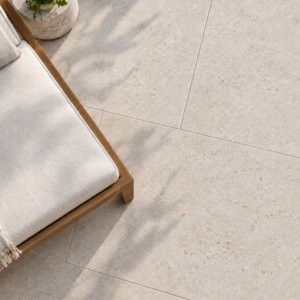
- Volcanic and igneous stone carrying the exposed walls and bases, with limestone used underfoot in protected areas.
- A stated absorption figure requested for the delivered batch before anything is bedded.
Siting decisions worth making at survey stage
Most of the risk on a geothermal-adjacent site is removed before the design starts, on the day someone walks the ground with a plan.
- Warm ground patches mapped, so nothing sensitive is placed on an anomaly.
- Prevailing wind noted, since the scent and the vapor travel with it.
- Spring and seep lines recorded, including seasonal ones that appear only after rain.
- Services routed away from mineral-bearing water and warm ground alike.
- Planting chosen for the soil chemistry that actually exists on the plot.
Building near Sulphur Springs, with the geology accounted for
A spring-zone address buys drama that no other Caribbean location can match, and it charges for it in metals and mineral staining rather than in danger. The specification answers are straightforward: keep bright metals off the property, use marine-grade or coated fixings, route mineral water away from pale surfaces, let volcanic stone take the exposed positions and limestone the sheltered ones, and map the warm ground before siting anything. Do that and the landmark stays an asset. Where the same palette continues up the hillside, our Piton view villa stone guide carries it on. Let the geology choose the materials and the address does the rest.