A Grenadian pool lives a double life. For half the year it is the familiar Caribbean picture — sun, pale stone, blue water. For the other half it shares its deck with serious rain, and the pools that stay beautiful through both halves are the ones whose stonework was designed for the wetter one. Grenada’s hillside infinity pools have their own guide in the hillside villa story; this one covers the whole-island fundamentals — the deck, the edge and the water, engineered for the Spice Island’s generous sky.
The wet-season deck
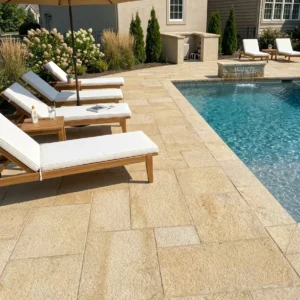
Rainfall is the Grenadian pool deck’s real design driver. Falls must move storm water off the deck fast and away from the pool — never toward it, where runoff carries debris and dilutes chemistry — which on generous decks means channel drains between deck and garden, falls of honest steepness, and discharge routes planned to soakaways or storm paths rather than over the nearest wall. Joints want to be full and flush so sheeting water crosses them cleanly. The reward for getting this right is a deck that is usable twenty minutes after a downpour — which, in wet season, is the difference between a pool that gets used and one that gets looked at.
- Falls that move storm water off the deck fast and away from the pool, never toward it.
- Channel or slot drainage on generous decks, sited clear of lounger positions.
- Outfalls sized for a downpour, with a route that does not scour the planting below.
- Joints and bedding specified to drain rather than to hold water under the stone.
- A hose test before handover, so the first storm is a confirmation and not an experiment.
An edge for a lush setting
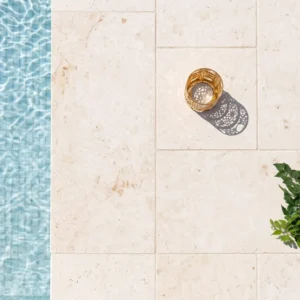
Coping choice in Grenada answers to the setting as much as the swimmer: pale stone edges read luminously against the island’s deep greens and the dark volcanic accents local design favors, and a honed-but-textured top surface keeps wet hands and feet secure through the humid months. The lush surroundings add one practical note the drier islands skip: organic debris. Leaves and blossom land on copings under any planted canopy, and wet leaves on smooth stone are genuinely slippery — so texture earns its place, overhanging planting gets pruned back from the waterline, and the skimmer’s little ritual extends to a broom pass along the edge. Profiles follow the villa’s architecture as everywhere; the coping range covers the shapes.
The surround as a composition
Grenada hands pool designers a palette trick no coral island can copy: the dark feature wall. A backdrop in local volcanic stone — behind the pool, holding the hillside, framing an outdoor shower — makes pale water-and-deck compositions look almost theatrical, and the two-stone partnership reaches its most photogenic form here. Planting completes it, with the wet-climate caveat: greenery close to water drops litter and sends roots toward moisture, so beds near the deck want contained, well-chosen species and clean stone edges, keeping the jungle’s drama at exactly arm’s length.
Rain, chemistry and the stone
Wet season works on pool water too: heavy rain dilutes sanitizer and shifts balance, and the correction cycle is simply part of Grenadian pool keeping. For the stonework the rules stay reassuringly simple — rinse-friendly, pH-neutral cleaning; no acid products anywhere near limestone; and sealing decisions made honestly on the basis of use rather than habit. Splash-zone stone in a well-balanced pool weathers gracefully; the failures worth preventing are mechanical, which is why bedding quality and movement joints matter more than any bottled product. A pool built on the natural-stone edge principles and maintained with a light, regular hand outlasts every shortcut.
- Rinse-friendly, pH-neutral cleaning products kept on site rather than ordered after a problem.
- No acidic products anywhere near limestone, including many tile cleaners sold locally.
- Sealing decided honestly on the basis of the stone and its exposure, not as a default.
- Sunscreen and oil treated as the routine stain, cleaned before it weathers in.
- Spare units from the original batch stored dry for the piece that eventually chips.
Building for the first wet season
The program advice writes itself from the climate: build falls and drainage in the dry months, test them with a hose before handover, and let the first wet season be a confirmation rather than an experiment. Samples belong on site early — viewed wet and dry, against the garden’s green and the villa’s walls, because Grenada’s light and foliage shift stone tones more than any brochure allows. The Grenada guide carries the ordering detail; the pool it produces should feel inevitable in both of the island’s seasons.
The evening pool: light, rain and the night swim
Grenada’s pools earn a second life after dark, and wet season improves it — a warm night swim in soft rain is the kind of memory villas are rented for. The stonework’s part is light and safe footing. Underwater lighting reads best against pale interiors and copings, so the stone choices made for daytime comfort repay themselves at night; deck lighting should graze the stone low and warm, marking edges and steps without flattening the texture that makes wet surfaces safe. The coping line deserves particular clarity after dark — a subtle change of texture or a lit edge tells bare feet where water begins — and any step into the pool zone follows the same consistent-riser discipline as every stair on the property. Rain adds atmosphere and subtracts visibility, which is one more argument for textured deck finishes and falls that clear water fast even mid-shower. Design the night pool as deliberately as the day one, and the wet season stops being the off season altogether.
Warmth, covers and the mountain-evening swim
Grenada’s pools run pleasantly warm most of the year, but the island’s topography writes exceptions: villas at altitude and pools shaded by hillside or canopy can turn genuinely fresh in the cooler months and after long rain, and the owners who notice usually ask about heating late, when retrofits cost most. The forward-planned answers are modest. Solar pool heating suits the island’s sun economy and asks only roof or bank space plus plumbing runs sleeved at build time; heat pumps serve smaller volumes — plunge pools especially — and want their equipment pad, power and acoustic screening designed into the machinery court from day one. Covers do the cheap half of the work, holding overnight warmth and keeping wet-season debris out of the water, and their practical demand is architectural: a roller housing or discreet stone-edged recess at the pool’s end, drawn before the surround is cut rather than improvised against finished coping. The stonework’s role in all of it is anticipation — sleeves, pads, recesses and access panels planned while planning costs pennies. A pool that swims comfortably at seven on a misty-season evening, lights glowing under pale coping, is the version of Grenada owners moved for; the difference between having it and wishing for it is a page of services drawing at design stage.
Grip, measured rather than assumed
A pool deck that spends half the year wet from rain as well as from swimmers deserves a finish chosen from test data. The relevant standard and its limits are set out clearly in this account of frictional testing on stone walking surfaces.
- ANSI A326.3 measures dynamic coefficient of friction and supports testing in place as well as in a laboratory.
- Its 0.42 benchmark applies to level interior surfaces walked on wet, so an exterior deck sits outside that scope.
- Polished finishes generally fail the benchmark and have no place around a pool.
- Coarser honed and lightly textured finishes test better and stay usable in rain.
- Denser stone often tests lower than softer stone in the same finish, so test the specimen you are buying.
What the wet season really looks like
Planning a Grenadian pool project around the calendar is easier when the calendar is a number rather than a feeling. The Caribbean Regional Climate Centre profile for Grenada gives the shape of the year.
- A wet season from June to November, with more than 100 mm of rain in every month.
- A dry season from February to April, often under 50 mm per month, which is the building window.
- Mean annual rainfall of around 1,161 mm at the airport, and over 3,000 mm at higher elevations.
- Mean annual temperature near 27.5 degrees Celsius, so the deck is warm almost every day.
- Base and bedding works scheduled in the dry months, with laying finished before the rains return.
Ordering the edge and the field together
Pool packages go wrong at the interface between shelf material and cut work. Ordering them as one job removes most of the risk.
- Field paving and coping quoted from the same batch, so tone matches at the most visible line.
- Corners counted as dedicated units and identified as internal or external.
- Curves templated in ply and numbered to a setting-out drawing before production.
- Steps, benches and weir stones listed separately because they carry longer lead times.
- Spares ordered with the main run, since the edge is where damage concentrates.
Pool stone in Grenada that works in both seasons
A Grenadian pool has to be two things: the bright, barefoot picture everyone imagines, and a surface that sheds serious rain without staining, ponding or turning slick. Those two jobs are not in conflict, but they do have to be designed together, in the dry months, with falls tested by hose before anyone swims. Choose a pale, dense stone in a textured finish, drain the deck away from the water, keep acid off the limestone, and the pool looks the same in October as it did in March. For the coping profile and material choice, the detail in our Grenada stone supply guide is the next step. Design the deck for the rain and it will look effortless in the sun.