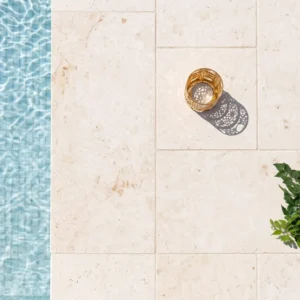
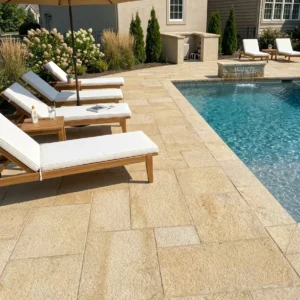
Every celebrated pool in Turks & Caicos is really a celebrated edge. The water is a given — it is the coping that hands swimmers in and out, catches the eye in every photograph, and takes more concentrated wear than any other stone on the property. Choosing it well is a short exercise with long consequences, and the TCI market’s split between private villas and condominium amenity pools makes the choice more interesting than a catalog page suggests.
Three profiles, three temperaments
The working shortlist is short. Bullnose — a fully rounded front — is the traditional friendly profile: soft on hands and the backs of knees, forgiving on small setting-out errors, at home on classical and Caribbean-vernacular villas. The eased square arris — a crisp rectangle with just the sharpness taken off — is the island-modern choice, drawing a thin clean line between water and deck that suits TCI’s white-box architecture. The drop-face (or rebated) profile carries the stone down over the pool’s beam, hiding the shell and reading as a thick, floating slab of stone; it is the most architectural of the three and the least tolerant of sloppy installation. None is superior in the abstract — the villa’s lines decide, and the honest test is a full-size profile sample held against the actual pool shell, not a drawing.
- Bullnose, fully rounded, for hands and the backs of knees, and forgiving of small setting-out errors.
- Eased square arris for a crisp modern edge, with just enough radius to stay comfortable.
- Drop-face or rebated profiles where the edge should read thick and shadow the wall below.
- Whichever profile is chosen, the same one must run corners, steps and spa edges without exception.
Villa pools and amenity pools are different jobs
A private villa pool sees a family and its guests; a condominium amenity pool sees every unit’s occupants, their sunscreen, their coolers and a daily dosing regimen, all year. The specification shifts accordingly. Amenity coping earns thicker sections and the densest stone on the shortlist, because edge chips multiply with traffic and a chipped edge at a commercial pool is a liability conversation, not just a cosmetic one. Joint spacing tightens, repairs must be plannable — which argues for holding spare units from the same batch — and the profile choice leans toward eased square edges that survive decades of pool furniture better than delicate rounds. Villa owners can afford to choose almost purely on comfort and line; boards and property managers should choose on duty cycle first.
The comfort question at the water’s edge
Coping is the one stone surface guests touch with skin more than feet: palms on the edge, forearms during a poolside conversation, the sit-and-dangle position every pool invites. Pale limestone keeps that contact pleasant through a TCI afternoon in a way dark stone cannot, and a honed or lightly textured top surface adds grip for wet hands without rasping skin. The deck behind the coping carries the same logic across the wider surface; the edge simply feels it most intensely, which is why the wet-sample test — sit on it, lean on it, splash it — belongs in every selection.
Fixing, beds and movement
Coping fails at the bed, not in the stone. Full mortar beds with no voids are non-negotiable — a hollow under coping announces itself first as a drummy sound and later as a cracked unit — and the perimeter needs movement joints at the corners and at sensible intervals along straight runs, because a sun-baked pool surround moves daily and a rigidly grouted ring has nowhere to send that movement except through the stone. The junction with the waterline tile below and the deck behind deserves drawn details rather than site improvisation, and on renovation work the old bed must come out entirely; new coping over tired mortar inherits every one of its problems.
- Full mortar beds with no voids, checked by sounding before the grout goes in.
- Movement joints at every corner and at sensible intervals along straight runs.
- A bond breaker where the coping meets the pool shell, so structural movement is not shared.
- Falls running away from the water, never back toward it, along the whole perimeter.
Ordering the edge properly
Coping is cut work, not shelf stock. Straight runs order from linear measure with corners as dedicated units; curved pools need templated radius pieces — a paper or ply template of each curve travels to production, and the pieces come back numbered to a setting-out drawing. Order spare units with the main run in the same batch, because the edge is where damage concentrates and a matching spare five years on is worth many times its freight. Profiles, radius work and copings for raised spa walls all ship alongside the field stone from the same TCI order, and the villa-owner’s edge guide from our Jamaica series covers the geometry questions in more depth — the physics do not change between islands, only the architecture around them.
Beyond the perimeter: spas, ledges and raised beams
Modern TCI pools rarely stop at a simple rectangle of coping, and every additional water feature multiplies the edge details. A raised spa wants cap stones on its surrounding wall that agree with the main coping while working harder — they are seat, step and splash zone at once, so generous width and a comfortable arris matter doubly. Tanning ledges put coping logic underwater: the shallow shelf’s visible edge should be a clean dimensioned line, and its surface texture chosen for wet skin lounging directly on stone. Swim-up features, beam walls between pool and spa, and slot overflows each add their own cut specials — beam caps, transition units, corner pieces — and the golden rule is to schedule every one of them on the cutting list at order time. An edge package thought through as a family of details, cut from one batch, is what makes a complex pool read effortless; the alternative is a perimeter of near-misses that no amount of good laying can rescue.
The waterline handshake
Coping never works alone: directly below it runs the waterline finish — tile, glass mosaic or stone — and the junction between the two is the pool’s most scrutinized centimeter. The handshake succeeds on three agreements settled before installation. Level: the coping’s underside line must run dead true, because the waterline band beneath it is read against the water’s own perfect level and broadcasts every wobble. Color: the band and the coping should be chosen together against a wet sample — water deepens both, and pairings that sing dry can argue wet. And movement: the joint where coping meets the waterline system needs the right flexible detail rather than a rigid grout fill, because the pool shell and the surround live slightly different structural lives and their meeting point must absorb the difference invisibly. Renovations concentrate the issue: a new coping over an existing waterline (or the reverse) inherits the old component’s line, so the survey step — checking the existing run for level and soundness before committing — is what separates a crisp result from a compromise nobody mentions but everyone sees. Ask the installer to dry-lay the first three meters of the junction for approval; it is the mock-up habit at its smallest and most valuable scale.
Grip at the edge, measured rather than guessed
The coping is the wettest stone on the property and the one people push off with their hands and feet. Finish selection is therefore a measured decision, not a taste decision. The published account of friction testing for stone walking surfaces explains what the current standard actually covers.
- ANSI A326.3 replaced the withdrawn drag-sled method and supports testing in place as well as in a laboratory.
- The 0.42 benchmark is written for level interior surfaces walked on wet, so a pool edge sits beyond its scope.
- Polished tops generally fail that benchmark and have no business on a coping.
- Coarser honed and lightly textured finishes test better, which is why they dominate resort edges.
- Test the specimen you are buying, because ranges within a single stone variety are wide.
Bedding systems and what each one asks of the edge
Coping is one of the few places where the installation method is effectively decided for you. Paving elsewhere on the property may be sand-set or sit on pedestals, but the edge that people grab and push off cannot move. A clear summary of the options appears in this piece on detailing natural stone paving.
- Mortar-set for the coping itself, chosen wherever stability is the governing requirement.
- Sand-set kept for the open deck field, where minor settlement is tolerable and repairs are easy.
- Pedestal systems reserved for terraces above waterproofing, never for a pool edge.
- The transition between systems detailed deliberately, because that line is where movement concentrates.
Chemistry, sunscreen and the stains that stay
An amenity pool edge meets more chemistry in a month than a villa edge meets in a year, and most of it lands in the first eighteen inches of stone. Planning for that is cheaper than remediating it.
- Dosing points sited away from the coping run, never directly above it.
- Sunscreen and oil treated as the routine stain, with a neutral cleaner kept on site rather than ordered after the fact.
- Acidic cleaners kept off carbonate stone entirely, including the ones sold for tile.
- Spare units from the original batch stored dry, so a stained piece can simply be swapped.
Measuring a pool for coping without a second visit
Most coping delays are measurement delays. A pool that is surveyed properly once produces a cutting list that production can work from immediately.
- Linear measure taken along the finished shell line, not the excavation line.
- Corners counted and identified as internal or external, each as a dedicated unit.
- Curves templated in ply or paper, labeled, and numbered to a setting-out drawing.
- Steps, benches, spa edges and weir stones listed separately, because they carry longer lead times.
- Overhang dimension fixed before cutting, since it changes every piece in the run.
Choosing pool coping in Turks and Caicos with confidence
The edge is a small quantity of stone doing a disproportionate amount of work: it sets the profile of every photograph, takes the heaviest concentrated wear on the property, and is the surface guests touch with their skin. Choose a dense, pale stone in a textured finish, bed it solid, template the curves, and buy the spares in the same batch. Everything after that is maintenance measured in minutes. The deck behind it should be specified in the same conversation, and our guide to deck stone along Grace Bay covers that half of the surface package. Get the edge right and the pool looks finished from the first day it holds water.