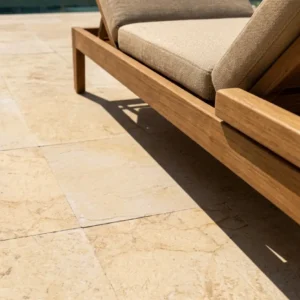
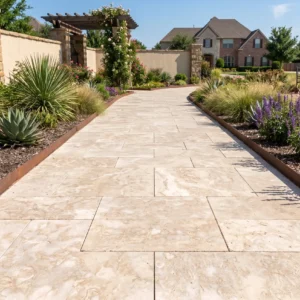
Barbados perfected the veranda long before anyone marketed “outdoor living”: the deep, roofed gallery where the house actually happens — breakfast, visitors, the six o’clock drink. Its floor works differently from any open terrace, and stone chosen by veranda rules turns the island’s favorite room into its finest.
The covered-floor privilege
A roof changes everything the exterior guides warn about: no direct rain scrub, no full-sun heat load, no UV bleaching hours. The veranda floor therefore unlocks the refined end of the finish spectrum — fine brushed and honed surfaces whose silk feel open terraces cannot risk — and the warmer, deeper end of the palette, since surface temperature stops ruling. It is the one exterior floor specified almost like an interior.
But it is still outdoors
Two exterior realities survive the roof and shape the spec:
- Wind-blown moisture — storms drive rain meters inside gallery lines, so the floor keeps exterior-grade slip sense at the perimeter band, and a texture step-up on the outer course is the elegant compromise
- Salt film — covered floors near the sea collect what rain never rinses, which makes the veranda the poster child for the monthly freshwater wipe-down on the care calendar
Levels, thresholds and the flow of the house
Verandas mediate between interior floors and garden grade, and the classic Bajan section does it in stone across two junctions:
- Interior floor flush to veranda floor — one material family, two finishes, which is the indoor-outdoor trick at its birthplace
- One generous step down to terrace or lawn, its nosing textured and its riser often cut in the accent stone
Get those two junctions right and the house breathes through them.
Absorption is the number that separates one limestone from another. The Natural Stone Institute records a range running from under one percent to over ten across the family, and notes that dolomitic stones generally carry higher density, lower absorption and better abrasion resistance — the industry variety data sets this out. That spread is why two stones sold under the same broad name can behave nothing alike underfoot.
Furniture, fans and the lived-in floor
Veranda floors live under planters’ drip trays, rocking chairs’ arcs, and the ceiling fans’ dust shadows: the practical spec answers each — saucers and pads as standard, a finish fine enough to mop but textured enough that damp evening air never slicks it, and a tone that flatters rather than fights the timber ceilings and coral walls Bajan galleries wear. Cream and soft ivory limestones are the traditional winners; the palette logic translates across the water intact.
Renovating heritage galleries
Many Bajan verandas sit on historic footprints — old tile, painted concrete, sometimes original coral flags worn hollow. The renovation path mirrors the coping playbook: the structure usually survives, the surface retires, and new stone lays over a corrected screed with the heritage details (timber posts, fretwork, stone walls) suddenly reading sharper against a calm new floor. Where original coral flags deserve saving, they can migrate to garden features while the gallery gains a floor that serves this century’s traffic.
Installation method matters as much as the stone itself. Industry guidance separates mortar-set work, sand-set exterior paving and pedestal systems, and stresses that drainage, movement and substrate condition drive long-term performance more than the material name does — the detailing guidance is worth reading before you specify.
Specifying the veranda
The order reads like an interior with weatherproof instincts:
- 2 cm thickness typically suffices, since the floor is roofed and pedestrian
- Fine brushed or honed field with a textured perimeter course
- Large formats for calm
- The same single-batch discipline as everywhere else on the property
Quantities are modest, the daily-use payoff is the island’s highest, and samples viewed in the gallery’s own shade rather than full sun make the choice in an afternoon. The Barbados guide carries the freight and sampling detail.
The gallery’s furniture story
Veranda furniture is the island’s most-lived, and each habit asks something of the floor:
- Rockers that arc the same floor line for decades
- Dining sets that migrate with the breeze
- Planters that drip and pots that scrape
The spec answers with a fine-textured surface that pads glide on, and the housekeeping card adds one gallery-specific line: saucers under everything that gets watered.
Verandas and the evening economy
The gallery earns its keep after dark: pale floors lifting lamplight, the evening physics of reflection at their gentlest, and the smooth-underfoot finish that bare evening feet notice. Where the veranda hosts the property’s dining ritual, borrow the dead-level zone trick; where it hosts the rockers and rum, the floor’s only job is silence — no rocking pavers, no lippage, the craft invisible as ever.
Tone under a roof, and why shade changes the choice
A veranda floor is judged in light that never reaches the terrace outside it, and stone chosen in full sun frequently disappoints once it is under a roof. Shade removes the sparkle from a brushed surface, deepens every tone by a grade or two, and makes a stone that looked bright and lively on a sample board read flat and cold. The practical answer is to view samples where the floor will actually live: on the gallery, in the afternoon, both dry and wetted. Most owners end up a shade lighter than they expected, and several end up choosing a finer finish than the terrace carries, because grip requirements fall away once the rain mostly stays outside.
Thresholds into the house
The junction between veranda and interior is where an otherwise good floor gives itself away. Four details carry it:
- A level threshold wherever the structure allows, because a step at the door reads as an afterthought and trips people carrying trays
- The same stone continuing inside, in a finer finish, so the eye crosses without a break
- A drainage channel or falls away from the opening, so wind-driven rain never reaches the door line
- A single-piece threshold unit rather than a joint sitting under the frame
Get these right and the veranda stops being an outdoor room attached to a house and starts being the room the house opens into, which is what the Bajan plan has always intended.
The veranda in a rental property
On a rental villa the gallery takes more abuse than any other floor on the property, because it is where every guest eats, sits and drags furniture. The specification adjusts accordingly:
- A slightly coarser finish than a private house would choose, because guests do not wipe their feet
- Felt pads fitted and replaced as a scheduled task rather than an occasional favor
- Attic stock held on site, since a chipped unit between bookings needs replacing this week, not next season
- A written housekeeping card, so successive cleaners use the same neutral products
None of that changes the stone. It changes the routine around it, which is usually where rental properties lose floors that would otherwise have lasted decades.
What veranda stone in Barbados has to survive
Bajan builders perfected the veranda generations before outdoor living had a hashtag, and its stone floor deserves the same unhurried standard: chosen in the gallery’s own shade, laid dead-level for the rockers, kept by the gentle covered-floor routine. Do it once, properly, and the island’s favorite room becomes your property’s finest — six o’clock, every day, for decades.