On a Barbadian project, the stone schedule is where design intent meets salt, sun and a supply chain that crosses an ocean. This checklist compresses what we have learned supplying Caribbean architects into the eight decisions that make a stone specification buildable — and defensible at handover.
1. Specify performance, not just appearance
Alongside color and finish, state the properties that matter here: dense, low-absorption paving-grade stone for anything exposed; textured finishes for wet zones; light tones where bare feet and sun coincide. An appearance-only spec invites substitution by whatever looks similar in a photograph.
2. Zone finishes on the drawings
Mark finish zones explicitly: bush-hammered or coarse brushed at pools and external stairs, finer brushed on terraces, honed only under cover. One stone in multiple finishes keeps color continuity while meeting each zone’s grip requirement — and it consolidates procurement.
3. Draw the specials early
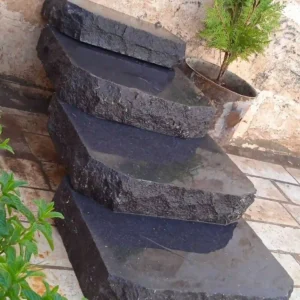
Copings, treads, sills and wall caps are cut-to-order items with real lead times. Detail them at design stage so they are cut with the main package rather than chased afterward:
- Profiles — bullnose, eased or square
- Nosing overhangs
- Drip grooves
4. Fix thickness by application
2 cm under cover, 3 cm exterior pedestrian, 5 cm+ vehicular — stated per area on the schedule. Thickness drives structure, freight (about 80 kg per square meter at 3 cm) and cost; ambiguity here is where budgets leak.
5. Demand single-batch supply
Write batch consistency into the spec: one production batch per continuous surface, hand-inspected, with attic stock from the same batch retained for the client. Color drift between deliveries is a defect you can specify away.
Absorption is the number that separates one limestone from another. The Natural Stone Institute records a range running from under one percent to over ten across the family, and notes that dolomitic stones generally carry higher density, lower absorption and better abrasion resistance — the industry variety data sets this out. That spread is why two stones sold under the same broad name can behave nothing alike underfoot.
6. Sample against reality
Approve range samples wet and dry, in exterior light, beside adjacent materials — render, timber, water. Our samples land within 3 working days; the coral-versus-imported comparison is worth running physically if local stone is also on the table.
7. Integrate the freight reality
Stone is a long-lead import: order at design freeze, quote landed cost through the client’s broker before sailing, and sequence crates to the program — the mechanics are in our Barbados freight guide.
8. Keep one accountable counterpart
Specification questions, production dates, substitution requests — one principal answering all three protects the schedule and the design. That is how we work: architect-direct, kareem@citadelstone.us, details in the Barbados supplier guide.
Writing the spec clause that survives procurement
Design intent dies in vague clauses, so write the stone section like you mean it. A robust clause names:
- Material class and color range, with the approved range-sample set as the referee
- Density and water-absorption limits
- Thickness per application zone
- finish per zone, by name
- Sizes and joint widths
- A specials schedule — copings, treads, sills — with profiles drawn
- Single-batch supply per continuous surface
- Attic-stock percentage
- The substitution protocol: no alternative accepted without a matching range sample
Installation method matters as much as the stone itself. Industry guidance separates mortar-set work, sand-set exterior paving and pedestal systems, and stresses that drainage, movement and substrate condition drive long-term performance more than the material name does — the detailing guidance is worth reading before you specify.
The submittal sequence that prevents site surprises
Sequence approvals so nothing is discovered at laying:
- Range samples first — approve variation, not a hero piece
- Then specials profiles, as cut samples or shop drawings
- Then a laid mock-up panel on the real bedding, wetted and walked, signed by client and architect
- Then first-delivery inspection against that mock-up
Each gate is minutes of attention that converts a potential dispute into a decision.
Coordinating the wet trades
Stone meets waterproofing at pools, planters and roof terraces, and the interfaces belong on drawings before anyone quotes:
- Membrane turn-ups behind coping lines
- Movement joints carried through the stone, never buried under it
- Drainage falls built into the screed rather than begged from the bedding
- Sealant joints, stone-to-shell and stone-to-frame, specified as flexible rather than mortared rigid
Every one of these is cheap on paper and expensive as a variation.
Program, procurement and the ocean in between
The stone package is a long-lead import with a broker in the middle: procurement that works backwards from the laying date through clearance at Bridgetown, sailing, production and sample sign-off lands comfortably; anything else lands expensively by air or late. The working numbers and document flow are in the freight guide; the architect’s job is simply to hold sample sign-off early enough that production can start when the program needs it.
Defects, tolerances and the honest conversation
Natural stone has a character clause, and the spec should carry both halves of it:
- What variation is embraced — tonal range, occasional veining, shells in shellstone, judged against the approved range set
- What is rejected at inspection — cracks, lamination, calibration outside tolerance
That single distinction, agreed before the first crate opens, prevents most of the arguments this trade is famous for.
Coordinating with the landscape architect
Stone packages straddle two designers, and the seams show when they do not meet: agree early who owns levels at the building-to-garden interface, share one stone schedule so hard landscape and architecture draw from the same palette and batch, and resolve the classic collisions on paper — tree pits versus paving falls, irrigation heads versus stain risk, planting soils versus stone edges. One joint site walk at design freeze, with both consultants and the stone schedule on the table, prevents the year of small site arguments that unresolved interfaces schedule.
The import side is more open than most people expect. Official commercial guidance states that almost all goods can be imported into Barbados, with licenses required for a defined list that is largely agricultural — the country guidance sets out the exceptions. Dimension stone does not appear on that restricted list.
Tolerances and setting out, specified like you mean it
“Flat” and “straight” are opinions until the spec gives them numbers:
- Surface regularity under a straightedge
- Joint-width tolerance
- Lippage limits between adjacent units
- Level tolerance at thresholds and drains
Match them to the stone’s calibration — dense calibrated limestone supports tight numbers, rustic products need honestly looser ones — and require a setting-out drawing with them.
The sustainability conversation, honestly
Imported stone carries shipping miles, and honest specification weighs them against the other side of the ledger:
- A natural material with no manufacturing energy beyond cutting
- A service life measured in decades, which amortizes its transport
- Unit-level repairability that avoids replacement cycles
- End of life as reusable stone rather than landfill composite
Add sea freight’s efficiency per metric ton-mile and the lifecycle comparison is less lopsided than it first appears.
Specifying stone in Barbados without surprises
The cheapest consultancy in coastal architecture is revisiting your own work: a year-one walk of the finished project — where do falls actually shed, which textures do bare feet choose, what has housekeeping learned, which details would you redraw — feeds directly into the next project’s stone section. Practices that institutionalize this loop develop signature detailing that survives value engineering because it is proven, not preferred. The stone schedule stops being a document you write and becomes one you evolve.