A Jamaican villa terrace is an outdoor room — and like any room, most of its character is decided by the floor. Same stone, different format and pattern, completely different mood. Here is the designer’s toolkit, minus the jargon.
Format sets the tone
Format sets the tone before pattern does:
- Large formats, 24 x 24 up to 36 x 36 in, read calm, modern and generous — fewer joints mean the eye rests
- Classic rectangles, 24 x 12 or 24 x 16, feel more traditional and forgive complex terrace shapes
- One large square mixed with one rectangle in a repeating set adds quiet rhythm without busy-ness
Patterns that earn their keep
Stack bond (grid) is crisp and contemporary — demands tight, consistent joints. Running bond (brick offset) is relaxed and hides minor size variation. French/Versailles pattern mixes four sizes into an old-world carpet — a natural fit for shellstone’s coastal character. Herringbone spends drama sparingly: an entry, a pool approach, not the whole floor.
Borders and banding
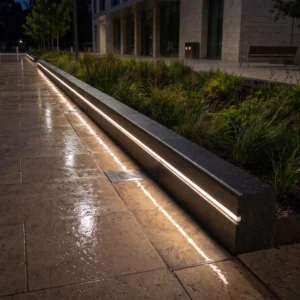
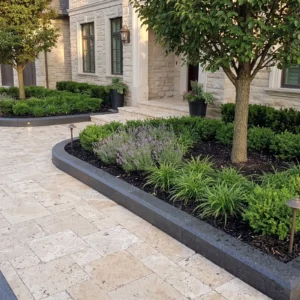
A single or double soldier-course border in a contrasting stone — black basalt pavers around light limestone is the Caribbean classic — does three jobs at once:
- Frames the terrace the way a rug border frames a room
- Hides the perimeter cuts
- Visually locks the composition together
Banding can also zone one large terrace into dining and lounging without a level change.
Indoor-outdoor flow
The strongest villa trick: run one stone from living room to terrace — honed or polished inside, textured outside — same color, different finish. Sliding doors open and the space doubles. Our finishes are cut on the same stones precisely to make this seamless.
Installation method matters as much as the stone itself. Industry guidance separates mortar-set work, sand-set exterior paving and pedestal systems, and stresses that drainage, movement and substrate condition drive long-term performance more than the material name does — the detailing guidance is worth reading before you specify.
Steps, edges and details
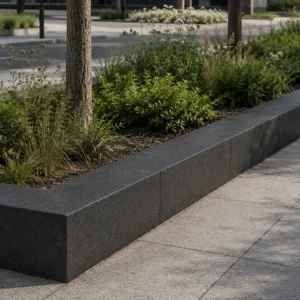
Terrace steps want full-depth treads with a slight overhang and a textured face; matching coping-profile stone on planter walls and seat walls carries the floor’s language upward. Details persuade more than area ever does.
From sketch to pallet
Send us the terrace dimensions and the look you want; Kareem prices format-and-pattern options against your square footage, cut to order. Samples arrive within 3 working days; freight, escrow and the full ordering path are in the Jamaica supplier guide.
Working with slope: terraces that step
Few Jamaican sites are billiard-flat, and the best terrace designs make the slope an asset:
- Two or three stepped levels — dining above, lounging below — connected by broad stone steps that double as casual seating
- Each level dead level, because furniture demands it, with the site’s fall absorbed at the steps
- Retaining edges turned into seat walls, capped in coping-profile stone
Joints, the quiet design decision
Joint width and treatment change a floor’s character as much as format does. Tight 2–3 mm joints read crisp and architectural — the choice for stack bond and modern schemes. Wider 8–10 mm sanded joints read relaxed and garden-like, forgive slight format variation, and suit running bond and Versailles patterns. Planted joints — creeping thyme or dwarf ground cover in wide gaps — turn a path into a garden feature but belong away from furniture zones. Decide the joint with the pattern, not after it; the installer will thank you and the floor will show it.
Absorption is the number that separates one limestone from another. The Natural Stone Institute records a range running from under one percent to over ten across the family, and notes that dolomitic stones generally carry higher density, lower absorption and better abrasion resistance — the industry variety data sets this out. That spread is why two stones sold under the same broad name can behave nothing alike underfoot.
Furnishing without fighting the floor
Terrace furniture and stone floors coexist happily with two provisions:
- Felt or rubber pads under metal feet, because bare steel eventually rust-stains any light floor
- Format planning around heavy fixed pieces — a built-in bench or masonry planter sits best centered on units or aligned to joints rather than landing arbitrarily
For dining zones, confirm the laying pattern gives chairs a rock-free slide.
Growing the design over time
Villas evolve — an outdoor kitchen next year, a pergola after that — so design the stone for growth:
- Order attic stock from the original batch, around 5 percent on a terrace
- Note the batch reference where the next owner will find it
- Lay sleeves and conduit now for the lighting and services a later phase will want
A pattern-to-mood cheat sheet
For quick reference when briefing a designer or pricing options: stack bond large-format = modern resort calm; running bond = relaxed classic, hides site imperfections; Versailles four-size = old-world estate, best in shellstone; herringbone = energy and formality, spend it on entries; contrasting soldier borders = definition and finish on any of the above. One field pattern, one border move, one accent stone — that trio covers ninety percent of great Jamaican terraces.
Micro-terraces: design moves for small spaces
Not every Jamaican outdoor space is a villa lawn — townhouse patios and garden corners deserve the same design intelligence at smaller scale. The moves invert: middle formats (18 x 18, 24 x 12) laid to a simple grid make a small court read ordered rather than busy; running the same stone up a low seat wall doubles usable edge without floor space; a single specimen planter on a stone plinth gives the eye a center; and continuing the indoor floor tone outside — even across two meters — borrows the interior’s square footage visually. Small spaces punish clutter and reward restraint even harder than large ones.
Pattern mathematics: ordering the right quantities
Each laying pattern carries its own waste arithmetic, worth knowing before the cutting list is final:
- Stack bond on a rectangular terrace wastes least — perimeter cuts only
- Running bond adds half-unit cuts at alternate row ends
- Versailles sets order by the repeat: measure the field in whole repeats, then edge
- Diagonal and herringbone layouts push perimeter waste highest, which is why their margin is bigger
Working drawings your installer will thank you for
A terrace lays best from one A3 sheet carrying five things:
- Field pattern and joint width
- Border course and its corners, drawn — mitred or basket, decided now
- Step positions with tread counts
- Fixture penetrations dimensioned: lights, drains, sleeves
- The laying origin marked — the line the first row follows, from which every joint inherits its discipline
Crews improvise beautifully when they must; they lay faster and straighter when they do not have to.
What a terrace design in Jamaica has to achieve
Agents marketing Jamaican villas will tell you where viewings are won: the first thirty seconds outside. A dated terrace discounts everything the interior promises; a composed stone terrace — calm field, crisp border, coherent steps — reprices the whole property’s first impression. Unlike kitchens, terraces do not go out of fashion in a decade: the stone that reads timeless today read timeless in 1990 and will in 2040. Few five-figure lines on a refurbishment budget hold value as stubbornly.