Jamaica sits on limestone — roughly two-thirds of the island is made of it — and quarrying is a real local industry. So why would anyone import limestone to Jamaica? Because “limestone” describes a family of rocks with wildly different jobs, and the local industry and the imported product serve different ones.
What Jamaican quarries actually produce
The overwhelming majority of Jamaican limestone output is aggregate:
- Crushed stone for concrete
- Road base and fill
- Cement production
It is essential material, produced at scale, and nothing shipped in competes with it. What the local industry produces very little of is dimension stone — stone cut into calibrated, finished floor and wall units.
What dimension stone requires
A paving tile is not small aggregate. Producing one needs three things a quarry alone does not have:
- A deposit dense and consistent enough to saw into thin units that survive handling
- Machinery to calibrate thickness to the millimeter
- Finishing lines that produce a controlled surface — brushed, honed, bush-hammered — at repeatable quality
That is a manufacturing chain rather than an extraction site, which is why finished stone flooring is a global trade.
Porosity: the coastal decider
Young, soft island limestone tends to be porous, and on a coastal floor porosity is a decay mechanism rather than a cosmetic trait. The sequence is always the same:
- Salt-laden water enters the pore structure
- It crystallizes as the surface dries
- The crystals break the face down from within
Imported paving-grade limestone is selected for density and low absorption — the properties that let a floor shrug off spray, pool chemistry and traffic for decades.
The sensible division of labor
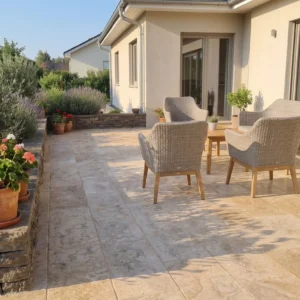
Use local material where it excels — fill, base, blockwork, mass landscaping — and imported dimension stone for the surfaces people see and walk on: floors, terraces, pool coping, steps and cladding. The two are complements in the same build, not rivals.
Jamaica quarries a great deal of its own rock, and it is licensed rather than informal. The Mines and Geology Division issues quarry licenses under the Quarries Control Act covering limestone, marl, shale, andesite and aggregates across the parishes, and separately evaluates high-purity limestone deposits — the division publishes its license register. What that industry supplies is aggregate and fill rather than calibrated dimension stone, which is the gap imports fill.
How to compare honestly
Get a sample of anything offered as local paving stone and one of ours, and run the doorstep tests: wet both and time the absorption, scratch both with a coin, weigh them in your hands. Density and absorption are not marketing claims; they are things you can feel. Our white limestone pavers samples arrive within 3 working days.
Sizes, finishes, freight to Kingston or Montego Bay and escrow terms are all in the Jamaica stone supplier guide.
A short geology of why density differs
All limestone is calcium carbonate, but geological age and burial history decide its character. Young island limestones — Jamaica’s coastal formations included — were laid down recently, buried shallowly, and remain relatively open-structured: lighter, softer, thirstier. The paving-grade material we ship comes from older, deeply compacted deposits where pressure and time closed the pore structure — the stone is measurably denser, absorbs a fraction of the water, and takes a finish that soft stone cannot hold. Neither is “better” in the abstract; they are different materials that happen to share a name, which is precisely why specifying by the name alone goes wrong.
What the numbers mean on a datasheet
Two figures do most of the talking when comparing any stone. Water absorption (percent by weight): paving-grade dense limestone typically sits well under 2–3 percent, while soft porous stone can drink several times that — and absorption is the gateway property, because water carries salt, stains and biological growth into the stone. Density (kg/m³): dense limestone runs around 2,600–2,700, which you can literally feel hefting a sample. Ask any supplier — including us — for these two numbers; a supplier without them is asking you to specify blind.
Absorption is the number that separates one limestone from another. The Natural Stone Institute records a range running from under one percent to over ten across the family, and notes that dolomitic stones generally carry higher density, lower absorption and better abrasion resistance — the industry variety data sets this out. That spread is why two stones sold under the same broad name can behave nothing alike underfoot.
Where each material wins on a Jamaican site
Be concrete about the division of labor. Local aggregate and marl: road base, concrete production, drainage layers, fill — jobs where crushing strength and price per metric ton rule, and where Jamaican quarries are unbeatable. Local soft cut stone: garden walls, rustic landscape features, sheltered decorative work where character outranks wear. Imported dense limestone: every horizontal surface that is walked, wheeled, splashed or rented — terraces, pool surrounds, copings, steps, driveways in vehicular thickness. Draw the line by exposure and traffic, and both industries end up on the same site doing what each does best.
The cost conversation, done honestly
Imported dimension stone costs more per square meter than local soft stone; freight alone guarantees it. The honest comparison is cost per year of service on the surface in question:
- A porous floor by the sea that pits in three seasons, needs annual sealing and reads tired at year five is not cheap at any price
- A dense floor maintained with a hose and a neutral wash is still presentable at year twenty
For back-of-house and low-exposure areas the arithmetic can point the other way, and it should.
Specifying without a laboratory
You do not need a materials lab to buy well. Four checks cover it:
- Demand the two datasheet numbers — density and water absorption
- Run the doorstep tests from earlier in this guide
- Ask where the stone has been installed in climates like this one, and for how long
- Confirm the finish options are cut into the stone rather than applied to it
Fifteen minutes of diligence at specification saves the renovation budget the shortcuts eventually spend.
Provenance: what quarry-direct actually means
“Imported” covers everything from traceable factory production to job lots of unknown origin, and the difference shows up two years after purchase. Quarry-direct supply means the stone’s journey is documented from named quarry through the finishing line to your crate: batch identity, consistent grading, and someone accountable at every step. Job-lot stone — bought cheap at a port, resold on an island — answers to no one when tones drift or a second delivery cannot match the first. The question to ask any supplier is simply: can you name the quarry and repeat the batch? The pause before the answer is the answer.
The look-alike middle: tiles pretending to be stone
Between local soft stone and imported dimension stone sits a third shelf: porcelain and concrete products printed to look like limestone. The honest comparison is that they are consistent and thin, and the good porcelains resist staining well. But:
- Printed faces repeat their pattern
- Edges chip white or gray against the print
- Heat behavior follows the body, not the picture
- None can be re-dressed or re-finished, so damage is permanent
How Jamaican professionals actually blend the two industries
Watch a well-run Jamaican project and the procurement pattern is instructive — two supply chains, two rhythms, one build:
- Local aggregate and blocks ordered by the truckload on short lead times, for structure and base
- Imported dimension stone ordered early, by cutting list, timed to the program
The site’s job is to keep them synchronized: base works proceed on local material while the stone crosses the water.
Where Jamaican limestone belongs and where it does not
Wherever you buy, these five settle the conversation quickly: What are the absorption and density figures? Can you name the quarry and hold a batch? What finishes are cut into the stone (versus applied)? Where has this stone been down for five-plus years in a climate like Jamaica’s? And what do samples cost and how fast do they arrive? (Ours: three working days, and the rest of the answers travel with them.) Suppliers who answer crisply are worth your cutting list; the rest were an email you did not send. Ask for the numbers and the choice makes itself.