What Finish and Format Reveal About Wholesale Tile Supply
Wholesale tile supply decisions hinge on two variables that most buyers underestimate until a job is already in progress — finish compatibility with the installation environment and format tolerance relative to the setting system. You can source the most competitively priced material on the market and still create a costly rework scenario if the honed surface you specified ends up in a high-traffic commercial corridor that demands a grip coefficient above 0.6, or if your 24×48 large-format slabs arrive with thickness variation that exceeds the tolerance your thin-set system can absorb. The format and finish conversation is where specification decisions either save or cost you significant money downstream.
Understanding Tile Finish Options and Their Field Implications
Your finish selection does more than determine how a surface looks — it governs maintenance cycles, slip resistance ratings, and long-term wear performance across the application environment. Polished finishes deliver the reflective depth that high-end residential and hospitality projects demand, but they require more frequent sealing on porous stone like marble or limestone because the densified surface still allows moisture infiltration at the microscopic level. Honed finishes land in a practical middle zone — lower sheen, better grip, and reduced visibility of scratching — making them the workhorse finish for most commercial floor applications.
Textured and brushed finishes take the performance dial further toward function. For outdoor applications, pool surrounds, and entry approaches exposed to rain or irrigation overspray, a brushed or flamed finish raises the static coefficient of friction into ranges that meet or exceed the thresholds outlined in ASTM natural stone tile slip resistance testing standards. The trade-off is that open-textured surfaces trap dirt more aggressively and require more intensive cleaning protocols — a detail that matters on large commercial projects where janitorial specifications are written well in advance of material delivery.
- Polished: highest reflectivity, densified surface, requires sealing every 12–18 months on porous stone
- Honed: matte to satin sheen, better slip resistance than polished, scratches less visibly over time
- Brushed or antiqued: mechanically textured, ideal for outdoor and wet-zone applications
- Flamed: thermal fracture surface finish, highest grip coefficient, typically specified for exterior heavy-use zones
- Tumbled: rounded edges and worn surface character, suited to rustic and Mediterranean design schemes
Format Selection: Structural and Code Considerations That Drive the Decision
Format isn’t purely an aesthetic call — it’s a structural and code-driven specification. Large-format tiles in the 24×24 range and above require a flatter substrate than smaller mosaic formats because the tile itself bridges substrate irregularities rather than conforming to them. The TCNA (Tile Council of North America) specifies maximum allowable substrate variation for large-format installations, and in projects where you’re working over concrete slabs with normal flatness tolerances, you’ll often need a self-leveling underlayment layer before any setting material goes down. According to TCNA natural stone tile installation standards, the maximum allowable variation for tiles with any edge 15 inches or longer is 1/8 inch in 10 feet — a tighter tolerance than most general contractors factor into their concrete pour specifications.
Building codes add another dimension that shapes format decisions, particularly for floor tile in load-bearing zones or on suspended slabs. In seismic design categories D, E, and F — applicable across several regions under the International Building Code — tile and stone flooring in certain occupancy types must be installed with isolation membranes or uncoupling systems that accommodate lateral movement without delamination. Your tile format influences which uncoupling products are compatible, because very large tiles have reduced flexibility and are more susceptible to cracking when substrate movement occurs. Specifying 12×24 rather than 24×48 in seismically active zones isn’t a style choice — it’s an engineering one.
- Tiles with any edge exceeding 15 inches require substrate flatness within 1/8 inch in 10 feet
- Seismic design categories may require uncoupling membranes — confirm IBC seismic design category before specifying format
- Suspended slabs with live-load deflection exceeding L/360 are incompatible with large-format stone without isolation layers
- Freeze-thaw cycling in cold climates affects exterior tile format selection due to dimensional movement
- Local AHJ (Authority Having Jurisdiction) may impose additional requirements beyond IBC minimums for commercial tile installations
Natural Stone Tile Categories Available Through Wholesale Channels
The range of natural stone tile available through wholesale tile supply channels covers far more territory than most buyers initially survey. Marble remains the most recognized category — available in polished, honed, and brushed finishes across dozens of origin varieties from Carrara to Calacatta to Turkish Emperador — but it’s also one of the most performance-sensitive options in the portfolio. Marble’s calcium carbonate base makes it reactive to acidic cleaners and vulnerable to etching in kitchens or outdoor environments with variable-pH exposure. You need to communicate that limitation clearly to the end client before the specification is locked.
Granite offers a fundamentally different performance profile. Its igneous composition delivers compressive strength values consistently above 19,000 PSI across most commercial-grade varieties, and its crystalline structure resists both acid etching and moisture absorption far more effectively than calcareous stones. For high-traffic commercial floors, exterior terraces, and food service environments, granite tile sourced through reputable wholesale tile distributors is often the most technically sound choice regardless of the price premium over porcelain alternatives. The Natural Stone Institute ASTM tile stone specifications provide finish-specific performance benchmarks across stone categories that are worth reviewing before finalizing your commercial specification.
For projects requiring broad format flexibility at competitive price points, consider the range of Citadel Stone tile options across granite, marble, and specialty stone categories — the warehouse inventory covers standard formats through large-format slabs with documented thickness tolerances.
What to Ask Marble Tile Suppliers About Quality Grading
Marble grading in the wholesale supply chain operates on a commercial classification system that isn’t always clearly communicated on order documentation. Standard commercial grades run from Select (minimal veining variation, tight color consistency) through Commercial (broader color range, acceptable veining irregularity) to Rustic or Economy (significant variation, possible natural voids or fissures). The grade you specify determines not just aesthetics but also installation labor — lower-grade material requires more time for selective layout and sorting on larger projects.
Your order documentation from tile distributors should specify grade, finish, nominal thickness, and calibration tolerance as separate line items. Calibration tolerance — the acceptable variation in actual tile thickness from the nominal dimension — directly affects lippage in the finished floor. Material calibrated to ±0.5mm tolerance installs cleanly with standard thin-set and minimal back-buttering. Material with ±1.5mm or wider tolerance typically requires more skilled labor and a thicker setting bed to compensate, which adds both time and cost to the installation phase. Ask for calibration certificates before confirming large orders.
- Request ASTM C503 compliance documentation for marble dimension stone on commercial projects
- Confirm calibration tolerance in writing — ±0.5mm is the target for straightforward large-format installation
- Ask whether each batch is from the same quarry block — color consistency across a single job lot depends on this
- Verify that finish is applied after calibration, not before, to ensure consistent surface sheen across the tile set
- For exterior marble applications, request freeze-thaw cycle test data — not all marble varieties are rated for outdoor freeze-thaw exposure
Building a Sourcing Strategy Through Reliable Tile Distributors
The distinction between a tile distributor and a tile importer matters more than most buyers appreciate when planning project timelines. An importer sources directly from overseas quarries and fabrication facilities, carries variable lead times based on shipping cycles, and typically operates on minimum order quantities that suit large projects but not smaller commercial or residential jobs. A stocking distributor — or a wholesale tile supply source like Citadel Stone that maintains warehouse inventory in the supply chain — provides accessible inventory with defined lead times that you can actually plan a construction schedule around.
Your sourcing strategy should align with your project’s phasing. For projects where tile installation is scheduled 10 to 14 weeks out, importing directly through tile distributors that maintain overseas connections can unlock price advantages of 15 to 25 percent compared to domestic warehouse pricing. For projects where installation starts in four to six weeks, or where your timeline has compressed mid-schedule, domestic warehouse stock is the only viable option. Citadel Stone maintains consistent wholesale tile supply inventory that ships within standard commercial lead times — typically far shorter than the import cycle — which makes it the practical choice when scheduling pressure is a factor.

Thickness Specifications and Matching Them to Application Demands
Tile thickness is one of the variables that gets standardized in product literature but varies meaningfully in practice. Nominal 3/8-inch tile (approximately 10mm) is appropriate for wall applications and residential floor installations on structurally sound substrates. For commercial floor tile subject to rolling loads — castered furniture, service carts, light pallet jacks in commercial kitchens or retail environments — you need a minimum of 1/2 inch (12–13mm) nominal thickness to prevent flexural cracking under point loads. Natural stone tile in the 3/4-inch to 1-inch range is typically reserved for outdoor terraces, load-bearing exterior platforms, or situations where the setting bed cannot be built up to compensate for substrate irregularity.
The thickness decision intersects directly with structural capacity when you’re specifying wholesale tile supply for suspended applications. Floor systems with live-load ratings at or near their design capacity can’t absorb additional dead load from 3/4-inch stone across large square footage without an engineering review. That conversation happens before material is ordered — not after the tile is on a truck headed to the job site. For most commercial projects, getting a structural confirmation of the allowable additional dead load is a standard part of the specification process, and it directly determines the maximum tile thickness you can use without remediation.
- 3/8 inch (10mm): wall tile and residential floors with sound structural substrate
- 1/2 inch (12–13mm): standard commercial floor specification for most interior applications
- 5/8 inch (16mm): heavy commercial and light industrial floors, exterior pedestrian areas
- 3/4 inch to 1 inch: exterior load-bearing platforms, areas with substrate irregularity requiring bed depth compensation
- Always verify that nominal thickness on the order matches the actual calibrated range in the test certification
Logistics, Delivery Planning, and Site Readiness
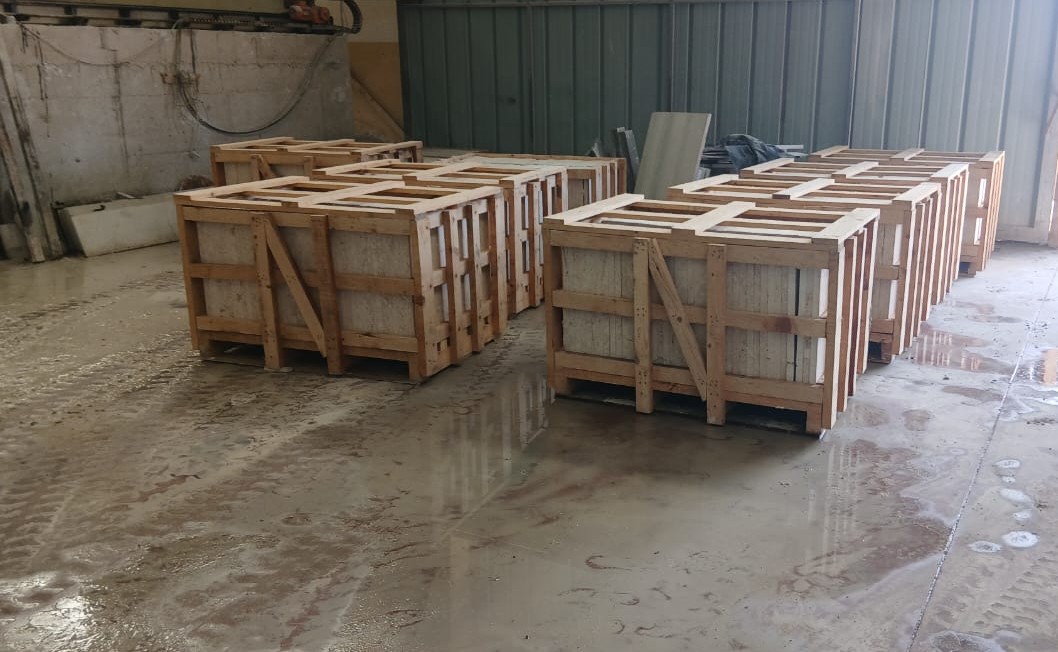
Your delivery plan for a wholesale tile order is as important as the specification itself — and it’s where projects most often lose time and money through poor coordination. Natural stone tile ships palletized, and each pallet of 2cm stone in a standard commercial format (12×24 at 400 square feet per pallet) can weigh between 2,200 and 2,800 pounds. Confirm that your site has truck access for a standard flatbed or liftgate delivery vehicle before the order is placed, because rescheduling a tile delivery around site access problems costs time on both ends.
Warehouse lead times vary by material category and current inventory levels — polished marble in standard formats tends to be readily available, while specialty finishes or less-common large formats may require a 2 to 4 week lead from warehouse to delivery. Confirming warehouse stock before committing to a project timeline isn’t optional — it’s the check that prevents the scenario where a scheduled tile installation sits waiting because material didn’t ship on the expected date. Build at least one week of buffer between your confirmed ship date and your installation start, especially on projects where the tile sequence gates other finish trades.
- Confirm site truck access and unloading equipment before placing a palletized order
- Request a written lead time confirmation from the distributor, not a verbal estimate
- Verify that pallet weights are compatible with your freight elevator or staging area capacity on multi-story projects
- Plan for a minimum 10 percent overage on natural stone tile orders to account for cuts, breakage, and future repairs
- Store pallets in a covered, dry area — moisture exposure before installation can affect adhesive bond performance
Getting Your Wholesale Tile Supply Specification Right
The wholesale tile supply decisions that produce durable, code-compliant, and visually consistent results aren’t made at the point of purchase — they’re made in the specification phase, before any order is placed. Your finish selection needs to align with the functional environment and the slip resistance thresholds required by the application and applicable code. Your format choice needs to account for substrate flatness tolerances, structural load capacity, and any seismic or freeze-thaw considerations relevant to the project conditions. Thickness has to match both the loading demands and the allowable dead load of the floor system. And your sourcing approach — whether from warehouse stock or direct import — needs to align with your actual construction timeline, not the most optimistic version of it. According to USGS dimension stone production and use data, natural stone remains one of the most durable and widely specified finish materials in both residential and commercial construction — but its performance is only realized when the specification gets the technical details right from the start.
As you finalize your wholesale tile supply specification, it’s worth considering how related stone products — including value-priced natural stone options — fit into the broader project budget. Exploring how granite pricing works at volume can open up cost-effective alternatives for secondary spaces within the same project scope. Tile ordered through Citadel Stone ships palletized and calibrated for consistent thickness, reducing lippage during large installations.
Related reading: Granite Remnant Buyers Guide: Smart Small Projects · Granite Countertop Installation: What to Expect · Stabilized vs Loose Decomposed Granite Compared.