What the Difference Actually Means for Your Project
The decomposed vs crushed granite decision trips up more specifiers than almost any other aggregate choice — not because the materials are complicated, but because their performance envelopes overlap just enough to create real confusion. Decomposed granite is a naturally weathered material that breaks down from solid granite into a sandy, fines-rich mixture with particles ranging from coarse sand to small gravel. Crushed granite, by contrast, is mechanically processed quarry stone reduced to angular, uniform aggregate with sharp edges and minimal fines. Both come from the same parent rock, but their behavior in service diverges significantly once they’re placed and loaded.
The distinction matters most when you’re reconciling two competing project demands: surface permeability and structural stability. Decomposed granite compacts into a semi-bound surface that sheds water slowly and handles foot traffic well. Crushed granite drains aggressively and locks under load — which makes it ideal for heavy-use base layers but problematic as a walking surface without a binder. Getting the choice wrong typically shows up within the first wet season, when either your surface washes out or your drainage fails entirely.
Decomposed Granite: Composition and Field Performance
Decomposed granite earns its name honestly — it’s granite that has weathered in place or during processing until the crystalline bonds between feldspar, quartz, and mica have weakened into a granular matrix. The fines content (particles passing a No. 200 sieve) typically runs between 8% and 15%, and that fraction is what gives decomposed granite its characteristic behavior: it compacts under load and moisture to form a cohesive surface that resists displacement far better than a clean aggregate would.
A compacted decomposed granite surface will typically achieve a density in the range of 95–100 lb/ft³ when properly installed, with permeability rates between 2 and 10 inches per hour depending on fines content and compaction effort. That’s permeable enough to handle moderate rainfall without ponding, but slow enough to prevent the rapid undercutting that pure gravels experience. According to NSI granite durability and application data, granite-derived aggregates maintain excellent resistance to degradation under repeated load-moisture cycles, which explains why decomposed granite outperforms softer aggregate options in long-term pathway applications.
- Fines content of 8–15% drives cohesion and compaction performance
- Natural particle gradation reduces segregation during placement and compaction
- Moderate permeability (2–10 in/hr) balances drainage and surface stability
- Slight plasticity index (PI 3–8 typical) means it binds under compactive effort
- Surface hardness varies with the parent granite mineralogy — quartzite-rich sources compact harder
- Color retention is strong because the mineral composition is stable, not dyed or treated
The practical limitation of decomposed granite shows up in high-traffic vehicular applications. Once wheel loads exceed roughly 8,000 lbs per axle, the fines migrate laterally and the surface begins to corrugate. You can extend service life significantly by adding a stabilizing binder — typically a liquid polymer applied at 0.25–0.35 gallons per square foot — but that changes your permeability calculation and your maintenance interval.
Crushed Granite: Composition and Field Performance
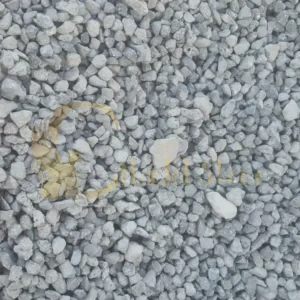
Crushed granite is what you get when quarry-grade granite is mechanically reduced through jaw crushers and cone crushers to a specified gradation. The critical difference from decomposed granite is the particle shape: crushed granite produces angular fragments with fresh, sharp faces that interlock under compactive effort. That angular interlock is the source of its exceptional load-bearing performance, and it’s also why it doesn’t behave like a surface material — the sharp edges are unpleasant underfoot and the low fines content (typically 2–5%) means it won’t bind into a cohesive mat without a stabilizer.
Standard crushed granite specifications for base applications typically call for a gradation conforming to ASTM C615 dimensional stone requirements, with particles sized between 3/4 inch and No. 4 sieve for base course work. The ASTM C615 granite dimension stone standard establishes minimum compressive strength thresholds that crushed granite aggregate readily exceeds — most crushed granite registers compressive strengths above 20,000 PSI at the parent rock level, which translates to exceptional base stability under repeated loading.
- Angular particle shape creates mechanical interlock that resists lateral movement under load
- Low fines content (2–5%) delivers drainage rates exceeding 20 in/hr in clean applications
- High internal friction angle (typically 38–45 degrees) makes it ideal for retaining wall backfill
- Uniform gradation simplifies compaction specification — standard 6-inch lift protocols apply reliably
- Minimal cohesion means it requires containment (edging, geotextile, or binding agent) to stay in place on slopes
- Dust generation during dry periods is a maintenance consideration for residential applications
Crushed granite aggregate suppliers offer several standard gradations, and your selection should be driven by application. A 3/4-inch minus gradation suits most base course applications. A 3/8-inch minus or decomposed granite blend suits topdressing and surface applications. Understanding the gradation distinction before ordering prevents the most common field error: using base-grade crushed granite as a walking surface and discovering it shifts underfoot within the first season.
Application Matching: Which Material Fits Your Use Case
The framework for choosing between decomposed vs crushed granite is simpler than most project teams make it. Define your primary performance requirement first — surface stability for pedestrians, structural bearing for vehicles, or drainage efficiency — then let that requirement drive the specification.
Decomposed granite is the right choice when:
- Your application is a pedestrian pathway, garden walkway, or informal patio surface
- You need a naturalistic, permeable surface that integrates visually with landscape plantings
- The project requires a self-compacting, low-maintenance surface over 3–5 year cycles
- Foot traffic is the primary load type, with occasional light vehicle access
- Your drainage goal is moderate infiltration rather than maximum permeability
Crushed granite is the right choice when:
- You’re building a base course under pavers, slabs, or concrete flatwork
- The application involves vehicular traffic, heavy equipment, or loaded pallet deliveries
- Your design requires maximum drainage performance beneath a surface layer
- You’re backfilling a retaining wall and need high internal friction angle material
- The project budget can accommodate higher material cost per ton for superior structural performance
The hybrid approach — crushed granite base with decomposed granite topdressing — solves both performance requirements simultaneously and is worth specifying on any project where you’re uncertain which material dominates. The base provides structural bearing; the topdressing provides the bound, walkable surface. This approach also extends the life of the topdressing layer because the well-draining base prevents the moisture accumulation that degrades fines-rich surface materials from below.
Installation Timing and Seasonal Considerations
Both materials have installation windows that affect long-term performance in ways most project schedules don’t account for. Decomposed granite compacts best when the material moisture content is between 8% and 12% — a range that occurs naturally in moderate temperatures but requires active management during extreme dry periods or when the material has been sitting in a warehouse or stockpile for extended time. Material pulled directly from covered warehouse storage in dry periods often needs light pre-wetting before compaction to achieve the density required for surface stability.
The practical scheduling implication is that early morning compaction work — before ambient temperatures drive surface moisture below the optimal range — consistently produces better density readings than afternoon work in warm, dry conditions. You’ll typically see a 3–5% density improvement from morning compaction runs compared to afternoon runs under the same compactive effort, which matters when your specification requires 95% modified Proctor density.
- Install decomposed granite during periods of moderate humidity for optimal compaction without pre-wetting
- Avoid placing and compacting in freeze-thaw cycles — frost heave redistributes fines and destroys surface cohesion
- Crushed granite base work is less moisture-sensitive but compacts poorly when frozen — schedule base work before ground freeze
- Allow decomposed granite surfaces to cure under light traffic for 2–4 weeks before opening to full use
- Liquid stabilizer applications require temperatures above 50°F for proper polymer cure — below this threshold, binder performance is unpredictable
- Spring installation after frost exit requires subgrade evaluation — heave-damaged subgrades need recompaction before aggregate placement
The USGS dimension stone production data tracks aggregate supply patterns that reflect real-world delivery logistics — USGS dimension stone production and supply data confirms that granite aggregate availability fluctuates seasonally with quarry output cycles. Planning your truck deliveries and confirming warehouse stock 3–4 weeks before your target installation window is a basic risk-mitigation step that experienced specifiers build into every project schedule, especially for spring installations when demand peaks sharply after the freeze season.
Drainage Performance and Subgrade Interaction
Drainage performance is where decomposed vs crushed granite diverge most dramatically, and the subgrade below your aggregate layer amplifies those differences in ways that aren’t obvious from the material specification alone. Crushed granite over a clay subgrade can actually perform worse than decomposed granite in some drainage scenarios, because the rapid water movement through the clean aggregate layer hits the impermeable clay and creates a perched water table directly beneath your surface. That perched water then destabilizes the aggregate-subgrade interface, leading to rutting and pumping that looks like an aggregate failure but is really a drainage design failure.
Decomposed granite’s slower infiltration rate actually works as a buffer in clay subgrade conditions — it moderates the rate at which water reaches the subgrade, giving the soil’s limited drainage capacity time to process the load. The practical specification response is to match your aggregate choice to your subgrade hydraulic conductivity, not just to your surface loading requirements.
- Over sandy or gravelly subgrades: crushed granite drains without subgrade interaction issues — full performance advantage realized
- Over clay or silty subgrades: consider decomposed granite or add a geotextile separator and subsurface drain with crushed granite
- Perched water table depth should be confirmed by test pit or soil probe before specifying either material in unknown subgrade conditions
- Decomposed granite’s self-sealing behavior under repeated wetting cycles can reduce long-term permeability — plan for periodic scarification and topdressing every 3–5 years
- Crushed granite base layers under impermeable surfaces (concrete, asphalt) must include positive drainage outlets — trapped water under a sealed surface creates frost damage in freeze-thaw regions
Ordering, Logistics, and Project Planning
Granite aggregate is sold by weight, and the tonnage calculations for decomposed vs crushed granite differ because their compacted densities differ. Decomposed granite compacts to approximately 100–110 lb/ft³; crushed granite runs 105–120 lb/ft³ depending on gradation and parent rock density. For a standard 4-inch surface layer of decomposed granite over 1,000 square feet, you’re looking at approximately 14–16 tons of material. Crushed granite for a 6-inch base layer over the same area requires roughly 20–24 tons. Running these calculations before your truck orders are placed prevents the partial-load scenario that stalls projects mid-installation.
For projects specifying crushed granite from Citadel Stone, warehouse stock levels can be confirmed ahead of your delivery window to lock in material availability and avoid the 4–6 week lead times that affect import-sourced aggregates. At Citadel Stone, our technical team regularly reviews fines content and gradation data from incoming aggregate stock, which gives you accurate performance data before material ships rather than after it’s placed.
- Order 10–15% overage for decomposed granite surface applications — compaction loss and waste at edges add up faster than expected
- Confirm gradation certificates with your supplier before delivery — fines content variation between loads affects compaction performance
- Truck access to the placement area determines whether you receive bulk delivery or super-sack pallets — confirm access width and clearance before scheduling
- Stockpile location on site matters: cover stockpiled decomposed granite to maintain consistent moisture content before compaction
- Crushed granite can be stockpiled uncovered without significant quality degradation — clean aggregate is not moisture-sensitive in the same way
Citadel Stone maintains granite aggregate inventory available for nationwide delivery, which typically compresses lead times to 1–2 weeks compared to the longer cycles common with specialty import aggregates. Confirming warehouse availability 3–4 weeks before your target installation date is standard practice for any project where schedule risk is a concern.
Cost Comparison and Value Over Time
Decomposed granite typically costs less per ton than processed crushed granite, but the cost-per-project comparison requires more nuance than a simple material price comparison. Decomposed granite surface installations require periodic maintenance — plan for rescarification and topdressing every 3–5 years at approximately 30–40% of the original installation cost per cycle. Crushed granite base installations are largely maintenance-free once placed under a durable surface layer, and the structural performance benefit extends the service life of whatever surface material sits above it.
The value calculation shifts meaningfully when you account for labor. Decomposed granite installs faster per square foot for surface applications because it self-levels more readily and requires fewer passes with a plate compactor. Crushed granite base work requires more careful lift management — standard practice is 6-inch compacted lifts with density testing between lifts on structural applications — which adds labor time but delivers a base that won’t require remediation for 20+ years under normal loading conditions.
- Decomposed granite: lower material cost, higher lifecycle maintenance cost — best value for low-traffic decorative applications
- Crushed granite: higher material cost, near-zero maintenance cost as a base layer — best value for structural and high-traffic applications
- Stabilized decomposed granite adds 15–25% to material cost but extends maintenance intervals to 7–10 years
- Factor in subgrade preparation cost — poor subgrades increase base material requirements for crushed granite applications significantly
- Granite aggregate from domestic quarry sources generally costs 10–20% more than imported alternatives but eliminates the supply chain risk and lead time variability that affects project scheduling
Professional Summary
The decomposed vs crushed granite choice comes down to a clear performance hierarchy: surface applications with moderate traffic demand belong to decomposed granite, and structural base applications with any vehicular loading belong to crushed granite. The confusion in the market exists because both materials are sold as “granite aggregate” by many granite aggregate suppliers without adequate gradation disclosure — always request a gradation certificate and fines content percentage before placing an order. Those two data points tell you more about actual field performance than any product description.
Your specification should also account for installation timing, subgrade conditions, and long-term maintenance tolerance before selecting a material. The projects that perform well over 15–20 year horizons are the ones where the material selection was matched to the full set of field conditions — not just the surface loading requirement. If your project involves a natural stone surface above the aggregate layer, reviewing how granite slab dimensions and seam placement interact with your base preparation is a useful next step — granite slab sizing and seam planning covers those specification details in practical terms. For projects where drainage and surface stability both matter, Citadel Stone can walk you through the fines content and grading differences between its granite aggregate options.