

What Circular Layouts Actually Deliver
Round paver stones demand a fundamentally different planning approach than rectangular grid layouts — and the projects that get it right start with pattern logic, not material selection. The geometry of a circular or arc-based layout creates natural focal points that rectangular grids simply can’t replicate, anchoring a patio, courtyard, or garden path in a way that reads as intentional and finished rather than filled. Your first decision isn’t which stone to use — it’s whether you’re building a full radial medallion, a series of concentric rings, or a transitional fan pattern that blends into a larger rectangular field.
The distinctions between these approaches matter more than most project briefs acknowledge. A full radial medallion works beautifully as a standalone centrepiece but creates awkward cuts at the perimeter unless you plan for a rectangular border course from the start. Concentric ring layouts, by contrast, allow more flexible perimeter integration, particularly when you’re working with mixed diameters. Understanding this before you commit to a pattern saves significant labour — and material waste — downstream.
Circular Paver Pattern Types Worth Considering
The range of circular paver patterns available to you is broader than most visual references suggest. Here’s a breakdown of the four main approaches and where each performs best:
- Radial medallion: Pieces radiate outward from a single central point, creating a sunburst or compass-rose effect — best for standalone patios and courtyard centrepieces
- Concentric ring layout: Multiple diameter rings built outward from a centre, with grout joints following the curve — suited for large format areas where the pattern needs to read from above
- Fan or sector pattern: Arc segments arranged around a partial curve, ideal for transitional areas between a curved path and a rectangular terrace
- Organic scatter layout: Mixed-diameter pieces placed in a naturalistic arrangement without strict geometry — works well for informal garden paths where a purely circular aesthetic isn’t the goal
Your choice between these circular paver patterns depends on the viewing angle, the area’s dimensions, and how the stone edges will be managed at perimeter transitions. A radial medallion in a 12-foot-diameter patio reads completely differently from the same pattern in a 6-foot entry landing, even using identical pieces. Scale the pattern to the space before you commit to a material order.
Stone Selection for Round Paver Projects
Material choice for round paver stones isn’t purely aesthetic — the stone’s working properties directly affect how cleanly it cuts to curve, how well it holds a tight joint in a radial layout, and how it performs over time at the perimeter edges. Limestone is among the most practical choices for circular work because its consistent grain structure allows clean radial cuts without the micro-fracturing you’ll sometimes see in more crystalline stones. According to NSI limestone technical specifications, limestone’s compressive strength and workability make it one of the most widely specified natural stones for custom patterned paving.
Tumbled finishes are particularly well-suited to organic scatter layouts, where the slightly irregular edges create a more natural visual flow between pieces. Honed finishes, on the other hand, produce crisper joint lines that make a radial medallion read with more precision. Your finish selection is, in effect, a pattern-clarity decision as much as a texture preference.
At Citadel Stone, we regularly work with project teams specifying round paver stones for both residential and commercial applications, and the material questions that come up most often centre on thickness consistency across a mixed-diameter pack — because circular layouts require level-plane accuracy across pieces of different sizes, and inconsistent thickness is the most common source of lippage in finished circular installations.
3 Piece Paver Patterns and How They Work
3 piece paver patterns are particularly effective for circular work because the size variation within the set naturally resolves the geometric challenge of filling curved space without excessive cutting. A typical three-piece set pairs a large-format anchor piece with two progressively smaller companions — and in a radial layout, the smaller pieces fill the tighter inner rings while the larger pieces carry the outer courses where circumference expands. This is a practical engineering solution, not just an aesthetic one.
The critical specification detail with three-piece sets is the size ratio between the largest and smallest piece. A ratio greater than roughly 2.5:1 between the primary and smallest piece creates irregular joint-width variation that undermines the pattern’s visual coherence. Tighter ratios — closer to 1.8:1 — produce more consistent joint widths as you move through the radial courses, which is the difference between a pattern that looks designed and one that looks assembled.
For projects sourcing Citadel Stone circular paving pieces, verifying that mixed-diameter packs maintain tight thickness tolerances across all three sizes is worth confirming before your truck delivery arrives on site — lippage caused by thickness variation is difficult to correct after setting.
Limestone Rock Wall Integration with Circular Paving
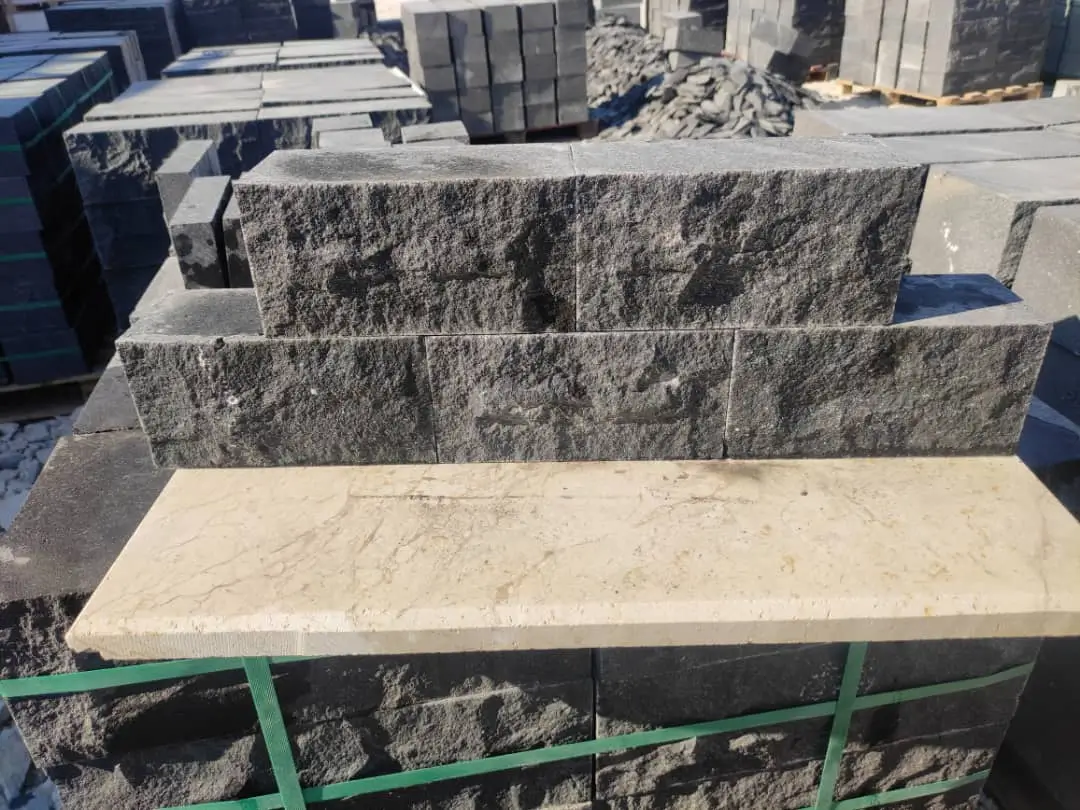
A limestone rock wall used as a border or retaining element around a circular paved area does more than define the edge — it creates a unified stone language across horizontal and vertical planes that significantly elevates the finished result. The challenge is that the curved geometry of a round paved area creates a variable joint condition at the wall base, particularly where the paving radius meets a straight wall run. Planning this junction in advance — with a defined transition course — prevents the improvised gap-filling that undermines otherwise well-executed circular layouts.
The ASLA permeable surfaces guidance reinforces an important design principle here: where circular paving meets a vertical wall element, drainage management at the junction is critical to long-term performance. Circular layouts funnel water outward from the centre, and a poorly detailed wall base can create ponding at the perimeter that saturates the bedding layer over time.
- Plan a 1% minimum fall away from the wall base across the paved surface
- Use a compacted aggregate drainage course beneath the outer ring courses where wall proximity concentrates water flow
- Detail the base of the limestone rock wall above finished paving level to prevent moisture tracking up into the wall material
- Use matching or complementary stone between the wall and paving field for visual continuity
Edge Restraint and Storm Performance
Circular layouts are more vulnerable to edge failure under storm conditions than rectangular grids, and this is an installation detail that deserves more attention than it typically receives. The radial joint geometry means there’s no continuous straight-line bond at the perimeter — each outer-course piece bears on a different axis, which reduces the collective resistance of the perimeter ring to lateral displacement under wind-driven rain saturation or rapid freeze-thaw cycling.
Specifying a continuous rigid edge restraint — steel or aluminium landscape edging pinned at 12-inch centres minimum — around the full circumference of a circular installation is non-negotiable for long-term performance. For larger installations (over 15 feet in diameter), consider a concrete haunch at the outer perimeter buried below finished grade, which converts the edge-restraint function from a surface detail to a structural one. This is particularly relevant in regions subject to hail and severe storm events, where hydrostatic pressure from rapid water infiltration can migrate laterally through an inadequately restrained perimeter and displace outer-ring pieces.
Joint integrity under wind-driven rain is the second performance variable worth addressing directly. Polymeric sand, properly activated, creates a semi-rigid joint that resists water infiltration more effectively than conventional jointing sand — ASTM stone and material testing standards provide the dimensional stone performance benchmarks that inform joint specification for exposed outdoor paving. Reactivate polymeric sand joints after any significant storm event where scouring has visibly reduced joint depth below the upper stone surface.
Installation Sequence for Circular Layouts
The installation sequence for round paver stones differs from rectangular field paving in one critical way: you set the centre first and work outward, not from an edge inward. This sounds obvious, but on-site it’s frequently reversed by crews accustomed to rectangular work — and once you’ve laid a partial outer ring before locking in the centre medallion, the cumulative error across radial joints compounds quickly.
- Establish the exact centre point and mark it permanently before any bedding work begins
- Set the centre medallion or hub piece first, levelled to finished-surface elevation
- Build outward in complete rings, checking radial alignment at every fourth course
- Pre-lay each ring dry before setting to identify cut-adjustment needs early
- Cut the perimeter transition pieces last, after the full circular field is locked in
- Activate edge restraint before introducing any vibration compaction — compaction without edge restraint displaces outer-ring pieces outward
Bed preparation for circular layouts should use a screeded sand bed at consistent 1-inch depth. Avoid the temptation to build up thicker sand beds under the smaller inner-ring pieces to compensate for thickness variation in the stone — this creates differential settlement that defeats the entire levelling exercise. Consistent stone thickness from the warehouse is the upstream fix; compensating with variable bed depth is the downstream problem you don’t want.
Sizing and Ordering Logistics
Ordering round paver stones for a circular layout requires calculating coverage differently than for rectangular field paving. Because radial layouts involve cut pieces, particularly at perimeter transitions and where circular fields meet rectangular borders, you should add a 12–15% waste allowance above your calculated area — higher than the standard 8–10% used for rectangular grid work. For 3 piece paver patterns and other multi-size configurations, order by area coverage target rather than by piece count, and confirm with your supplier that the size ratio within the pack matches your pattern specification.
Citadel Stone holds warehouse inventory across common circular-paving stone types, which typically brings lead times to 1–2 weeks for stocked material rather than the extended import cycle that project-specific fabrication requires. Confirm truck access at your delivery site in advance — mixed-diameter packs for circular work tend to arrive on pallets with irregular stacking heights that require adequate overhead clearance and a firm surface for pallet jack operation.
What Matters Most with Round Paver Stones
The variables that separate a lasting circular installation from one that requires remediation within five years come down to three decisions made before the first stone is set: pattern logic matched to the space’s scale, edge restraint specified as a structural detail rather than an afterthought, and stone sourced with consistent thickness across all diameter sizes in the pack. Every other variable — finish, colour, jointing compound — is secondary to getting those three right. Your pattern choice also determines how the stone reads under maintenance: a radial medallion with tight joints in a honed limestone will show differential weathering at outer rings before inner rings, which is worth factoring into your long-term maintenance planning if uniformity of appearance is a client priority.
As you broaden your hardscape specification work, different stone types and formats open additional design possibilities worth understanding. Yorkstone paver sizes and applications offer another dimension of natural stone paving to consider for projects where a more rectilinear aesthetic complements or borders circular features. Sourced from premium quarries in Turkey and the broader Middle East region, round paver stones ship in mixed-diameter packs.
Related reading: cobblestone pavers vs natural stone · limestone cobblestone paving patterns · limestone paver base preparation.