

Basics of sound behavior with hard natural stone
Understanding how sound interacts with stone surfaces is essential for acoustic specification. When sound waves strike hard limestone, four phenomena occur:
Reflection is the primary response—dense surfaces bounce sound back into the room rather than absorbing it, potentially increasing reverberation time. Absorption occurs when porous materials convert sound energy into heat through friction. Low-porosity stones like White Pearl have minimal void space, limiting absorption. Scattering happens when surface texture redirects sound in multiple directions, reducing problematic echoes without reducing total energy. Transmission refers to sound passing through material into adjacent spaces; massive, dense limestone blocks airborne sound effectively when properly sealed.
Frequency matters. Low frequencies (below 250 Hz) require thick barriers or tuned absorbers. High frequencies (above 2,000 Hz) are more easily scattered by texture and absorbed by thin porous materials. Dense limestone reflects most frequencies but can scatter highs if textured.
Standard tests quantify these behaviors: ASTM C423 measures sound absorption and generates absorption coefficients and Noise Reduction Coefficient (NRC). ASTM E90 measures airborne transmission loss, producing Sound Transmission Class (STC) ratings. ASTM E492 and E989 measure impact insulation for floors, yielding Impact Insulation Class (IIC) ratings. Verify testing labs hold ISO/IEC 17025 accreditation.
How White Pearl limestone typically performs
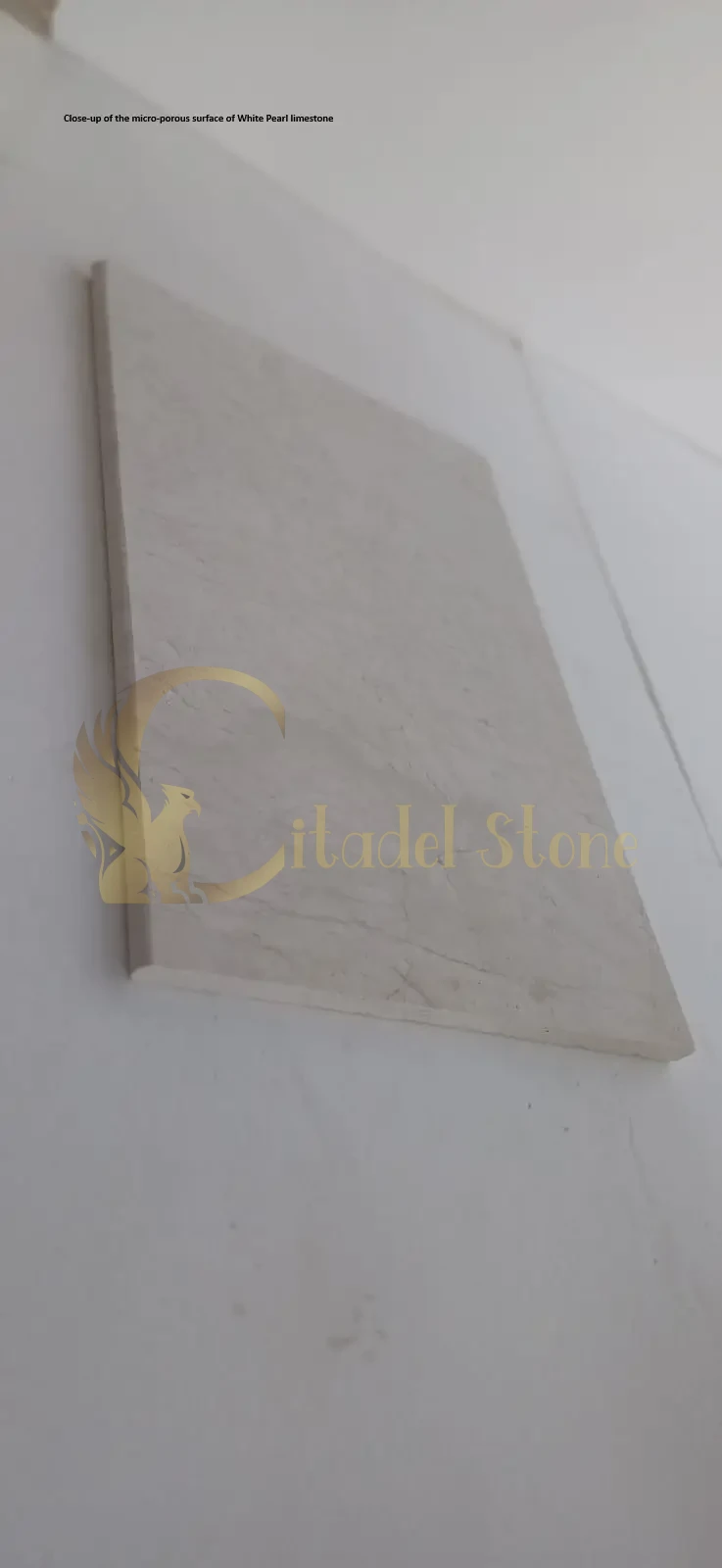
White Pearl is a dense, fine-grained stone with low porosity, dictating its acoustic behavior:
Sound absorption: White Pearl exhibits low absorption across frequencies due to its tight crystalline structure. Expect reflection to dominate, particularly at mid and high frequencies. This makes it unsuitable as a primary absorptive material but effective where sound reflection is desired or where visual elegance outweighs absorption needs.
Finish effects: Polished White Pearl reflects sound with minimal scattering, potentially creating flutter echoes. Honed finishes reduce gloss but remain relatively smooth. Textured finishes—flamed, brushed, or carved—scatter high frequencies, softening harshness and improving speech intelligibility. For acoustically sensitive spaces, specify honed or textured over polished.
Thickness and format: Thin cladding reflects sound but contributes little mass for isolation. Thick pavers add mass that improves transmission loss in sealed assemblies. Large-format slabs minimize joints, reducing flanking paths where sound leaks through gaps.
| Format/Finish | Expected Acoustic Behavior | Practical Implication |
|---|---|---|
| Polished thin cladding | High reflection; specular echoes | Use as feature surfaces; pair with absorbers |
| Honed thick pavers | Moderate reflection; low absorption | Better than polished; requires absorptive complements |
| Textured wall cladding | Reflection with high-frequency scattering | Improves speech clarity; reduces flutter echo |
| Large-format slabs (sealed) | High reflection; good mass for transmission | Effective for sound isolation between spaces |
White Pearl is not absorptive, but when combined with strategic treatments, it delivers elegance without compromising acoustic performance.
Tests & standards specifiers should request
Informed specification requires documented performance. Request these test reports from Citadel Stone:
| Test | Standard | What It Measures | When to Require It |
|---|---|---|---|
| Sound Absorption | ASTM C423 / ISO 354 | Absorption coefficients by octave band; NRC | Projects where reverberation control is critical |
| Airborne Transmission Loss | ASTM E90 / ISO 10140 | Sound Transmission Class (STC) | Walls/floors separating spaces requiring privacy |
| Impact Insulation | ASTM E492 + E989 / ISO 10140 | Impact Insulation Class (IIC) | Floor assemblies in multi-story buildings |
| Reverberation Time | ISO 3382 / ASTM E2235 | Room reverberation time (RT60) | Post-installation verification in completed spaces |
What to request on test reports:
- Sample description: finish, thickness, edge treatment
- Mounting details: specimen size, backing, air cavity depth
- Octave-band data at 125, 250, 500, 1000, 2000, 4000 Hz
- Test lab ISO/IEC 17025 accreditation
- Test date, report number, specimen photographs
Top 6 documents to request:
- Acoustic Technical Data Sheet (TDS)
- Full lab test reports from accredited facilities
- Sample description matching project specifications
- Mounting and installation details used during testing
- Batch identification linking test specimens to delivered material
- Mock-up approval protocol with acceptance criteria
Do not accept generic claims without lab documentation. Acoustic performance is assembly-dependent—the same stone performs differently on concrete versus resilient channels with air cavities.
Mitigation strategies — how to use White Pearl in quiet interiors
Deploy these strategies to achieve acoustic comfort with White Pearl:
1. Pair reflective stone with distributed absorptive materials
Combine White Pearl with acoustic ceiling clouds, fabric-wrapped panels, upholstered seating or heavy drapery. Position absorbers to interrupt reflection paths between parallel hard surfaces.
Best for: Libraries, galleries, hotel lobbies, offices
2. Specify textured or honed finishes over polished
Surface texture scatters high frequencies, reducing flutter echoes and slap-back. Honed finishes offer middle ground—less reflective than polished but easier to clean than heavily textured.
Best for: Hotel corridors, residential bathrooms, dining areas
3. Decouple cladding with absorptive backing
Mount White Pearl on resilient channels with air cavity and absorptive insulation (mineral wool, fiberglass) behind the stone. This improves both absorption and transmission loss through mass-air-mass assembly.
Best for: Hotel guest rooms, private offices, residential bedrooms
4. Increase mass and seal joints for airborne isolation
Use thick-format White Pearl in continuous, sealed assemblies. Seal all penetrations and perimeter gaps with acoustical sealant. Add mass-loaded vinyl if transmission targets are aggressive.
Best for: Partition walls, corridor walls, exterior facades
5. Use large-format slabs with controlled jointing
Large-format slabs minimize joint density and present more continuous surfaces, reducing flanking paths and simplifying maintenance.
Best for: Feature walls, continuous floor runs, high-visibility applications
6. Zone reflective and absorptive surfaces strategically
Designate limestone for focal features—fireplace surrounds, accent walls, thresholds—and use absorptive materials elsewhere. This delivers visual impact without acoustic overload.
Best for: Residential living rooms, boutique hotel lounges, gallery entries
Design examples & recommended assemblies
Quiet reading room (library)
Assembly: White Pearl honed wall cladding on one accent wall, mounted on resilient channels with mineral wool cavity. Complement with acoustic ceiling tiles, carpet and fabric-wrapped panels on remaining walls.
Finish: Honed to reduce glare.
Acceptance: Pre/post reverberation time measurement by acoustical consultant.
Boutique hotel guest room
Assembly: White Pearl textured cladding as bathroom feature wall; bedroom walls use gypsum with upholstered headboard wall. Floor assembly includes thick pavers over sound mat.
Finish: Brushed texture to scatter bathroom echo.
Acceptance: Mock-up tested for STC and IIC compliance; witness tests between adjacent rooms.
Art gallery wall
Assembly: Large-format White Pearl honed slabs as primary wall surface, complemented by suspended fabric baffles and carpet zones.
Finish: Honed for soft elegance.
Acceptance: In-situ reverberation testing mid-construction; adjust baffle density before artwork installation.
On-site testing & mock-up workflow
- Request pre-installation lab reports from Citadel Stone with ISO/IEC 17025 accreditation
- Produce full-size mock-up panel (minimum 4 × 8 feet) with specified stone, mounting and backing
- Perform baseline acoustic measurement by licensed acoustical consultant (reverberation time, background noise, transmission between spaces)
- Compare results to design targets — evaluate if mock-up meets project criteria; document with calibrated equipment
- Adjust finishes or assembly if needed — modify finish, add backing, increase air cavity or introduce supplemental panels; retest
- Obtain written acceptance — owner, architect and consultant sign off; mock-up establishes standard of acceptance
- Verify batch consistency — confirm delivered stone matches approved mock-up finish and thickness
- Conduct post-installation verification — final measurements confirm installed performance matches mock-up
Responsibility: Acoustical consultant conducts measurements; installer executes per approved details; architect/owner approves; Citadel Stone provides technical support.
Spec language & acceptance criteria (Template / non-legal)
TEMPLATE / NON-LEGAL SPECIFICATION SNIPPET
3.3 ACOUSTIC PERFORMANCE REQUIREMENTS
A. Testing & Documentation: Furnish White Pearl limestone with documented acoustic performance tested by an ISO/IEC 17025-accredited laboratory:
- Sound absorption: ASTM C423 or ISO 354
- Airborne transmission (if applicable): ASTM E90 or ISO 10140
- Impact insulation (floors): ASTM E492 + E989 or ISO 10140
B. Submittal Requirements: Submit before fabrication:
- Laboratory test reports with octave-band data
- Technical Data Sheet with acoustic performance summary
- Sample description: finish, thickness, mounting details
- Test specimen photographs
- Batch identification linking specimens to material lot
C. Mock-up & Verification: Fabricate and install mock-up panel of not less than 32 square feet demonstrating specified assembly. Engage Owner’s acoustical consultant to measure performance. Obtain written approval before bulk fabrication.
D. Installation Assembly: Install per approved mock-up details. Maintain continuous acoustical sealant at perimeters, penetrations and control joints.
E. Acceptance Criteria: Installed assembly shall achieve acoustic performance within acceptable range of approved mock-up as verified by post-installation testing.
Limestone Pavers — How we would specify for USA states
Natural stone pavers are prized for a neutral, light-reflective palette that helps reduce surface heat in sunny climates. The short, hypothetical notes below offer city-level specification thinking for a range of Florida locations — intended purely as guidance for designers and specifiers, not as descriptions of completed work.
Orlando
Orlando’s inland location brings extended humidity, frequent summer thunderstorms and strong solar exposure; salt spray is minimal but flash flooding and rapid wet/dry cycles matter, and freezes are only occasional. For Orlando we would specify white limestone tiles with low water uptake and colour stability under UV, selecting a fine textured or lightly honed finish to limit glare while improving traction when wet. Typical thickness guidance could be 20–30 mm for pedestrian terraces and 30–40 mm for light vehicle access, with subbase detail confirmed by engineers. The natural stone supplier could provide samples, technical datasheets, specification support and palletised delivery to help with mockups, tender documents and early testing.
Daytona Beach
Daytona Beach faces oceanic salt aerosol, high insolation and surge risk during severe weather; persistent humidity and hurricane-season planning are material factors while freezes remain unlikely. For Daytona Beach we would recommend white limestone pavers with tightly controlled porosity and a brushed or lightly textured surface to improve grip in wet conditions; honed options could be reserved for covered or sheltered spaces. Use the general 20–30 mm for patios and 30–40 mm for light vehicle areas as a starting point, and specify runoff, sealing and stain-control measures. The stone supplier could supply samples, technical datasheets, specification support and palletised delivery on request to support specification workshops and site trials.
Fort Myers
Fort Myers experiences Gulf Coast salt exposure, intense summer sun and sustained humidity, with seasonal storm risk and rare cold snaps to consider. For Fort Myers projects we would advise specifying white limestone flooring with proven low absorption and a textured surface for pool surrounds, promenades and terraces, while offering honed faces for sheltered lounges. As a typical guideline suggest 20–30 mm for pedestrian uses and 30–40 mm for light vehicle passages; include jointing and drainage notes for heavy rainfall events. The best stone supplier could make samples available, supply technical datasheets, offer specification support and arrange palletised delivery tailored to local logistics.
Cape Coral
Cape Coral’s extensive waterways elevate salt aerosol and tidal moisture exposure, combined with hot summers and steady humidity; hurricane resilience is a planning priority and frost is uncommon. For Cape Coral we would suggest white limestone paving tiles with consistent low porosity and a textured profile where frequent wetting is expected, keeping smooth honed variants for covered courtyards. Apply general thickness ranges of 20–30 mm for pedestrian finishes and 30–40 mm for occasional light vehicle access, and detail falls to accelerate drainage. The stone provider could prepare samples, provide technical datasheets, assist with specification support and offer palletised delivery to staging areas as required.
Melbourne
Melbourne’s Atlantic-side conditions bring salt-laden breezes, strong sun and high humidity; resilience to UV and tropical storms should inform finish selection and maintenance planning. In Melbourne we would favour white limestone outdoor tiles with stable low absorption and select finishes to match exposure — textured or brushed for exposed decks, honed for shaded courtyards — following a 20–30 mm guideline for pedestrian areas and 30–40 mm for light vehicle zones. Include sealer and cleaning recommendations in the specification to protect appearance. The supplier could provide samples, technical datasheets, specification support and palletised delivery to help with prototypes and approvals.
Gainesville
Gainesville’s inland position brings humid summers, intense convective downpours and a slightly greater seasonal variability — including a marginally higher chance of rare cold snaps than the far southern coast. For Gainesville we would recommend white outdoor pavers with low water uptake and finishing choices aligned to use — textured surfaces for poolside safety, honed faces for canopied terraces — with typical 20–30 mm for patios and 30–40 mm for light vehicle ways. Reference freeze-susceptibility testing where marginal risk exists. The supplier could supply samples, technical datasheets, specification support and palletised delivery to assist tendering and sample evaluation.
Across these varied locations, common specification priorities would be to choose stone with limited water uptake and documented resistance to salt exposure, select finishes appropriate to wet or covered settings, and detail joints, falls and drainage to shed water quickly. Include simple maintenance regimes and compatible sealer recommendations in specification documents, and always coordinate subbase and load-bearing design with geotechnical or structural advisers for trafficked areas. Where projects are coastal, it would be sensible to request independent chloride or salt-spray test data and to include recommended cleaning and maintenance regimes to reduce biological growth in shaded, humid locations. The supplier could also provide test certificates, finish and format samples, templating help and delivery options adapted to site needs.
Practical trade-offs — aesthetics vs acoustic comfort
Reflective stone surfaces amplify light, create spaciousness and convey luxury—but can create acoustic discomfort. The key is recognizing that not every surface must be absorptive. Acoustic design targets balanced reverberation, not zero reflection.
Strategies for balancing aesthetics and acoustics:
- Feature zoning: Use White Pearl on a single focal wall while treating remaining surfaces with absorptive materials
- Mixed material palettes: Combine limestone with wood, fabric, acoustic plaster or perforated panels
- Selective polishing: Reserve polished finishes for small areas; use honed or textured on large expanses
- Ceiling treatments: Keep limestone on walls for visual impact; reserve ceilings for acoustic panels
- Furniture and soft goods: Specify upholstered seating, area rugs and drapery to offset hard surfaces
Communicate acoustic goals early. If clients desire extensive limestone in libraries or hotel rooms, set realistic expectations about supplemental treatments required. Show precedent images where stone and absorption coexist successfully.
FAQs — short answers
Will polishing worsen acoustics?
Yes, slightly. Polished finishes create more specular reflection and flutter echoes than honed or textured finishes. For quiet spaces, specify honed or textured White Pearl.
Can stone walls alone keep a room quiet?
Not entirely. Massive stone walls provide good sound isolation (blocking external noise) but don’t absorb sound within the room. You’ll still need absorptive treatments for reverberation control.
Do wall-mounted stones reduce reverberation?
No, unless the stone is thin and mounted on a decoupled assembly with absorptive backing. Standard hard-mounted cladding reflects sound and increases reverberation.
Is White Pearl suitable for recording studios?
Generally no. Recording studios require high absorption and diffusion, not reflection. If limestone must be used aesthetically, limit it to small accent zones.
Can I use limestone flooring in quiet spaces?
Yes, if the floor assembly includes adequate impact insulation (sound mat, resilient underlayment) and the room includes ceiling and wall absorbers. Test the full assembly for IIC compliance.
How do I know if my project needs acoustic testing?
Consult an acoustical engineer if your project includes adjacent spaces requiring privacy, spaces where speech intelligibility is critical, or spaces where reverberation affects comfort.
What’s the difference between sound absorption and sound blocking?
Absorption reduces sound energy within a room (controls echo). Blocking prevents sound transmission between rooms (maintains privacy). Dense limestone is better at blocking than absorbing.
Do textured finishes compromise cleanability?
Yes, moderately. Deeper textures trap soil and require more frequent maintenance. Honed finishes offer a middle ground for most applications.
Conclusion & Citadel Stone CTA
The acoustic properties white pearl limestone make it naturally reflective, but with informed specification and strategic design, it performs beautifully in quiet interiors. Success requires understanding the interplay between stone finish, mounting assembly and complementary acoustic treatments, supported by documented lab testing and mock-up verification. Citadel Stone provides the acoustic TDS, lab reports and technical consultation you need to specify White Pearl limestone with confidence in acoustically sensitive projects. Request acoustic test data, order a mock-up assembly, or schedule a briefing with our technical team to explore how White Pearl can deliver both elegance and acoustic comfort.