Surface finish determines more about a travertine installation’s long-term performance than almost any other specification decision — yet most projects treat it as an aesthetic afterthought. This travertine stone texture guide goes deeper than “honed is smoother than tumbled.” Each finish category changes the stone’s absorption rate, slip resistance, thermal behavior, and maintenance interval in ways that cascade through your entire project spec. Understanding those relationships is what separates a 25-year installation from one that starts showing problems in year seven.
What Travertine Texture Actually Means Technically
Travertine’s pore structure is the foundation of every texture conversation. The material forms through rapid precipitation of calcium carbonate in spring and river environments, which creates interconnected voids — some microscopic, some large enough to see — distributed unevenly through each slab. Your finish choice doesn’t just change the surface appearance; it determines how those voids behave under foot traffic, water infiltration, and thermal cycling.
A polished finish closes the surface pores mechanically through progressive abrasion, producing a reflective face that dramatically slows moisture ingress. A split-face or cleft finish, by contrast, exposes raw internal geology — every pore, void, and crystal formation is active and open. Between those extremes, you have honed, brushed, tumbled, and sandblasted finishes, each representing a different trade-off between surface openness and practical utility.
The absorption coefficient shifts significantly across finish types. Polished travertine typically absorbs at 0.5–2% by weight under ASTM C97 testing conditions. Tumbled and split-face surfaces can reach 4–8% absorption on the same block, depending on void density and fill treatment. That difference matters enormously for sealer selection, freeze-thaw performance, and staining resistance — particularly in outdoor applications where you can’t control what contacts the surface.
Honed Travertine: The Specification Workhorse
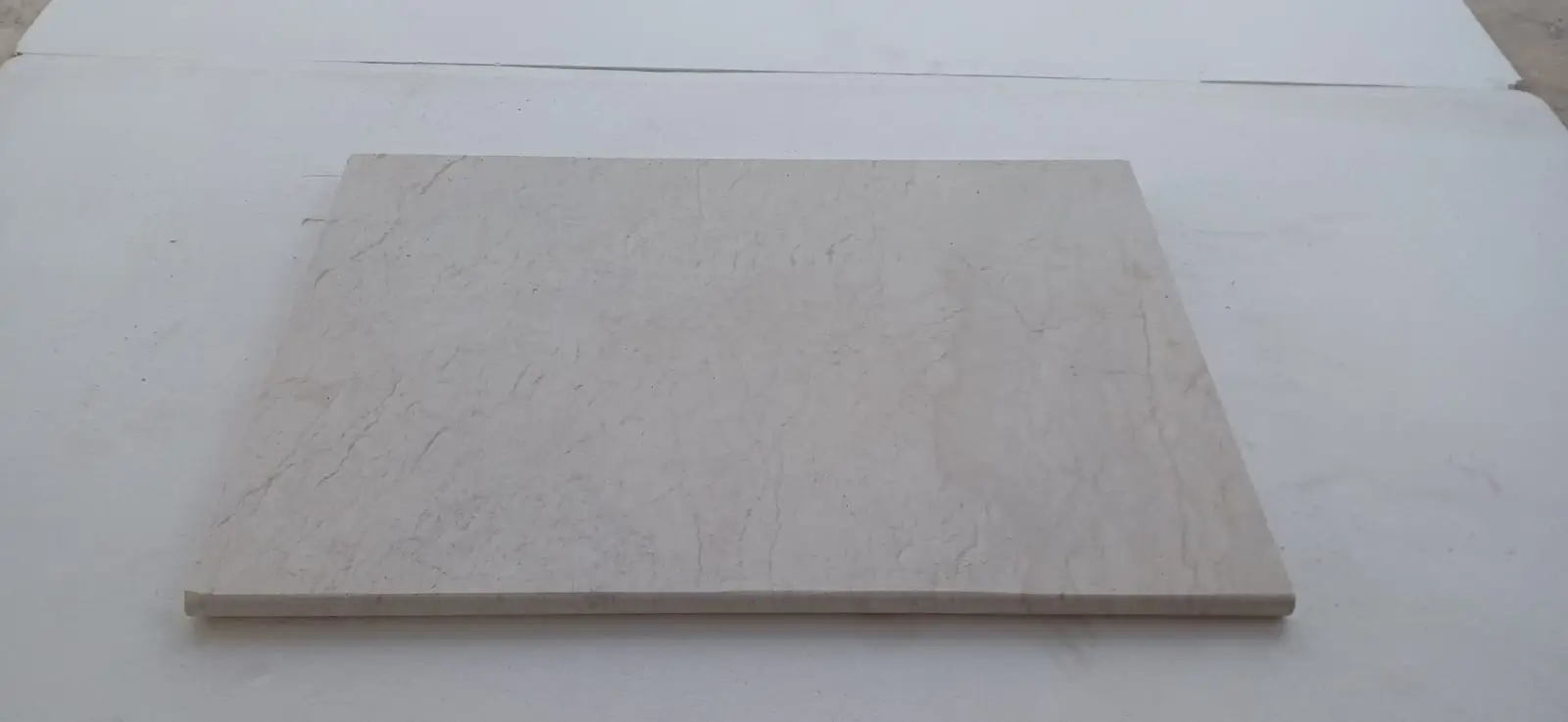
Honed travertine sits in the sweet spot for most interior and covered exterior applications. The surface is ground flat and smooth without the final buffing passes that produce a polished sheen, leaving a matte to low-sheen face that’s far more forgiving in wet or high-traffic conditions than polished alternatives. You get a surface that reads refined without demanding the maintenance schedule that polished travertine requires.
From a slip-resistance standpoint, honed travertine with unfilled voids typically registers a Dynamic Coefficient of Friction between 0.50 and 0.65 when tested dry — adequate for most interior applications. When the surface is wet, that number drops, which is why specifying honed travertine for pool surrounds or shower floors without texture additive in the sealer is a mistake you’ll hear about quickly. For high-moisture zones, consider whether a more textured finish would serve the application better before committing to honed.
Honed surfaces also respond well to penetrating sealers, which is the preferred sealer type for travertine in most situations. The slightly open surface allows the sealer to penetrate several millimeters into the stone rather than sitting on top, giving you genuine stain protection rather than a surface film that scratches and peels. Reapplication every 18–24 months is realistic for most interior honed applications; outdoor honed travertine in full sun exposure may need resealing annually.
- Best for: indoor flooring, wall cladding, countertops, covered outdoor areas
- Maintenance interval: 18–24 months interior, 12 months exposed exterior
- Sealer type: penetrating impregnator, solvent or water-based
- COF dry: 0.50–0.65 depending on void density and fill type
- Void treatment: fill with grout or epoxy for high-traffic applications
Tumbled Stone Travertine: Aged Character With Practical Advantages
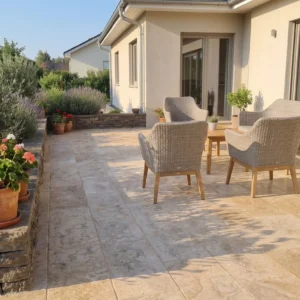
Tumbled stone travertine is produced by loading cut pieces into a drum or barrel and mechanically abrading them against each other and aggregate media. The process rounds edges, softens corners, and introduces micro-scale surface relief that mimics centuries of natural weathering. The result reads as genuinely antique — and that aesthetic has made tumbled travertine the default choice for Mediterranean, Tuscan, and Old World landscape styles.
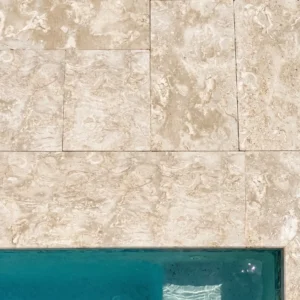
The practical advantages are real, not just aesthetic. Rounded edges mean you’re not chipping sharp corners under foot traffic or furniture loading, which is the most common physical damage mode in standard-edge travertine installations. The textured surface provides substantially better slip resistance than honed finishes, with dry COF values often exceeding 0.70, making tumbled stone travertine a defensible choice for pool decks, outdoor patios, and other wet-exposure areas where slip risk is a liability consideration.
According to Natural Stone Institute travertine properties and outdoor suitability, travertine’s open-pore structure and natural absorption characteristics make tumbled finishes particularly well-adapted for outdoor conditions where surface drainage and texture retention matter across seasonal cycles. That performance profile is why tumbled stone travertine remains the top-specified finish for pool surrounds and resort-style outdoor living spaces across varied climate zones.
One detail worth noting: tumbled travertine typically ships unfilled, meaning the surface voids are open. For pool surrounds and outdoor patios, you’ll want to discuss fill treatment with your installer before sealing. Leaving voids open allows water infiltration that can accelerate surface degradation in freeze-thaw regions — filling with epoxy grout before sealing adds a meaningful service life extension.
Brushed and Antique Finishes: Texture Depth With Controlled Surface
Brushed travertine starts as a honed or sawn surface, then passes through mechanical wire or diamond brushes that scratch linear texture into the face without removing significant material. The result is a surface with directional grain, good slip resistance, and a weathered look that stops short of the rounded, fully aged appearance of tumbled stone. It’s a strong middle-ground choice when you want texture performance without losing the square edges and consistent geometry that tumbled pieces sacrifice.
Antique-finish travertine uses acid washing as a final step to etch and open the calcium carbonate surface slightly, enhancing natural color variation and producing a soft patina. This finish works well in traditional design contexts and pairs naturally with aged-look mortars and jointing compounds. From a performance standpoint, the acid treatment leaves the surface slightly more porous than brushed alone, so sealer application timing and type become more critical — always allow full cure after acid treatment before applying any penetrating sealer.
- Brushed COF dry: 0.65–0.75, making it suitable for most exterior applications
- Directional texture means installation orientation affects slip performance — specify perpendicular to primary traffic direction
- Antique finish: allow 72-hour minimum cure after acid treatment before sealing
- Both finishes maintain square edges, simplifying grouting and pattern work
- Color variation is amplified by brushing and acid treatment — expect more batch-to-batch variation than honed or polished
Travertine Split-Face Stone Texture for Vertical Applications
Split-face travertine is created by mechanically cleaving the stone along its natural bedding planes, exposing raw interior geology. The resulting surface is dramatically three-dimensional — you’re looking at actual stone cross-section rather than a processed face. Projection depth on travertine split-face stone panels typically ranges from 0.75 to 2.5 inches across a single piece, creating shadow lines and visual weight that no other finish can replicate.
This finish is almost exclusively specified for vertical applications: feature walls, exterior cladding, fireplace surrounds, landscape retaining wall faces, and accent columns. Using split-face material on horizontal walking surfaces creates unacceptable trip hazards and water pooling — don’t let a client push you toward it for patio applications regardless of the aesthetic appeal. The dimensional variation that makes it spectacular on walls makes it genuinely dangerous underfoot.
Installation of split-face panels requires mechanical anchoring in most exterior applications, particularly for panels exceeding 4 square feet. Adhesive-only installation on exterior vertical surfaces fails when the substrate cycles through temperature extremes — the differential movement between the stone and the substrate exceeds the adhesive’s bond strength over time. Your mortar bed thickness also needs to accommodate surface variation; a minimum 3/4-inch back-butter on each piece is standard practice, not a recommendation.
For landscape design integration, travertine split-face stone walls carry enormous aesthetic range. In modern minimalist settings, tight-jointed split-face panels in Silver or Ivory travertine create textural contrast against clean horizontal lines. In desert xeriscaping environments, the rough stone face echoes natural canyon formations and reads as deeply contextual rather than applied. The Citadel Stone texture and finish guide covers the full range of split-face profiles and their best-use applications across design styles.
Polished Travertine: Where It Works and Where It Doesn’t
Polished travertine achieves its mirror-like surface through progressive grinding with increasingly fine diamond abrasives, closing surface pores mechanically and bringing out the full depth of color and crystalline pattern in the stone. The visual effect is genuinely striking, and the sealed surface is among the easiest to maintain in interior environments — spills sit on the surface rather than penetrating, making daily cleaning straightforward.
The limitations are equally real. Polished travertine in exterior applications scratches quickly from foot traffic, airborne grit, and UV exposure, losing its sheen within one to two seasons. The closed, low-absorption surface also makes sealer adhesion more difficult — penetrating sealers struggle to enter sufficiently, and topical sealers scratch and peel. For exterior applications, polished travertine is generally the wrong specification regardless of aesthetic preference.
Interior applications where polished travertine performs well include formal entry floors, bathroom walls and surrounds, fireplace cladding, and stair risers where abrasion is limited. Verify that the installation’s substrate is flat within 1/8 inch over 10 feet before specifying polished travertine — any substrate undulation telegraphs through the highly reflective surface and becomes immediately visible under raking light conditions.
Sandblasted and Sawn Finishes for Demanding Outdoor Use
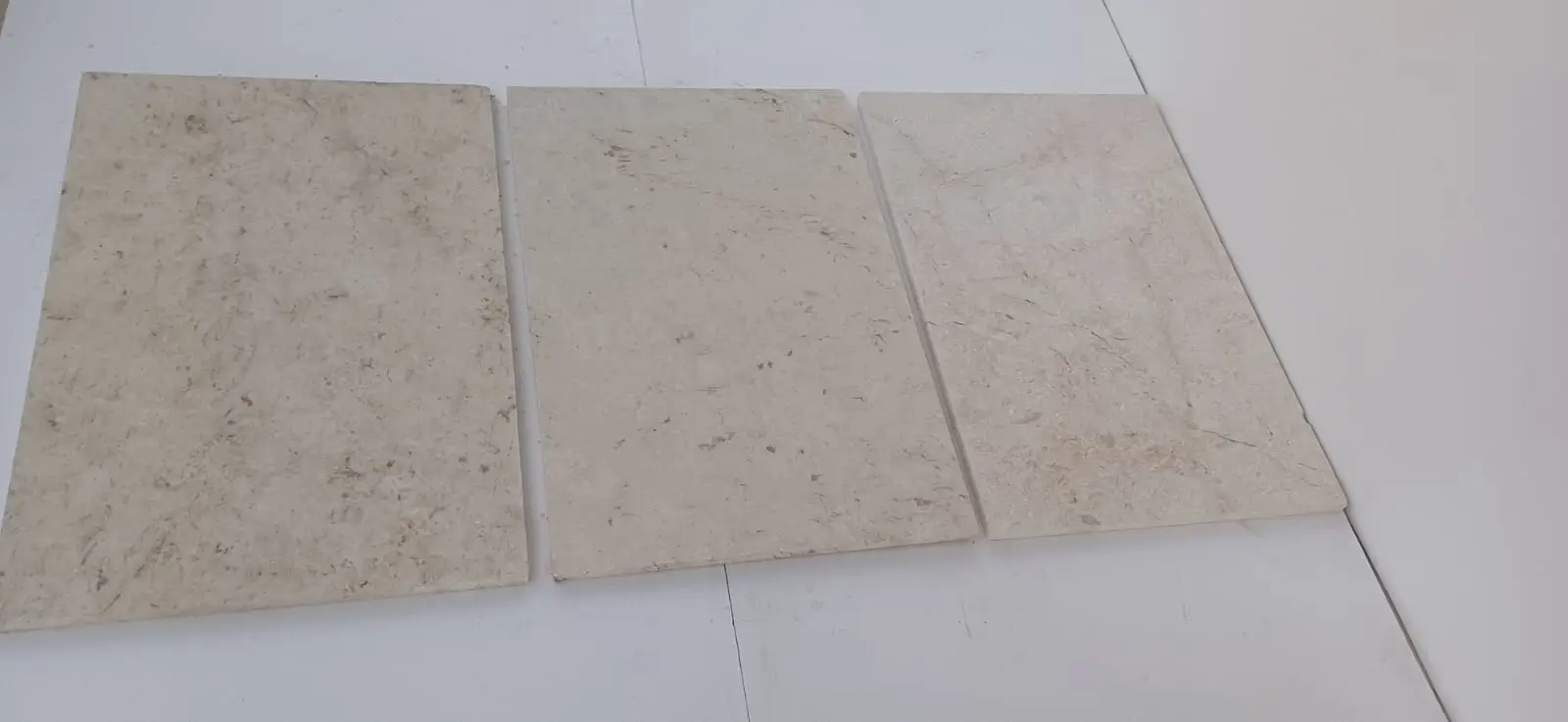
Sandblasted travertine uses high-pressure abrasive media to mechanically roughen the surface, opening pores and creating consistent texture without the directional marks of brushing. The result is a uniformly matte, slightly coarse face with excellent slip resistance — dry COF values above 0.80 are achievable, placing sandblasted travertine firmly in the appropriate range for ramp applications, commercial exteriors, and high-foot-traffic areas where slip liability is a primary concern.
Sawn travertine, also called natural cleft or gauged, refers to stone cut with a diamond saw and left with a lightly textured machine face rather than receiving any additional surface treatment. This finish is common in travertine paver applications where cost efficiency and texture adequacy are both priorities. The surface reads as clean and contemporary without significant processing cost, making travertine pavers in sawn finish a practical choice for large-area outdoor projects.
According to ASTM C1527 travertine dimension stone standard specifications, travertine must meet minimum requirements for absorption, modulus of rupture, and compressive strength regardless of surface finish — and those baseline values hold across all finish types. What the standard doesn’t capture is the significant variation in effective porosity between finishes, which is why your sealer specification should always be finish-specific rather than generic.
Travertine Texture and Landscape Design Integration
Finish selection takes on an additional dimension when you’re specifying travertine for landscape applications where the stone needs to integrate with planting, water features, and the broader site aesthetic. Different landscape styles make very different demands on finish character — and getting the travertine stone texture right means the stone feels contextual rather than imported.
Tropical and lush planting schemes typically call for tumbled or brushed travertine in warm ivory and gold tones, where the aged texture and earth colors complement dense foliage without competing for visual attention. Modern minimalist landscapes often specify large-format honed travertine in Silver or Noce tones, where clean geometry and restrained texture reinforce the design’s horizontal emphasis. Desert xeriscaping environments are where split-face stone finds its natural home — the dimensional texture and raw geology read as authentically geological, connecting the built environment to the surrounding landscape rather than contradicting it.
Colonial and traditional garden styles tend toward tumbled travertine with irregular joint patterns and aged-look grouts, creating surfaces that feel established rather than newly installed. At Citadel Stone, we’ve supplied travertine texture selections for projects across all of these landscape contexts, and the consistent pattern we see is that finish choice matters more to contextual success than color or format. The texture is what the eye reads first at human scale — color is secondary at viewing distances above 10 feet.
- Modern minimalist: honed or lightly brushed, large format, tight joints, Silver or Light Ivory tones
- Desert xeriscaping: split-face feature walls, tumbled pavers, warm gold and walnut tones
- Tropical planting: tumbled or brushed, irregular patterns, ivory and gold palettes
- Traditional/colonial: tumbled with aged grout, medium format, classic ivory or Noce tones
- Mediterranean/Tuscan: tumbled stone travertine is the dominant choice, full stop
Ordering, Logistics, and Project Planning for Travertine Texture
Your finish decision affects more than aesthetics — it affects lead times, minimum order quantities, and truck delivery requirements. Split-face panels and specialty finishes like antique and brushed are typically available in shorter warehouse runs than commodity honed or tumbled product. If you’re specifying a less common finish for a large project, confirming warehouse stock levels before finalizing your project schedule prevents timeline compression later.
Citadel Stone maintains travertine texture inventory across finish categories with national shipping capability, which means your project timeline typically works from a 1–2 week lead time for in-stock finishes rather than the 8–10 week import cycle that custom or low-volume orders require. For split-face panels specifically, confirm panel dimensions and projection depth ranges with our technical team before ordering — nominal dimensions can vary 10–15% in actual projection depth, which affects your furring and anchor specification.
Truck delivery of split-face material requires special handling awareness. The dimensional projection on split-face panels creates irregular stacking geometry, and improper securing during transport chips projecting stone faces — a damage mode that’s irreversible and often not discovered until the pallet reaches the site. Specify crated delivery for split-face travertine and confirm your site has adequate forklift access before scheduling the drop. According to USGS limestone and travertine natural mineral formation data, travertine’s calcite crystalline structure makes it moderately brittle under point-load impact, reinforcing why proper handling from warehouse to installation is a real specification concern, not just a logistics note.
- Confirm warehouse stock for specialty finishes before project scheduling
- Split-face panels: verify projection depth range against anchor specification
- Request crated delivery for split-face and antique-finish material
- Verify truck access and unloading equipment at your site before scheduling delivery
- Order 10–12% overage on tumbled and split-face material to account for natural void variation and field cuts
Before You Specify Travertine Stone Texture
The travertine stone texture guide decision tree is straightforward once you’ve mapped your application requirements honestly. Your primary filter is the exposure context: interior dry, interior wet, exterior covered, or exterior fully exposed. That single variable eliminates most of the finish options immediately. From there, slip resistance requirements and maintenance expectations narrow the field further, leaving you with one or two finishes that genuinely fit the application rather than a long list of possibilities.
Don’t underestimate the maintenance conversation with your client before the specification is final. A polished finish in a high-traffic entry is an aesthetic win that becomes a maintenance burden within 18 months — and that conversation is easier before installation than after. Honed with quality penetrating sealer delivers 80% of the aesthetic at a fraction of the ongoing maintenance cost for most residential applications. For exterior applications across varied climate zones, tumbled or brushed finishes consistently outperform smoother options over time, and the performance gap widens with years of service. For a closer look at how material characteristics connect to long-term project costs, travertine pricing and value factors provides useful context for budget planning alongside your finish selection.
Split-face and brushed finishes sourced through Citadel Stone are particularly specified for exterior feature walls where dimensional texture adds visual depth.
Related reading: what type of stone is travertine · travertine stone colors · how to clean travertine stone floors.