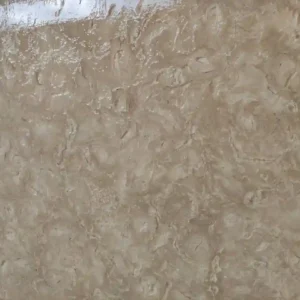
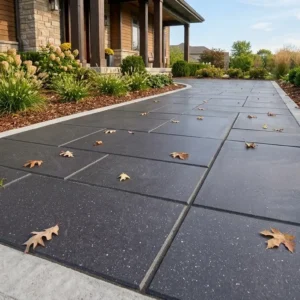
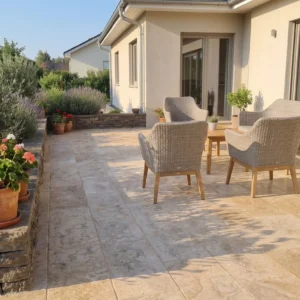
Most travertine stone price factors don’t announce themselves on a quote sheet — they hide in variables that experienced buyers learn to read between the lines. Thickness tolerances, quarry origin, fill type, and warehouse stock levels all shift the final landed cost by 20–40%, yet most buyers compare quotes at face value and miss these distinctions entirely. Getting the full picture of travertine stone price factors before you sign off means you’re evaluating the right data points, not just the per-square-foot number at the bottom of a proposal.
What Actually Drives Travertine Stone Pricing
The base material cost is only the start. Travertine forms through a mineralization process that deposits calcium carbonate in layered, porous sheets — and the density, void pattern, and mineral consistency of those layers vary significantly from one quarry system to the next. That variation translates directly into pricing tiers that have nothing to do with marketing or brand positioning.
Your quote reflects a chain of decisions made well before the stone reached a warehouse: which quarry vein was accessed, how the blocks were gang-sawn, what fill compound was used to stabilize surface voids, and whether the material passed density checks. Each of those decisions costs money — or cuts it. Understanding where the savings come from helps you assess whether a lower quote represents genuine efficiency or a material compromise you’ll pay for later on site.
Here are the core travertine stone price factors every serious buyer should evaluate:
- Raw block quality and quarry-vein consistency
- Slab thickness and dimensional tolerance control
- Fill type — epoxy, cement, or unfilled
- Surface finish — honed, polished, tumbled, or brushed
- Edge profile complexity and fabrication labor
- Lot size and warehouse stock availability
- Shipping method, truck access requirements, and delivery distance
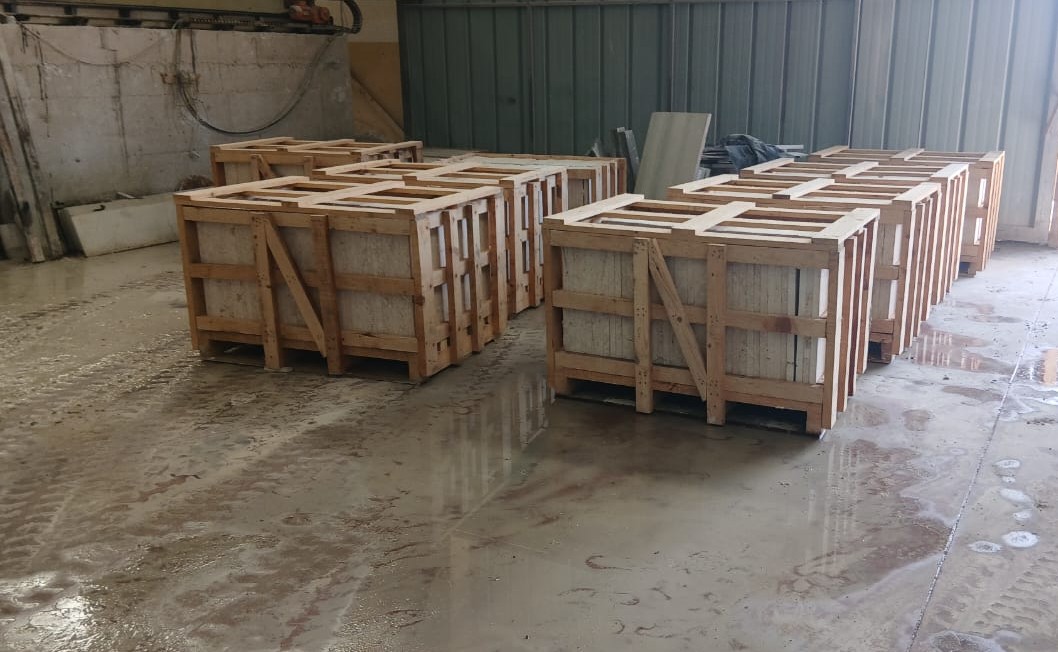
Quarry Origin and Block Grade
Travertine sourced from well-established quarry systems — particularly operations with deep vein access and consistent mineralogy — commands a premium over material pulled from shallower or more irregular deposits. Buyers often encounter travertine described simply as “commercial grade” or “premium grade,” but those labels are not standardized. What matters is the actual density range, void distribution, and color consistency within the lot.
The mineral formation process behind travertine is well documented — according to USGS limestone and travertine natural mineral formation, the carbonate deposition environment directly influences the structural porosity and long-term performance characteristics of the finished stone. Higher-grade blocks tend to show tighter void networks, more predictable fill adhesion, and lower absorption coefficients — all factors that reduce rework costs on demanding projects.
At Citadel Stone, we inspect incoming travertine lots against density and color benchmarks before they reach warehouse inventory, which is why we’re specific about vein origin and grade in every quote rather than grouping material under broad category labels. That sourcing discipline — drawing material from selected quarries in the Middle East where geological consistency is well established — makes a measurable difference in field performance.
Thickness and Dimensional Tolerance
Nominal thickness — 1/2″, 3/4″, 1″, 1-1/4″, 1-1/2″ — is where many buyers assume they understand the spec. The real story is in tolerance. A 1″ nominal slab that leaves a quarry gang saw can carry a tolerance range of ±1/8″ to ±3/16″ depending on the cutting operation’s calibration. That variation forces your installer to adjust the mortar bed continuously, adding labor time and introducing inconsistent lippage risk across the field.
Premium-grade travertine stone pricing reflects tighter thickness tolerances — typically ±1/16″ — which reduces installation labor by a measurable margin. For large-format travertine (18″×18″ and above), tolerance control also affects grout joint consistency and long-term deflection behavior on flexible substrates. You’re not just paying for a prettier slab; you’re paying for dimensional precision that translates into installation efficiency.
- 1/2″ pavers: best for wall cladding and light-duty interior applications
- 3/4″ pavers: standard residential floor and covered patio use
- 1″ to 1-1/4″ pavers: outdoor patio and pool deck specification range
- 1-1/2″ and above: driveways, heavy-use commercial areas, and subgrades with movement potential
According to ASTM C1527 travertine dimension stone standard specifications, dimensional tolerances and physical property minimums are defined for travertine classified as dimension stone — a useful benchmark when evaluating whether a supplier’s stated grade aligns with independent standards.
Fill Type and Its Effect on Price
Travertine’s natural voids — the air pockets formed during carbonate deposition — require filling before most surface applications. The fill compound used is one of the least-discussed travertine stone price factors, and one of the most consequential for long-term performance.
Epoxy fill costs more than cement fill at the factory level, but it bonds differently to the parent stone, handles thermal cycling better, and resists moisture intrusion more effectively in exposed applications. Cement-filled travertine is standard for many interior applications where thermal and moisture stress is low. Unfilled travertine — used deliberately in tumbled and rustic applications — carries the lowest material cost but requires grouting strategy during installation to prevent water infiltration and freeze-thaw damage in exposed climates.
- Epoxy-filled travertine: higher unit cost, superior bond strength, preferred for exterior and wet applications
- Cement-filled travertine: mid-range cost, adequate for interior and low-exposure exterior use
- Unfilled travertine: lowest material cost, requires comprehensive grout-fill at installation, suitable for tumbled aesthetic applications
The fill specification should appear explicitly in any quote you evaluate. If it doesn’t, ask — because a cement-filled and epoxy-filled slab of the same nominal size and finish can differ by $2–$4 per square foot at the material level alone, a gap that compounds significantly across large project footprints.
Surface Finish and Fabrication Costs
The finish applied to travertine stock adds a meaningful layer to the travertine stone price. Each finish category involves different tooling, abrasive sequences, and quality control steps — and the cost follows accordingly.
Honed travertine — the most common specification for floors and pool decks — requires progressive abrasive grinding to achieve a flat, matte surface. Polished travertine adds a resin-buffed gloss that requires a denser, more consistent base material to achieve uniform reflectivity, which explains why not all travertine grades are available in polished finish. Tumbled travertine requires barrel or mechanical tumbling to achieve its characteristic rounded edges and antiqued texture — a labor-intensive process that often runs $1–$3 per square foot above honed pricing for comparable material grades.
- Honed: standard cost baseline, slip-resistant matte surface, suitable for most exterior applications
- Polished: premium cost, requires tight density spec, primarily used for interior floors and countertops
- Tumbled: premium labor cost, antiqued aesthetic, popular for pool decks and old-world patio designs
- Brushed: mid-range, textured surface with directional grain, good slip resistance in wet zones
- Chiseled edge: additional fabrication charge per linear foot, applies to edges of coping and treads
Subgrade Conditions and Installation Cost Impact
Here’s a travertine stone price factor that most supplier quotes don’t capture at all: the cost impact of your site’s subgrade conditions. The material price and the installed price are two different numbers, and soil composition is one of the primary reasons they diverge.
Expansive clay soils present the highest risk for travertine installations. Clay that absorbs moisture and swells — then contracts as it dries — generates differential movement across the slab plane that no adhesive system fully compensates for. The standard approach is to over-excavate by 4–6″ beyond the design depth and install a compacted angular aggregate base, which adds excavation labor, haul-off cost, and base material cost before a single travertine unit is placed. On sites with caliche layers — a calcified hardpan common in arid western soils — you’ll face the opposite challenge: breaking through dense, irregular substrate that slows installation and increases equipment time.
Sandy soils are more forgiving for travertine but require careful attention to compaction depth. Loose, uniform sand without adequate fines will continue to consolidate under foot and vehicle traffic, causing low points and lippage failures within two to three seasons. Rocky subgrades tend to produce consistent support, but irregular depth to bedrock means your base preparation labor becomes unpredictable until excavation is underway.
- Expansive clay: requires deep angular aggregate base, geotextile separation layer, and controlled joint spacing
- Caliche: adds excavation cost, may require mechanical or hydraulic breaking equipment
- Sandy subgrade: compaction testing at multiple depths is essential before setting travertine
- Rocky subgrade: support is consistent but depth variation adds base-leveling labor cost
These subgrade realities don’t change the travertine stone price itself — but they directly affect which thickness specification you should select. Sites with poor subgrade stability require 1-1/4″ to 1-1/2″ travertine pavers to distribute point loads and resist flexural cracking. Specifying 3/4″ material on an unstable base to save $1.50 per square foot at purchase often leads to panel cracking within the first freeze-thaw season.
Lot Size, Warehouse Stock, and Lead Times
Volume pricing on travertine follows a reasonably predictable curve. Orders below 200 square feet typically attract a premium of 15–25% above mid-volume pricing. Orders in the 500–2,000 square foot range hit the standard pricing tier most quotes reflect. Above 2,000 square feet, you can expect meaningful quantity breaks — often 8–15% depending on material grade and current warehouse inventory levels.
Warehouse stock availability is a real pricing variable. Material held in domestic warehouses allows you to avoid the 6–8 week import cycle that applies to made-to-order international stone shipments. For time-sensitive projects, that lead time difference is worth paying a modest premium to access. Citadel Stone maintains standing travertine inventory across standard commercial sizes, which typically compresses lead times to one to two weeks from confirmed order to truck delivery — a meaningful advantage when your project schedule is already under contractor pressure.
Factor truck access constraints at your delivery site as well. Standard flatbed delivery assumes clearance of 13’6″ height and adequate turning radius for a 48’–53′ trailer. Sites with restricted access — narrow driveways, low overhead clearance, or steep grades — may require a smaller delivery truck with a higher freight charge per unit, or require material transfer from a staging area. These logistics costs don’t appear on the material quote, but they’re real travertine stone price factors that affect your total project budget. For a detailed breakdown of how material grades, sizes, and lot quantities translate into final pricing, review our travertine cost breakdown before finalizing your specification.
Color Variation and Veining Premium
Travertine’s natural color palette — ranging from classic ivory and walnut to silver, noce, and gold — reflects specific mineral deposits in the parent formation. Not all colors are equally available in consistent supply, and that scarcity drives pricing variation that surprises buyers who approach travertine as a commodity material.
Ivory and classic walnut travertine are the most reliably stocked colors because they represent the highest-volume quarry production. Silver and noce (dark walnut) travertine typically carry a $1–$3 per square foot premium above ivory pricing for comparable grade and finish, driven by lower quarry yield and higher selection labor. Rare vein-cut colors with pronounced directional movement — where the stone is sawn perpendicular to the natural layers to reveal the cross-section pattern — add further cost because of the increased waste ratio in the cutting process.
- Classic ivory and light walnut: highest availability, most competitive pricing
- Silver and gold travertine: mid-tier premium, moderate availability
- Noce and dark walnut: higher premium, lower quarry yield
- Vein-cut orientation: premium over standard cross-cut due to higher material waste
- Matched dye lots for large projects: verify stock quantity before committing — color drift between production runs is real
The Natural Stone Institute provides reference data on travertine’s structural and aesthetic properties — NSI travertine properties and outdoor suitability outlines absorption rates and finish performance characteristics that directly correlate with why certain color grades command higher prices in demanding applications.
Edge Profiles, Coping, and Fabrication Add-Ons
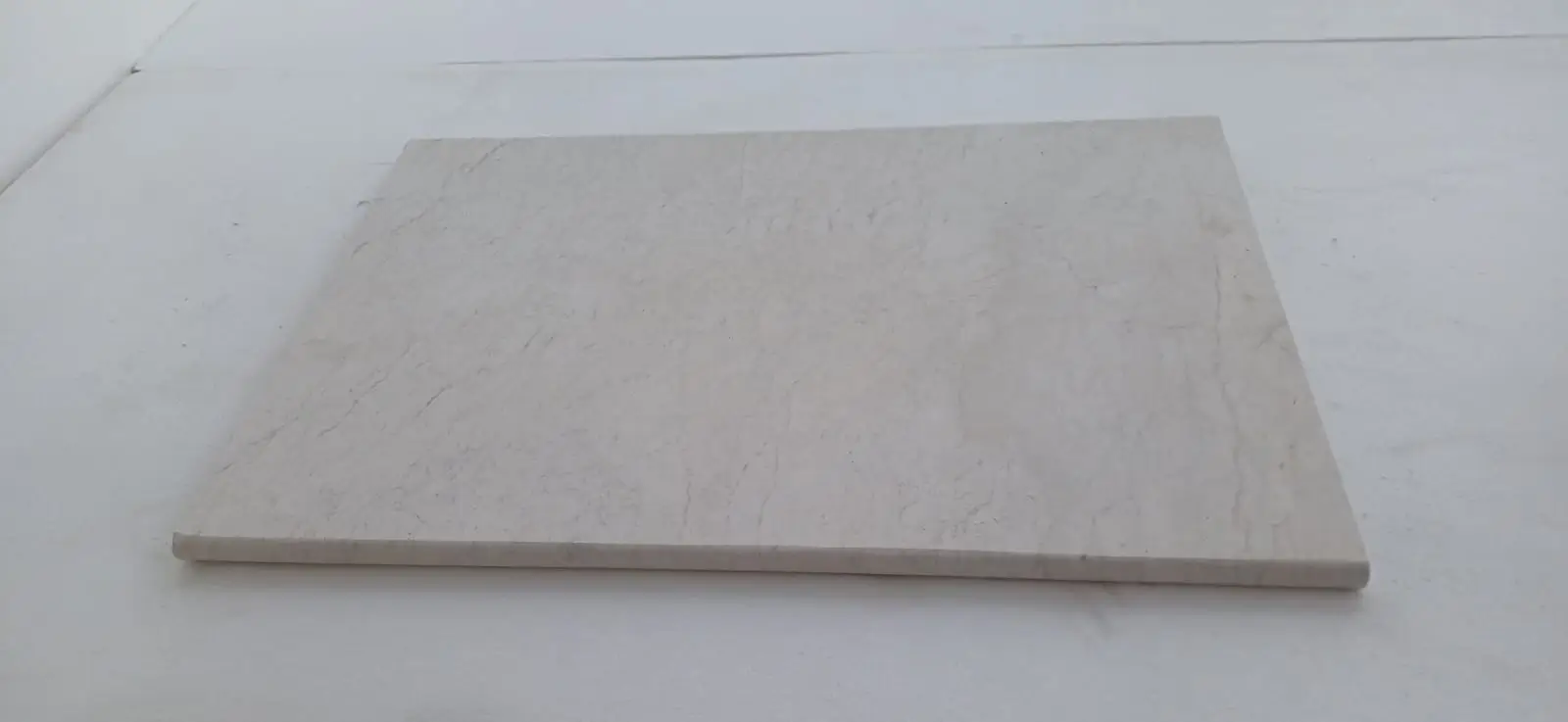
Standard field tiles require only cut edges — typically ground smooth at the factory. The moment your specification includes coping, treads, thresholds, or custom-edge profiles, fabrication costs enter the equation at a separate rate from the material square-footage price. This is one of the travertine stone price factors most frequently underestimated in early budget conversations.
Pool coping in travertine — typically a 12″×24″ or 6″×24″ bullnose format — requires a routed or chiseled edge profile on one or two exposed sides. Fabrication charges for standard bullnose run $4–$9 per linear foot above the base material cost. Ogee and pencil-round profiles add further tooling cost. Step treads with chiseled or honed noses carry similar fabrication premiums plus a thickness upcharge if you’re specifying 1-1/2″ or 2″ travertine pavers for structural rigidity.
- Standard bullnose coping: $4–$9 per linear foot fabrication premium
- Ogee edge profile: $8–$14 per linear foot, requires denser-grade base material
- Chiseled-face coping: factory or field chiseling charge, adds rustic character with additional labor
- Custom radius coping (for curved pools): requires template fabrication and material overage — budget 15–20% waste
- Step treads: thickness and edge premium combined, verify structural thickness spec with your engineer
Decision Points for Travertine Stone Price Factors
The travertine stone price you see on a first quote is a starting position, not a final number. Every variable discussed here — grade, fill type, finish, thickness tolerance, color, lot size, fabrication complexity, and delivery logistics — moves that number in one direction or another. Your job as a buyer is to make sure the quotes you’re comparing reflect the same specification, not just the same stone name.
Subgrade conditions deserve early attention, especially on sites with expansive clay or caliche. Getting a geotechnical read on your base before selecting travertine thickness saves the kind of specification revision that delays projects and recalculates budgets mid-stream. A 1″ slab on a stable, compacted angular aggregate base will outperform 3/4″ travertine pavers on underprepared expansive clay every time — and the delta in material cost is minor compared to the cost of field correction.
Sealing also deserves a place in your total cost picture. Properly sealed travertine extends maintenance intervals and protects fill adhesion in freeze-thaw and high-moisture environments — for practical guidance on protecting your investment, travertine sealing methods and climate considerations covers the right approach for different installation contexts. Across all of these decisions, specification clarity is your most effective cost-control tool. Understanding the cost drivers behind a travertine quote helps buyers compare suppliers accurately, and Citadel Stone makes those factors transparent upfront.
Related reading: How to Clean Travertine Stone Without Damaging It · ph neutral cleaner for travertine · what type of stone is travertine.