Start With What Rolls Over It
Paving fails where the section was chosen for looks and the load arrived anyway. In Saint Vincent and the Grenadines that usually means a delivery van on a villa forecourt, a generator wheeled across a terrace, or a barrow of aggregate crossing finished work during a second phase. Decide the traffic duty of every zone on the drawing first, then choose depth, then format, then finish. Reversing that order is the most expensive habit in island hardscape. A section that suits the load is almost never the dearest item on the list; it is simply the one chosen deliberately.
Terraces, Pool Decks and Bare Feet
Pedestrian zones are the easiest to get right and the easiest to over-build. Laid on a properly compacted base, a thinner unit is perfectly sound underfoot and far kinder to the last leg of the journey. For these areas we normally look at:
- Slabs around 20 mm to 30 mm for interior floors and covered loggias
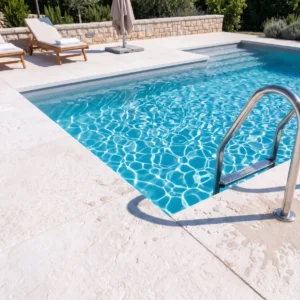
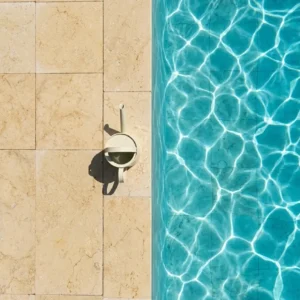
- Roughly 30 mm for open terraces and pool surrounds on a bedded build-up
- Larger formats to cut the joint count around water
- A textured, non-polished face for wet grip without an open, dirt-trapping surface
Thinner is not weaker when the base is right, and every unit of weight saved on a pallet is weight that does not have to be lifted onto a vessel later.
Courts, Paths and Shared Access
Between the terrace and the driveway sits everything a villa actually uses: the path up from the dock, the service run to the kitchen door, the entrance court where a car occasionally turns. These take point loads and trolley wheels rather than sustained traffic, and they are where a mid-weight paver earns its place. Step up in depth, shorten the format slightly, and run the joint pattern with the direction of travel so trolley wheels do not drop into it. Things worth pinning down before these zones are priced:
- The heaviest single item that will ever cross, not the average one
- Whether service vehicles will ever reverse over the path
- Where the pattern changes direction at thresholds and steps
- Falls and outlets, since these runs often collect water off roofs above
Driveways, Forecourts and Service Yards
Vehicle zones are a different conversation, because the failure mode is rotation and settlement rather than wear. Practical rules that hold up here:
- Move to a heavier section, around 50 mm to 60 mm or above, for regular vehicles
- Drop the unit size as the load rises, so each piece is held by those around it
- Consider setts or small units where a vehicle turns on the spot
- Restrain every edge, because unrestrained paving creeps under turning loads
- Build the base for the vehicle, not for the stone
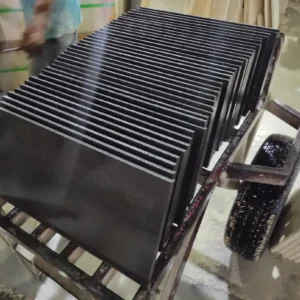
Where a client wants a darker, denser surface in a working area, denser basalt for vehicle bays is often a more sensible answer than a pale stone in a heavy format.
The Layer Nobody Photographs
Every paving decision here rests on Rabacca. The volcanic aggregate worked in the Parish of Charlotte, screened into sands, gravel and cobbles, is the sub-base, the bedding and the concrete under almost everything built in this country. Imported limestone or basalt is the wearing surface sitting on top of it. They are different products in different layers of the same build, not alternatives. Agree the base build-up with your local supplier and engineer before fixing paver thickness, because a generous, well-compacted base lets you specify a lighter unit and ship less weight.
Format Versus the Vessel
On the main island, format is a design question. Once a project is bound for Bequia, Mustique, Canouan or Union Island it becomes a freight question, because the container is broken down at Kingstown and reloaded onto an inter-island vessel. That changes what is sensible:
- Keep pallet weight and footprint within what the vessel and the dock can handle
- Prefer units two people can lift where mechanical offload is uncertain
- Split very large formats across zones rather than across separate pallets
- Order cuts and specials with the main consignment, never as a later shipment
Finish Does Real Work Here
Texture is not decoration in this country. Rain arrives hard and briefly, and the main island still contends with volcanic ash from the 2021 eruption of La Soufriere, which is abrasive and has to be swept and washed off rather than left in place. The face you want grips when wet, stays closed enough that fine gray ash does not embed, and is dense enough to take repeated washing down without opening up. Low absorption is the through-line across every zone. Ask for the same stone in two finishes and wet them both on the same day before deciding.
A Short Way to Decide
Mark the plan in three bands: feet, trolleys, vehicles. Assign a depth to each band, choose the largest format the last leg will carry, and hold one finish across the site so the zones read as a single surface. If you want those depths checked against your own drawings, send them over and ask for paver depths matched to duty as the brief. Write the answer as a table your contractor can price from, with depth, format, finish and pallet weight against every zone. Specify by load first and the stone will outlast the building schedule.