Ground That Never Sits Flat
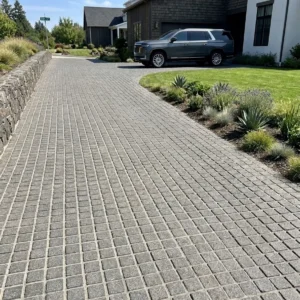
Saint Vincent and the Grenadines gives a builder very little level ground to work with. The main island rises steeply off the coast road, and even the flatter Grenadines put a villa terrace on a shelf that falls away toward the water. Crews here spend as much time managing gradient as they spend managing material. That is why hand-laid setts stay in the conversation long after wide-format slabs have been ruled out on a site. A short unit can chase a slope in small steps, while a long slab has to be cut, propped or abandoned.
What a Small Unit Buys You
The advantage is geometric rather than sentimental. A sett is short enough that the level difference between one end and the other stays small, so a run of them absorbs a change in height that would leave a long slab rocking on two corners.
- Every unit sits on its own bed, so a dip in the sub-base does not telegraph across the finished surface.
- Joints open and close slightly around a curve or a crown without any cutting.
- A damaged unit lifts out and goes back without disturbing the courses beside it.
- Short units let a mason build a fall by eye where a long straightedge would fight the ground.
The Base Under the Surface
Nothing on a slope works without the layer nobody sees. Vincentian construction is built on Rabacca, the volcanic aggregate worked in the Parish of Charlotte and screened into sands, gravel and cobbles. That material is the sub-base, the bedding and the concrete haunching. It has been doing that job for generations, and it is the right product for the layer it occupies. Imported dimension stone belongs above it as the wearing surface. On a gradient the two must be specified together, because a fine wearing course over a poorly compacted base finds every weakness the first time heavy rain runs down it. Get the compaction and the drainage right underneath and the surface above needs little more than a routine wash-down; get them wrong and no stone on earth will rescue the job.
Falls, Drainage and Volcanic Ash
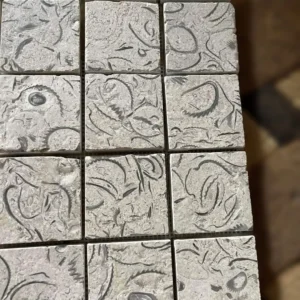
Rain arrives in short hard bursts, and the April 2021 eruption of La Soufriere left a cleaning problem that most Caribbean specifications never have to consider. Fine gray ash is abrasive, it settles into open textures, and it has to be swept and washed away rather than left in place. On sloping paving that argues for dense, low-absorption stone with a texture that releases dirt under a hose. The sett depths we carry here are picked with that wash-down in mind.
- Set a positive fall to a defined outlet instead of letting water sheet over an open edge.
- Choose jointing that can be flushed clean without washing out of the joint.
- Keep the texture grippy in rain but tight enough that fines do not embed.
- Add a channel where the gradient concentrates the flow into one line.
Edge Restraint on a Gradient
A slope is a slow machine for moving paving downhill. Restraint is what stops it, and on falling ground it deserves far more attention than it usually gets.
- Haunch the lowest course into concrete before anything above it is laid.
- Use a deeper header course or a curbstone at the foot of every run.
- Break long falls into terraces with a step rather than one continuous slide.
- Detail the edge for wind as well as water on exposed Grenadines frontage.
Coursing and the Mason’s Eye
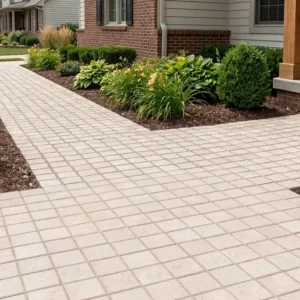
Setts on uneven ground are laid, not installed, and the coursing lines carry the visual work. Straight courses read as a formal path. Curved or fanned courses let the surface bend with the contour and disguise the fact that nothing on the site is square. Most Vincentian jobs end up with both, a disciplined run near the house and a looser field where the ground turns awkward. If you want the setting out agreed before pallets land, send the levels and we will work back from them, which is part of how we serve SVG projects rather than an extra.
Getting Units onto a Grenadine Site
Ocean freight reaches the country directly at Kingstown, with Campden Park as the second cargo point, and the new Kingstown cargo terminal has been handed over in stages since September 2025. Beyond that, nothing rolls to Bequia, Mustique, Canouan, Mayreau or Union Island by road. Each Grenadine is a separate small-vessel leg on services such as the Bequia Express, the MV Gem Star or the MV Barracouda.
- Pallet footprint and weight bind the last leg far more than container price does.
- A container is often broken down at Kingstown into Grenadines-sized consignments.
- Hand-liftable units survive a jetty landing better than oversized crates do.
- Book the inter-island leg into the schedule, not as an afterthought at the end.
Agreeing the Specification Locally
Development runs under the Town and Country Planning Act, administered by the Physical Planning Unit, and work needs permission before it begins. On a sloped site the paving choice touches drainage and retaining structures, so it belongs with your own architect or engineer rather than with a supplier alone. Our job is accurate sizes, honest weights and samples early enough to change a drawing. It also pays to walk the site with the mason before the order is placed, because the person laying the units usually spots the awkward transitions first. On steep ground the survey decides the paving, not the catalog page.