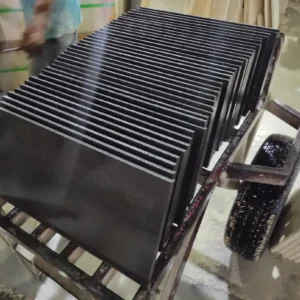
The Number That Surprises People
A buyer sees a price per square foot, multiplies by area, and builds a budget on the result. Then the container arrives and the real figure is meaningfully higher. Nothing improper has happened. Import charges on dimension stone entering Barbados are simply a separate stack of costs that sits between the supplier’s invoice and the pallets on your site. The problem is never the existence of those charges. It is finding out about them in the week the money is due rather than in the month the budget was written.
The Lines That Build a Landed Cost
Landed cost is assembled from a small number of components, and every one of them is knowable before you order.
- Common External Tariff duty, assessed at the tariff line applicable to dimension stone.
- VAT at 17.5 percent, calculated on the value the entry establishes rather than on the invoice alone.
- Environmental levies, which apply according to the current schedule for imported goods.
- Clearance, port handling, and the broker’s own fee for filing and attendance.
- Inland haulage to the parish, plus any staging or smaller-vehicle shuttle the site needs.
It pays to be precise about what is actually being imported. Barbados has quarried its own coral limestone for more than three centuries and that stone remains the island’s reference point, so imported dimension stone arrives as a complement to it rather than a rival. Describing the goods accurately keeps the entry moving.
Who Actually Files the Entry
This is the part overseas suppliers cannot do for you. A local customs broker files the entry in Barbados, classifying the goods, calculating what is owed and lodging the declaration. Appoint one before the vessel arrives, not after, and give them everything early.
- A draft commercial invoice, weeks ahead, while the wording can still be changed.
- The packing list with weights and piece counts, crate by crate.
- The bill of lading, sent as soon as it is issued rather than on arrival day.
- Confirmation that the description reads as dimension stone and not as something looser.
- Agreement on who pays port handling and who attends if an examination is called.
A good broker will read the paperwork early and tell you whether anything is going to cause a query, which is far cheaper than discovering it while charges accumulate at the port.
What an Itemized Quote Should Show
Ask for the version that separates everything, then compare suppliers on the same basis.
- Material cost by format and thickness, with the wastage allowance shown as its own quantity.
- Crating and pallet weights, since weight drives freight and freight is not a rounding error.
- Ocean freight to Bridgetown stated as a figure, not as an estimate to be confirmed later.
- Duty, VAT and levies shown separately, with the assumptions behind each one written out.
- Clearance and inland delivery, including whether staging on a narrow parish road is included.
An itemized document is also a negotiating tool. When every line is visible, you can see which ones move and which are fixed by law. That is the practical value of proper landed paving cost planning for an island project.
Where Quotes Go Wrong
The usual failures are predictable, and every one of them is avoidable with a document that shows its working.
- Material only, priced to the loading dock, leaving the buyer to discover the rest later.
- One bundled figure, so no single line can be tested against another supplier.
- No wastage allowance, which turns a shortfall into a second ocean voyage.
- A loose invoice description, which stalls the entry on a classification query.
None of these is dramatic. Each one simply moves a cost from the quotation stage, where it can still be discussed, to the clearance stage, where it cannot.
VAT and Your Own Accounts
VAT paid at import is a real cash outflow at the moment of clearance regardless of how it is eventually treated in your books. Registered businesses handle input tax under the normal rules that apply to them, and your accountant is the right person to confirm your position before you plan around it. What matters for the build program is simpler: the money must be available when the entry is filed, not when the project completes. Treat it as a cash flow event with a date attached.
One point is specific to an island served by a deep-water port. Because ocean freight reaches Bridgetown directly from the US East Coast, a consolidated order is one entry carrying one set of charges. Split the same material across two sailings and you file twice, pay handling twice, and face two clearance windows instead of one.
Timing the Money Against the Vessel
Charges do not arrive evenly, and mapping them onto the sailing schedule turns a run of shocks into a plan.
- Material and crating, paid at origin before anything is loaded.
- Ocean freight, committed at booking rather than at arrival.
- Duty, VAT and levies, which all land together inside the clearance window.
- Storage and demurrage, which begin quietly whenever release is slow.
That last line is why documents reaching the broker early are worth more than almost any saving negotiated elsewhere.
Asking for the Right Document
Do not ask what paving costs. Ask what it costs delivered to your gate in your parish, with every charge named. Send the area, the thickness by zone, the access constraints and the target laying date, then ask for an itemized quote built on those inputs. A quote that names every charge before the ship sails is worth more than a lower headline number that hides three of them.