A flat island that holds its heat
Anguilla is roughly sixteen miles long and three miles across, and Crocus Hill, at about 240 feet, is the highest ground anywhere on it. There is no elevation to retreat to and no cool valley air to borrow. What the island does have is steady trade wind, long dry spells, and the lowest rainfall in the Lesser Antilles, somewhere near thirty-five to forty inches a year and famously erratic. In a house built for that climate, the floor is not a background decision. It is the largest uninterrupted surface in the room, the one people meet barefoot from morning until night, and the one that quietly sets how warm the space feels.
Why a stone floor reads cool
Stone feels cool for two ordinary physical reasons. Dense stone draws heat away from skin faster than timber or vinyl, so contact temperature falls quickly even when the air has not moved at all. A stone floor bedded on a slab also carries real thermal mass, which makes it lag behind the day, sitting below air temperature through the hottest hours and releasing that stored coolness after sunset. In a shaded room at Meads Bay or Barnes Bay, that lag is the difference between a floor you cross quickly and a floor you are happy to sit on. The effect is strongest where the stone is laid in full contact with the substrate rather than over a soft underlayment.
Tone does more work than expected
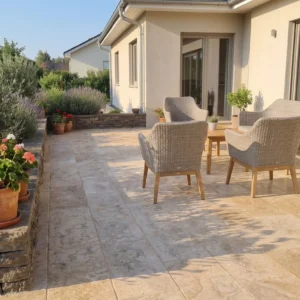
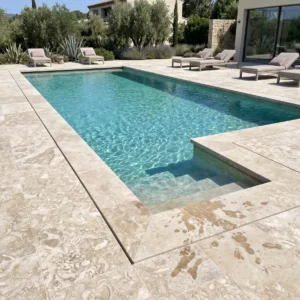
Pale limestone reflects much of the light energy that gets past the glazing, so the surface gains less heat over the course of an afternoon. Darker stone sitting in a sun patch can turn uncomfortable by three o’clock. That is one honest reason to favor light floors in a villa interior here, and the same logic carries out onto covered terraces.
- Pale, low-variation stone stops sun patches from turning into hot spots.
- Matte and lightly textured faces scatter glare instead of throwing it at eye level.
- Carrying one tone from interior to covered terrace makes both zones read cooler.
- Mid-tone stone works better as a border or threshold than as an entire floor.
The island is limestone already
Anguilla sits on reef limestone from shore to shore, and the historic masonry around The Valley was built from what was at hand. Nobody here needs persuading that limestone belongs in an Anguillian house. What the island does not produce is the industrial half of the story: dimension-sawn, gauged tile supplied in repeatable lots with matching thickness, tested absorption and a consistent worked face. Specifying limestone flooring that stays cool is therefore a supply and processing decision, never a claim about which rock is better. Imported material earns its place by arriving calibrated and crated, so a large floor can be set to one joint width without sorting every crate on site.
What to specify for comfort
Comfort and durability pull in the same direction here, because a floor that stays cool is usually a floor chosen on measured properties rather than on photographs taken somewhere else.
- Low water absorption, so salt-carrying moisture is not drawn deep into the stone.
- High density and a tested breaking strength suited to the room and the bedding method.
- A texture that keeps its grip when a dry, salt-dusted floor is suddenly wetted.
- Consistent gauged thickness, which protects joint lines and keeps thresholds flush.
- A tone judged under Anguillian light rather than under a showroom lamp.
Rooms that gain heat fastest
Heat rarely arrives evenly across a plan. On most villas the gains cluster in a few predictable places, and a floor specification that ignores them will feel inconsistent from one room to the next.
- West-facing living rooms taking low afternoon sun across a wide opening.
- Glazed corners where two elevations meet and the shading devices run out.
- Transitions from covered terrace to interior, where the shade line travels all day.
- Stair landings and galleries under rooflights, which trap warm air above the stone.
Getting the floor to Road Bay
Freight shapes a specification as much as the drawings do. The documented structural route for material bound for Anguilla runs from the US mainland into Port St. Maarten and then crosses the Anguilla Channel on a short feeder leg to Road Bay at Sandy Ground, so the consignment is lifted and set down twice before it reaches site. Blowing Point is a passenger terminal, not a cargo berth. Planning that second handling is part of what our Anguilla stone supply desk does before anything ships.
- Crates specified for a second lift, not only for the first vessel.
- Banding and edge protection that survives handling at both quays.
- Spare stock ordered with the main lot, from the same production run.
- Clear labeling so the right crates open first on a phased fit-out.
Testing comfort before you commit
The only reliable test is a physical one. Put a small piece of the actual stone on the actual slab, in the room it is meant for, and walk on it barefoot at two in the afternoon and again after dinner. Look at it wet, look at it dry, and look at it with the shutters half closed and the fans running. Photographs flatten tone and hide texture, and no data sheet will tell you how a floor feels at the end of a hot day. Comfort is the one specification you can only confirm with your own feet.