What Humidity Does and Does Not Do
Start by dismissing the wrong worry. Humid air does not dissolve, warp or rot a limestone floor. What it does is keep surfaces damp for longer after rain, condensation or a shower, and a damp surface behaves differently from a dry one. Water sitting in a thin film is what turns a beautiful floor into a hazard, and it is also what feeds the faint biological growth that shows up in permanently shaded corners. Every finish decision below follows from that one behavior, not from any fear of the humidity itself.
The Finish Menu in Plain Terms
Finish names get thrown around loosely. Here is what each one actually gives you underfoot.
- Honed: smooth, matte, no shine. The workhorse for interior floors and the default in most island homes.
- Brushed: honed and then worked with abrasive brushes, leaving a soft, slightly undulating surface with more grip.
- Tumbled: edges and faces softened, giving an aged look with useful texture, though the joints collect more.
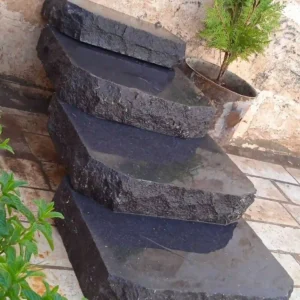
- Bush-hammered: deliberately pitted and rough, made for exterior and heavily wetted areas rather than living rooms.
- Polished: reflective and elegant, and the one finish to keep away from any floor that gets walked on wet.
Honed Is the Default for a Reason
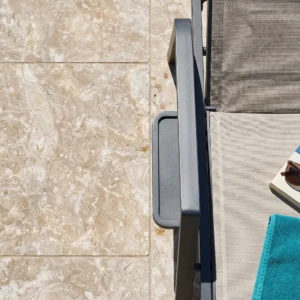
A honed surface gives you a matte floor that hides the dulling and micro-scratching that would show instantly on a polished one. It cleans easily, it does not glare under bright light coming off a white wall, and it holds up under sand tracked in from the beach. Its limitation is honest: honed stone is a smooth surface, and any smooth surface loses grip when a film of water sits on it. That is a placement problem, not a reason to reject the finish. Use it across the dry body of the house, keep it away from the strip inside an external door and away from a pool surround, and it will serve for decades without argument.
Texture Versus Cleaning Effort
Every gain in grip costs something in cleaning. Deciding where you accept that trade is most of the job.
- More texture means more grip when wet and more places for sand, dust and cleaning residue to sit.
- Smoother finishes wipe clean in one pass but need to be kept out of routinely wet zones.
- Wider joints add grip of their own and are worth considering where texture alone is not enough.
- Shaded outdoor areas that stay damp need texture whatever the appearance argument says.
If you are specifying the main living floor of a house, a practical route is to pick a low-gloss tile surface for the dry areas and step up the texture only where water genuinely lands.
Where the Floor Gets Wet and Stays Wet
Map the water before you map the finishes. In a typical house on these islands the wet map looks like this.
- The strip inside every external door, where rain blows in and feet arrive wet.
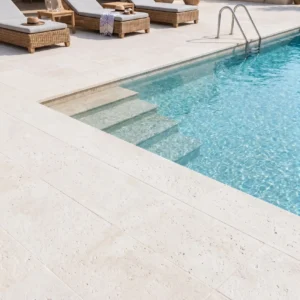
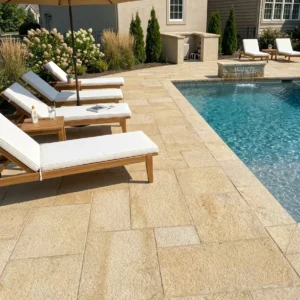
- Pool surrounds and the route from the pool back to the house, which is often the least considered path.
- Shower floors, bathroom thresholds and the area around a laundry.
- Shaded terraces on the windward side, which dry slowly and stay green if the texture is wrong.
Matching Finishes Across a Threshold
Changing finish at a doorway is normal and sensible, but it should be a deliberate line rather than an accident. Keep the same stone and the same tone on both sides and change only the surface treatment, so the eye reads one floor flowing through the building while feet get the grip they need in each zone. Line the change up with the door leaf, not with the frame, and make sure the two finishes sit at the same level so nobody catches a toe on a lip. The same logic applies at the head of a flight of steps, where a change in texture is a useful warning that the level is about to alter.
Test Before You Buy a House Lot
Photographs cannot tell you how a finish feels wet. A short physical test settles arguments that would otherwise run for weeks.
- Wet a piece thoroughly and stand on it barefoot, then repeat with a wet foot and a dusty floor.
- Leave a piece outdoors in a shaded spot for a couple of weeks and see what it looks like afterward.
- Spill the things your household actually spills, then clean them off with plain water.
- View the piece in the room it is destined for, at the hour that room gets its worst light.
It also helps to read up on the surface finish library before committing, because the same block of stone performs very differently depending on how its face was worked.
A Realistic Spec for Island Conditions
Specify honed for interiors, brushed or textured for wet zones and exterior transitions, and keep polished out of the house entirely unless it is on a vertical surface. Ask for dense, low-absorption material, because a tighter stone holds less water and dries faster in humid air. Then agree the finish across the whole order at once so the pieces match batch to batch. Remember that the base course beneath all of it will come from local aggregate producers, as it always has; the imported units are the wearing surface laid over work that was already being done well here. A floor that stays safe when wet has already earned its keep, and everything else about it is a bonus.