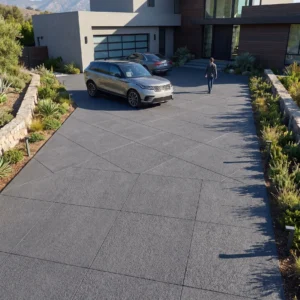
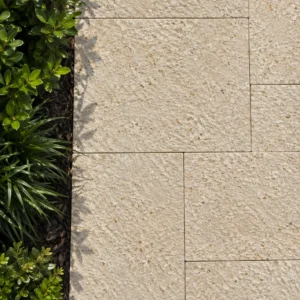
Thickness specification is the variable most slate patio stones projects get wrong first — not finish selection, not color choice, but the structural call that determines whether your installation survives seasonal ground movement or starts rocking within three years. For pedestrian patio applications, 3/4-inch nominal slate is too thin; you need a minimum of 1.25 inches to resist flex cracking across typical joist spans of 18 to 24 inches. Push that to 1.5 inches if you’re working on an aggregate base with any meaningful clay content in the subgrade below. This slate patio stones guide covers every specification decision that matters — from subgrade assessment to sealer selection — so the system beneath your stone is as sound as the stone itself.
What Makes Slate Perform Outdoors
Slate is a metamorphic rock formed under intense directional pressure, which is exactly why it cleaves into flat, consistent planes — a property geologists call foliation. That same layered structure also makes outdoor performance more nuanced than most buyers expect. According to Britannica’s overview of slate metamorphic properties, the degree of metamorphism and mineral composition directly affect durability, absorption, and resistance to weathering. Harder, denser slates with low absorption rates — typically below 0.4% by weight — are the ones that hold up decade after decade in demanding outdoor conditions.
Color plays a performance role too, not just an aesthetic one. Darker slate varieties tend to have higher iron content, which can cause surface oxidation (rust staining) when exposed to sustained moisture. Confirm iron-oxide content with your supplier before specifying black or dark-charcoal finishes near water features or in consistently wet zones.
Reading Your Site Conditions Before You Specify
Your base system is only as reliable as what’s underneath it. The subgrade — the native soil — drives more long-term slate patio performance variation than any material property you could specify. Expansive clay soils present the most common failure scenario: seasonal moisture cycling causes vertical movement of 1.5 to 3 inches in some soil profiles, which no amount of sand-set slate stones for patio use can absorb without cracking or displacement.
Here’s the site-assessment process worth running before you finalize your specification:
- Dig a test pit to 18 inches and observe soil color and texture — gray or blue-gray clay indicates high plasticity and poor drainage
- Check whether the soil holds a ribbon when you roll it between your fingers — if it does, treat the site as expansive
- In sandy or loose soils, compaction verification matters more than depth — sandy subgrades compact unevenly and can settle under load over time
- Rocky or caliche-dominated subgrades require mechanical scarification before base material placement to ensure bonding between layers
- Slopes greater than 2% need drainage channels or French drain integration to prevent hydrostatic pressure from lifting the base during saturation events
For clay-dominant sites, a geotextile separation fabric between native soil and your compacted aggregate base is not optional — it’s the difference between a stable platform and progressive base contamination over five to ten years.
Base Preparation That Actually Holds
The standard recommendation you’ll see online — four inches of compacted aggregate base — undersells what most slate patio stones installations actually need. For pedestrian-only applications on stable, non-expansive soils, four inches of 3/4-inch compacted crushed stone is a workable minimum. On clay subgrades, push that to six inches. For vehicular-adjacent areas or any load beyond foot traffic, eight inches with a 95% Proctor compaction rating is where the spec should sit.
Compaction lifts matter as much as total depth. Compact in two-inch lifts — not all at once. Running a plate compactor over a six-inch unlifted pour of aggregate does not produce uniform compaction through the full depth; it consolidates the top two inches and leaves the lower material loose. That lower layer is what shifts first when subgrade moisture changes.
- Use angular crushed stone, not rounded pea gravel — angular particles interlock and resist lateral movement under load
- Set bedding sand at a consistent 1-inch depth — overset sand beds compress unevenly and create low spots within the first year
- Screed the sand bed to ±1/8-inch tolerance before placing any slate stones for patio surfaces
- Tamp each slate unit individually after placement — don’t rely on the rubber mallet strike alone
Thickness, Finish, and the Trade-Offs You Need to Know
Slate patio stones are typically available in three nominal thickness ranges: 3/4 inch, 1.25 inch, and 1.5 inch. The 3/4-inch option is frequently used for indoor flooring and is sold through big-box retail channels — including as Lowe’s patio stones inventory — but it’s undersized for outdoor aggregate-set installations. It can work in mortar-set applications over a concrete slab, but the patio environment (freeze-thaw, ground movement, thermal cycling) creates too much flex load for the thinner profile.
Finish selection affects more than appearance. Cleft-finish slate — split along natural foliation planes — gives you the most texture and grip, with a coefficient of friction typically in the 0.7 to 0.9 range under wet conditions. Honed slate is smoother and more dimensionally consistent, but wet-surface slip resistance drops into the 0.5 to 0.6 range, which is acceptable for covered applications but worth flagging on open, exposed patios. ASTM C629, the standard specification for slate dimension stone, provides the absorption, modulus of rupture, and flexural strength benchmarks your material should meet before it goes on a project.
Joint Spacing and Thermal Expansion in Practice
Slate has a thermal expansion coefficient of approximately 5 to 6 × 10⁻⁶ per °F — moderate compared to granite but higher than most homeowners account for when running full-contact dry-lay installations. At that rate, a 24-inch slate unit expands roughly 0.002 inches per 10°F of temperature change. That sounds negligible until you’re specifying a 400-square-foot patio with minimal joint spacing and surface temperatures swinging 60°F between morning and peak afternoon.
The practical consequence: don’t set joints below 3/16 inch on open patios. A full tight-contact installation looks clean on day one and starts producing spalling and edge chipping in the second or third summer as material-to-material contact creates compressive stress. Polymeric joint sand at the 3/16- to 1/4-inch width handles that expansion budget comfortably and still reads as tight to the eye from standing distance.
- For large-format slate units above 24 inches on any side, increase joints to 3/8 inch minimum
- Install perimeter expansion joints — not just polymeric sand — at transitions to structures, walls, or fixed elements
- In freeze-thaw climates, verify that your chosen slate achieves a freeze-thaw durability rating — ASTM C629 requires no more than a 20% modulus of rupture loss after 100 freeze-thaw cycles
Sealing: What It Does and What It Doesn’t
Sealing slate patio stones is not a maintenance shortcut — it’s a genuine performance intervention that changes how the material behaves in moisture-cycling environments. Natural slate has an absorption rate that varies significantly by origin and metamorphic grade; some slates sourced from Middle East quarries run as low as 0.2% by weight, while softer slates from other origins can reach 3% or higher. High-absorption material without sealer will develop efflorescence, iron staining, and spalling in wet climates far faster than sealed equivalents.
Use a penetrating silane-siloxane sealer for exterior slate rather than a topical film-forming product. Topical sealers trap moisture beneath the surface when the substrate is porous, accelerating the very damage they’re meant to prevent. Penetrating sealers work into the pore structure and repel water without creating a vapor barrier. Apply two coats on dry, clean material — not on a newly installed surface that hasn’t fully cured its bedding bed. First reapplication is typically at 18 to 24 months, then every three to five years depending on UV exposure and traffic.
How Slate Compares to Alternative Patio Materials
Material selection always involves trade-offs, and a thorough slate patio stones guide wouldn’t be complete without addressing where slate wins and where it concedes ground to alternatives. For a broader view of how different natural stone options stack up in patio applications, our slate and stone comparisons provide a useful side-by-side reference across multiple performance categories.
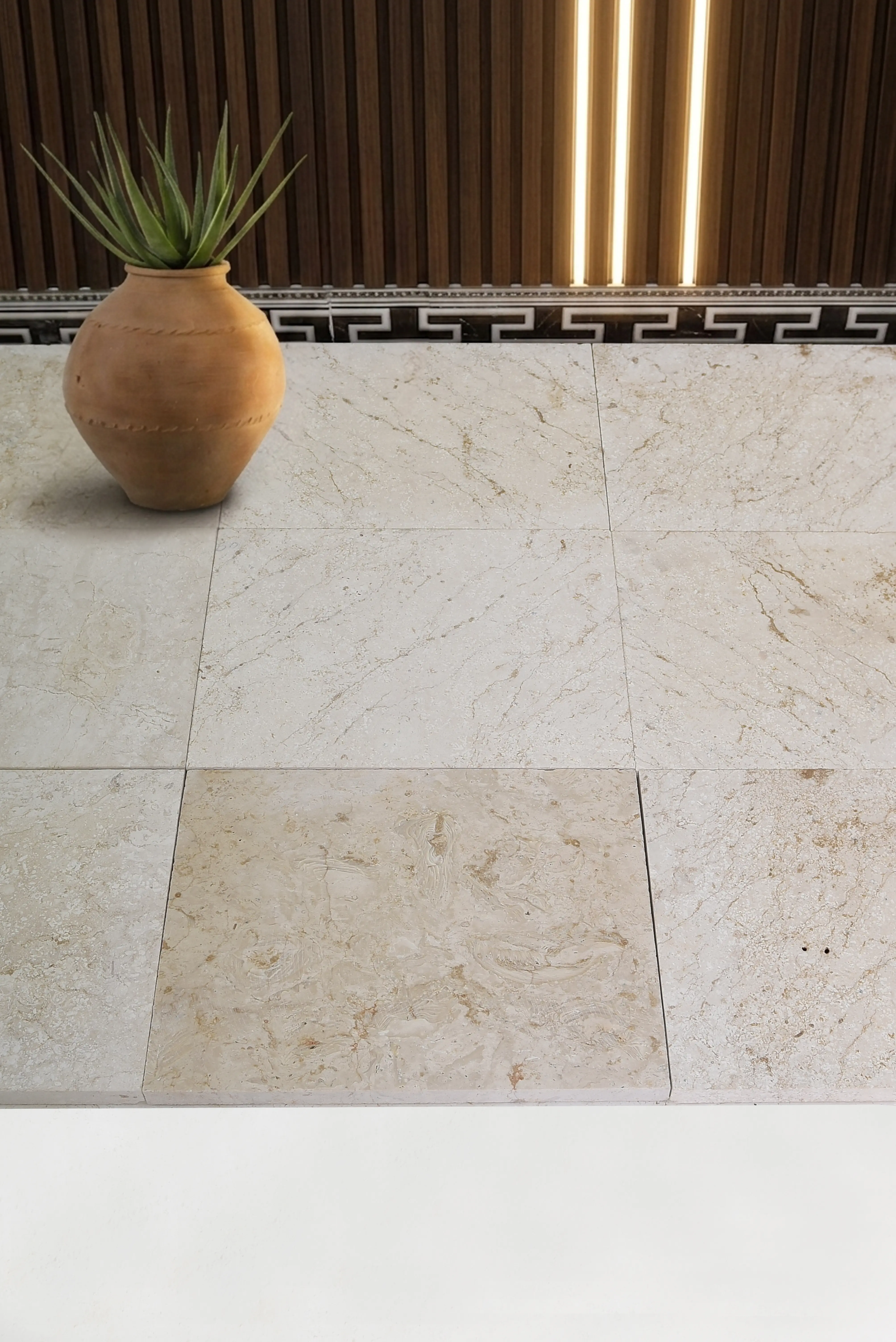
Bluestone is slate’s closest competitor in terms of visual character and installation approach, but it’s denser and heavier — helpful for stability on marginal subgrades, but more demanding on truck delivery logistics and handling. Travertine offers a warmer aesthetic and lower surface temperature under direct sun, but its open-pore fill can degrade over time on heavily trafficked outdoor surfaces. Granite outperforms both in compressive strength — typically above 19,000 PSI versus slate’s 8,000 to 12,000 PSI — but requires more aggressive mechanical cutting and generates more waste during custom sizing.
- Slate vs. bluestone: slate is lighter and easier to handle; bluestone is denser and more frost-tolerant in extreme freeze-thaw zones
- Slate vs. travertine: slate has a more consistent surface; travertine fills can pit under heavy foot traffic and UV exposure
- Slate vs. concrete pavers: slate provides natural variation and visual depth; concrete pavers offer tighter dimensional tolerances and easier replacement of individual units
- Slate vs. flagstone: flagstone is a broader category — slate IS a flagstone material when split to irregular shapes, but uniform-cut slate offers more dimensional control for formal settings
Ordering, Lead Times, and Project Planning
Your project timeline depends on warehouse stock levels more than most specifiers plan for. Slate sourced from selected quarries across the Middle East typically carries a 6 to 10 week import cycle when ordered to specification. Citadel Stone maintains standing warehouse inventory of its most popular slate formats and finishes nationally, which can compress that lead time to 1 to 2 weeks for standard sizes and colors. Confirm availability before committing your installation crew to a start date — stock levels for natural stone fluctuate with quarry output and seasonal demand cycles.
For truck delivery logistics, verify site access early. Slate pallets for a 400-square-foot patio typically weigh 3,500 to 4,500 pounds — within standard flatbed truck capacity — but long driveways with tight turning radii or low overhead clearances can create delivery complications that push your schedule by days. According to USGS dimension stone production and use data, slate remains one of the more consistently stocked natural stone categories in US distribution networks, which helps reduce sourcing delays compared to some specialty materials.
Order 10 to 12% overage on your calculated square footage. Slate is a natural material with variation in cleft depth and color tone — cutting waste during fit-up runs higher than with manufactured products, and you want matching material from the same quarry lot for repairs rather than hunting for a close approximation three years later.
Getting Your Slate Patio Stones Specification Right
Every slate patio stones decision comes down to choices made well before the first unit goes down — subgrade assessment, base depth specification, thickness selection, and sealer compatibility. The material itself is remarkably capable when the system beneath it is properly engineered. Where slate installations fail, the root cause is almost always a base that was undersized for the actual subgrade condition, not a defect in the slate itself. Take the soil profile seriously, compact in proper lifts, and size your joints for thermal movement rather than aesthetics alone.
Your stone selection connects to other project decisions too. If your patio design incorporates a fire feature, material performance near sustained heat is a separate specification question worth examining before finalizing any natural stone choice — heat-safe patio stone options covers how different materials respond to the thermal demands of fire pit zones, making it a useful complement to the slate planning decisions outlined here. At Citadel Stone, we evaluate our slate stock through hands-on quality checks at the warehouse — assessing cleft consistency, absorption characteristics, and thickness tolerance — so you’re specifying from material we’ve actually examined, not just a catalog description. Compared to travertine, the slate Citadel Stone carries generally shows less surface porosity, making it a lower-maintenance choice in humid climates.
Related reading: Sealer for Patio Stones: Types and Application Steps · Circular Patio Paving Ideas: Patterns and Layout Tips · patio stepping stones ideas.