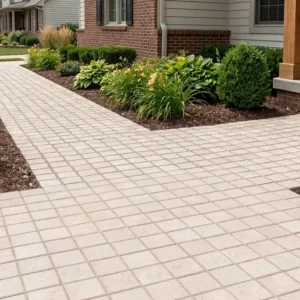
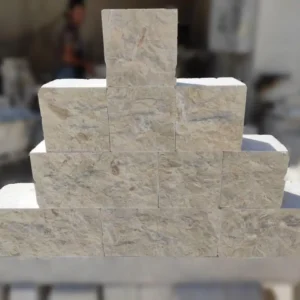
Three Islands, Three Different Gradients
The US Virgin Islands is not a single paving market, and slope is the clearest reason why. St. Croix is the largest of the three main islands and the flattest. St. Thomas and St. John are steep. That one difference changes nearly every decision a paving contractor makes, from unit size to the number of days on site. A driveway on a St. Croix lot may fall a few inches across its whole run, while a villa approach above Charlotte Amalie can lose that much in one course.
Small units exist for the second condition. Setts are bedded individually, so a setter follows the ground rather than fighting it, taking up the fall across dozens of joints instead of forcing it into a handful of wide ones. Large-format slabs want a plane, and ground that rolls, steps and turns does not offer one.
Measuring the Fall Before Ordering
Before any quantity is fixed, the fall across the area should be surveyed and drawn rather than judged by eye. A steep site forces an early decision: does the surface run continuously with the slope, or is it broken into terraces with steps between them? That single choice drives unit size, cutting volume, edge details and labor hours far more than the choice of stone does.
Why Small Units Suit Broken Ground
On uneven ground the argument for setts is mechanical rather than decorative.
- Each unit is bedded on its own, so a rolling surface is met joint by joint instead of packed under one large piece.
- Cutting waste stays low, because a small unit can often be turned or shuffled where a slab would have to be cut.
- Failures stay local, so a settled patch is lifted, re-bedded and relaid without disturbing the surface around it.
- Deeper units resist rocking on ground that will never be perfectly consolidated.
- Steps, ramps and level changes use the same unit as the flat runs, so the surface reads as one piece.
Bedding and Restraint on a Grade
Gravity works on a bedding layer every day of the year. On a slope, paving without proper restraint creeps downhill in increments too small to see until the joints at the top of the run begin to open. The remedy is restraint at every downslope edge and a bedding layer held to a consistent depth, rather than a bed thickened and thinned to correct levels unit by unit. Contractors ordering deep setts for graded island sites should check the calibrated thickness on the data sheet first, because a pallet of mixed depths turns a slope into guesswork.
- Hold one bedding depth across the area and correct levels in the sub-base beneath it.
- Restrain the lowest edge of every run, including internal steps and thresholds.
- Compact in layers on made ground, because a slope has usually been cut and filled at some point.
- Keep jointing material consistent, since a change part-way through a run behaves differently under rain.
Runoff Between May and October
Rainfall here concentrates between May and October and tends to arrive in bursts rather than steadily. On a grade that means sheet flow with real energy behind it, hunting for the weakest joint on the way down. Cross-falls, channels, a catch point at the foot of the run and an edge that resists undercutting all belong on the drawing.
Seismic Movement Is a Design Input
The territory sits on the boundary between the North American and Caribbean plates. On 18 November 1867 a magnitude 7.5 earthquake struck the Anegada trough between St. Croix and St. Thomas as two shocks ten minutes apart, generating tsunamis that exceeded 30 feet in places, with Charlotte Amalie and Frederiksted heavily affected. That history is a reason to build paving that can move a little and be repaired easily.
- Flexible, sand-set or drainage-mat systems absorb small ground movement that a rigid bed transmits straight into cracks.
- Movement joints belong in the layout from the start rather than cut in after a crack appears.
- Edge restraint carries more of the load on a grade than it ever does on flat ground.
- A sett surface can be lifted and relaid after movement, which a monolithic pour cannot.
Permits and Coastal Review
Building work is administered by the Department of Planning and Natural Resources through its Division of Permits, which enforces the 2021 International Building Code and the 2021 International Residential Code and also covers floodplain management and the National Flood Insurance program. Applications go through the CitySquared e-permitting system or on paper. Coastal Zone Management is a separate DPNR division with its own review, and shoreline paving falls to it. You can read how we handle territory orders before you commit to a delivery date.
Getting Stone Onto a Hillside Site
Delivery is its own design problem. The Virgin Islands Port Authority operates the cargo ports and ocean freight arrives directly from the US mainland, with Crowley, TOTE Maritime and Tropical Shipping among the carriers serving the territory. From the port gate to a hillside address the constraints turn local: narrow approaches, tight turns, and the fact that the territory drives on the left, which changes which side of a truck can unload against a bank or a wall.
- Confirm the largest vehicle that can reach the site, then size pallets to it.
- Agree a staging area clear of the running lane before the container is booked.
- Plan any last leg to St. John with your carrier instead of assuming a mainland-style schedule.
- Check gate widths and headroom along the approach, not only at the site boundary.
Send us the fall, the access route and the island, and we will specify setts that suit all three.