What Heritage Means in These Islands
Heritage here is stone, and most of it was never decorative. The Turks and Caicos National Trust, established in 1992, holds Cheshire Hall Plantation on Providenciales, where the remains of a late-1700s cotton plantation survive as a Great House, a cotton-press base, a kitchen, a cistern and a well. Those remains are the physical record of a plantation and of the people forced to work it, and they are protected accordingly. The salt industry left fabric of its own on Salt Cay, Grand Turk and South Caicos, in the salinas and the settlements built around them. Anyone paving near that material is working next to a record, not a backdrop, and the detailing should reflect that.
The Local Stone, Described Accurately
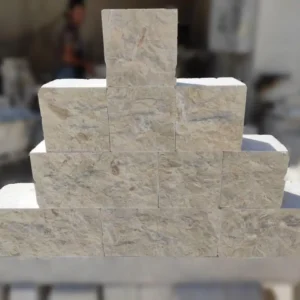
The islands sit on a soft limestone platform, and limestone rubble was the historic building material. That stone is soft, and today it serves as fill and screening rather than as a wearing surface. Locally screened gravel is a by-product of the same work and is not recommended for concrete use, so imported aggregates carry the structural load on modern jobs. None of that makes the island’s limestone lesser. It is the ground, the reef, the beaches and the plantation walls. Imported dimension stone is simply the finished surface laid over it, and the two are complements rather than competitors. Understanding that division of labor keeps a specification honest, because it stops anyone claiming the imported material is replacing something the island failed to provide.
Where New Paving Meets Old Fabric
The junction between a modern surface and an old wall is where restraint gets tested, and it is worth resolving on paper before anyone breaks ground on the site.
- Leave a clear margin so the new surface never abuts historic masonry
- Avoid rigid ties between new paving and any old wall that still moves
- Keep excavation shallow and away from foundations of unknown depth
- Route drainage away from old fabric rather than through or under it
- Keep the new work reversible wherever the setting is sensitive
Choosing a Sett That Defers
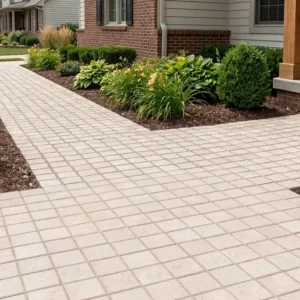
The instinct near old stone is to imitate it. Resist that. A copy tends to read as a copy, competing with the original for attention while never quite matching it. A better result comes from a quiet modern floor in a small module that sits comfortably at the same scale as historic rubble work without pretending to be it. Small units also handle irregular ground and irregular boundaries, which historic settings supply in quantity, and they can be lifted and relaid in patches if a wall is later stabilized or a service run has to cross the surface. That reversibility is worth more near protected fabric than any decorative gesture. It is the argument for cobblestone formats for restoration work on sensitive sites.
Finish, Tone and Joint Treatment
Tone does more work than format in these settings, and a few decisions carry most of the result.
- Choose a pale, low-gloss face that stays cooler underfoot than a dark one
- Match joint color close to the stone so the grid stays quiet
- Pick texture for wet grip first and for appearance second
- Keep the module small enough to follow uneven historic boundaries
Permissions and the Planning Route
The Physical Planning Ordinance is the foundational legislation, published as Chapter 09.02 in the 2021 Revised Laws and administered by the Department of Planning, with the TCI Development Manual serving as the guidance document and Section 7.5 covering environmental impact assessment. The building code sits in the Building Regulations of 1990, and parts of the OECS code refer to CUBiC for wind and earthquake loads. Sensitive and coastal sites bring extra steps.
- Engage a locally licensed architect before the design is fixed
- Allow roughly three months for planning permission on a normal project
- Secure a building permit before construction rather than during it
- Expect environmental assessment on coastal work under the Development Manual
- Speak to the National Trust early if the site sits near protected fabric
Salt, Storms and the Maintenance Case
Two storms explain the local caution. Hurricane Ike passed just south of the islands in September 2008 with winds near 135 miles per hour, damaging most homes on South Caicos, and building codes were strengthened afterward. Hurricane Irma crossed as a Category 5 in September 2017 with sustained winds above 156 miles per hour, hitting South Caicos, Grand Turk and Salt Cay hardest. Salt is the constant between events.
- Specify dense, low-absorption stone and judge it on salt crystallization
- Ignore freeze-thaw claims entirely, since it never freezes here
- Use stainless fixings and keep cast zinc alloys off the job
- Bed and bond exposed surfaces rather than laying them dry
Working Respectfully and Getting Supplied
Good work near heritage fabric is mostly a matter of not overreaching, and the logistics have to support that patience rather than fight it. Almost everything arrives through South Dock on Providenciales, which handles more than 85 percent of national port traffic, and outer-island loads continue from there by barge. Draft at the dock is only about 11 feet, with berthing limited to vessels of roughly 110 TEU, so schedules are set by physics rather than by preference. On a heritage site that is an advantage, because it forces the sample stage and the approvals to happen before any stone is committed. We arrange sourcing stone for TCI sites with those legs planned rather than assumed. Near old stone, the best new surface is the one nobody notices first.