Why Curves Defeat Large Formats
A curve is where a paving specification quietly falls apart. Large units are rectangles, and a rectangle meeting an arc has to be cut, so every sweeping edge on a drawing becomes a row of tapered pieces on site. Each of those pieces takes time, leaves a thin fragile point somewhere and rarely matches its neighbor. Multiply that around a turning circle and the labor bill has grown while the surface has become weaker at precisely the edge that vehicles clip. Small units avoid the whole argument, because a sett is close enough to square that a curve is expressed by rotating courses rather than by cutting them.
The Geometry of a Small Unit
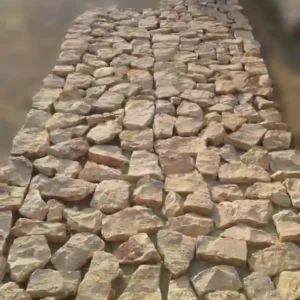
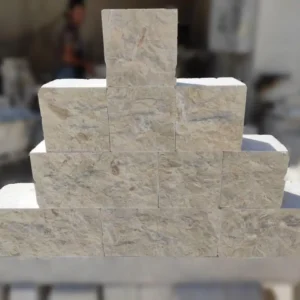
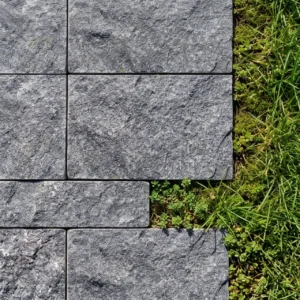
The useful property of a sett is that its joint width absorbs error. Across a long straight run that hardly matters, but around a radius it is everything, because each course can open marginally on the outside of the arc and close on the inside without anyone noticing. That single behavior is what lets a small module follow a curved boundary, a tree pit, a pool coping line or an irregular island wall. It is also why the format survives ground that never quite matches the drawing, which describes most sites on Providenciales. Compare face sizes in small cobble units we stock before fixing the geometry.
Radial Coursing for Turning Circles
A turning circle is the classic case, and radial coursing is the classic answer. Courses run as concentric rings around a center point, so the pattern itself explains the geometry to anyone using it.
- Fix the true center first and work outward, never inward from a boundary
- Keep ring widths consistent so the eye reads the circle rather than the joints
- Let joints open slightly on the outer rings instead of cutting tapers
- Bring the pattern to a stop against a border course, not against a raw edge
- Test one ring on the ground before committing the whole circle
Courtyards, Borders and the Field
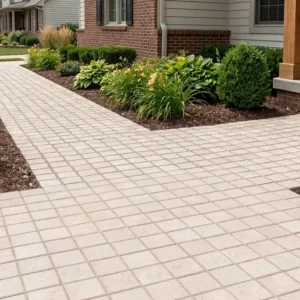
An entrance court behaves differently from a circle because it has corners, doors and a strong sense of front. Here the border does the structural and visual work. A perimeter course of two or three sett rows frames the space, absorbs the irregularity of the building line and gives the field pattern something honest to die into. Inside that frame the field can be laid in a simple bond and left alone. Restraint reads as confidence in a courtyard; a busy field competes with the architecture and usually loses. Where a court has to accommodate both parking and arrival on foot, use the border to draw that division rather than changing material halfway across, which always looks like a decision taken late.
Setting Out on the Ground
Patterns fail in the setting out, not in the laying. An hour with string, chalk and a few dry-laid courses will settle arguments that a drawing cannot.
- Mark the arcs full size and walk them before any bedding is mixed
- Dry lay a sample panel of each pattern being considered
- Check the layout against door thresholds and drainage outlets together
- Agree where the pattern changes direction and mark it physically
Our guide to how radial coursing is set out covers the same ground in more detail.
Cutting, and How to Avoid Most of It
Some cutting is unavoidable, but most of it is self-inflicted. Borders absorb the awkward geometry that would otherwise land in the field. Changing course direction at a natural line, such as a threshold or a channel, hides the transition. Sizing a court so the field lands close to a whole number of courses is free at the design stage and expensive afterward. Where a cut is genuinely needed, keep it away from the trafficked edge and never leave a sliver at a corner where a wheel will find it. Cutting also produces dust and slurry, which is worth thinking about on a site with a cistern catching water from the roofs above, so keep the cutting station downwind and well away from any open collection point.
Barefoot Traffic, Glare and Grip
Curved paving in these islands usually surrounds a pool or fronts a villa, so the surface gets used barefoot in strong sun and then soaked by a sudden shower. Salt, not frost, is the exposure that decides how it ages.
- Choose pale, low-heat-gain tones for decks people cross without shoes
- Avoid a high-gloss face that throws glare across an open court
- Pick a texture that still grips when the surface is wet and salted
- Keep joints full so nothing works loose beside a pool edge
- Fall the surface away from the building and into a channel
From Layout to Delivery Schedule
A curved layout changes the order in which stone is needed, which matters when every pallet crosses an ocean. South Dock on Providenciales carries more than 85 percent of national port traffic, draft is about 11 feet and berthing is limited to vessels of roughly 110 TEU, so nothing arrives in a hurry or by accident.
- Order borders and the field together so tone matches across the court
- Allow extra on curved work, where waste runs higher than on straight runs
- Confirm the pattern before shipping, since a change offshore costs weeks
- Treat any outer-island barge movement as a separate scheduled leg
Set the geometry out on the ground first and the pattern lays itself.