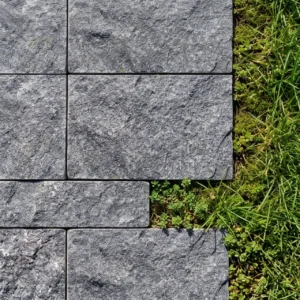
Why a curve punishes large formats
A curve is a series of small direction changes, and paving can only follow it in units small enough to make each change without a visible cut. Put a large slab on an arc and every course either fans open at the outer edge or needs a tapered cut on the inner one; do that twice and the eye reads a mistake rather than a shape. Setts solve the same geometry by having more joints to spend. The tighter the radius, the smaller the unit has to be, and that relationship is fixed before anything about the pattern is decided. The same rule applies to a serpentine path or a rounded terrace nose: the sharpest point on the whole line, rather than the average, sets the unit size for everything else.
Set out from the center
Curved work goes wrong when it is set out from the nearest straight edge and the error is pushed around the bend. The discipline is the opposite: establish the geometry first, and let the perimeter take the tolerance.
- Fix the center point of every arc on the drawing and on the ground.
- Strike each radius physically before a single unit is bedded.
- Set the first course off the center line, then work outward from it.
- Leave the closing course against the wall or edging, where a cut is expected.
- Check the arc again once a third of the area is laid, not at the end.
Coursing choices that survive a bend
Some bonds turn well and some do not. A running bond curves happily, because the joints stagger anyway and the eye accepts a widening joint on the outer arc. A stack bond makes every deviation visible, since the whole point of that pattern is lines running true. Herringbone locks well underfoot and under wheels but wants a defined boundary at the curve, which usually means a border course following the arc and taking the cuts. On a court or a circle, radial coursing built out from the middle is the honest answer, because the geometry of the pattern and the geometry of the shape agree. Basketweave and other square repeating blocks read as small tiles, and they hold their shape better in straight panels flanking a curve than they do across it.
Joint width is your tolerance budget
On a straight run a joint is a detail. On an arc it is a budget: the difference between the outer and inner arc length has to go somewhere, and it goes into joints, into cuts or into a border. Deciding how to split that difference is the point at which sett gauges that follow an arc stop being a size on a list and start being a layout decision.
- A slightly open outer joint is normal on a curve and should be planned, not hidden.
- Smaller units keep joint variation below the level the eye actually notices.
- Joint material must resist washout, because a cloudburst finds the widest joint first.
- Hold a consistent joint on the inner arc and let the outer one carry the variation.
Courtyards and the closed shape
A closed shape is unforgiving in a way an open terrace is not, because the pattern has to arrive back where it started. In a small courtyard the whole floor is visible from one position and there is nowhere to lose an error. That argues for setting out the central feature first, whether it is a drain, a tree pit or a plain circle of contrasting units, and for a unit size that divides comfortably into the width. In Willemstad there is an extra condition: a courtyard in Punda, Otrobanda, Pietermaai or Scharloo sits inside the 1997 UNESCO World Heritage area, so the pattern is a conservation matter as well as a design one. A closed courtyard also gives water only one way out, so a central channel or gully becomes the organizing point, and the pattern is better drawn around it than adapted to it afterward.
Fans, arcs and radial work
Radial layouts do more than decorate. A fan built from overlapping arcs distributes the direction changes evenly, so no single joint carries the whole discrepancy, and it reads as deliberate at every scale from a doorstep to a turning court. Decorative paving of this kind is what a Dutch-speaking contractor calls sierbestrating, though the appeal of a fan is structural as much as visual. It is also demanding to set out, which is why it repays drawing before ordering. If a fan is on the table, how a fan bond is set out is worth reading alongside the site plan.
Cutting, closers and waste
Curved work uses more stone than its area suggests, and pretending otherwise turns into a second delivery.
- Allow extra for cuts on every arc, every border and every closing course.
- Keep offcuts sorted on site, because many closers come out of them.
- Cut wet where possible, so the face stays clean and the dust stays down.
- Order the border material in the same batch as the field, never later.
Drawing, sampling and ordering
The sequence that keeps a curved job calm is drawing, then sample, then quantity, then order.
- Draw the arcs at a real scale, with every center point dimensioned.
- Get a physical sample and lay a short curved section as a trial.
- Count units off the drawing rather than estimating from area alone.
- Add border, closers and the waste allowance before the order goes out.
Draw the radius first, and the pattern, the unit size and the order quantity all follow from it.