Wet stone is a different material
Dry, almost any paving feels secure. Add a film of water, a wet foot, sunscreen residue and a child running from the shallow end and the same surface becomes a different product. That is the condition a deck in Dorado, Palmas del Mar or a Rincon guesthouse lives in for most of the year, so it is the condition worth specifying against. Texture, not tone and not format, does the work here, and it is the one decision that cannot be corrected later without lifting the surface. Everything else on a pool project can be adjusted after the fact: furniture moves, planting grows in, lighting gets rewired. The surface underfoot is poured, bedded and grouted once.
The finishes that give you grip
Grip comes from what happens in the top fraction of the surface. Several worked finishes deliver it in different ways, and each reads differently underfoot.
- Bush-hammered: a peened, evenly pocked surface with strong grip and a pale daylight reading.
- Sandblasted: a fine open texture, less aggressive than bush-hammering and friendly to bare feet.
- Brushed: the softest of the worked options, best where a pool sits under cover or shade.
- Tumbled: eased edges and a broken face that suits an informal courtyard and hides wear well.
- Flamed, on dense dark stone: a thermally shocked face with an assertive grip, common on basalt.
Grip without shredding feet
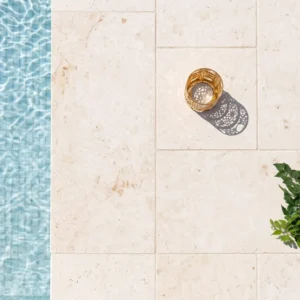
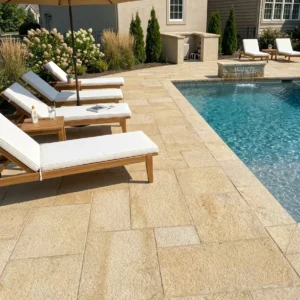
The trap is overcorrecting. A surface can be so aggressive that guests avoid it barefoot, and an aggressive texture also traps sunscreen, body oils and organic film that then need scrubbing, which slowly polishes the high points anyway. The target is a texture that stays honest wet while still being pleasant to stand on for an hour. Wet-testing a real piece of textured limestone paving we stock settles that argument faster than any brochure, because comfort and grip are both judged with feet rather than eyes.
Coping, edges and the first step
Most incidents happen within three feet of the water, so the detailing there deserves more attention than the field.
- Coping profile: a bullnose or eased edge is kinder to shins and hands than a sharp sawn arris.
- Overhang: a small drip edge keeps water off the pool wall and off the face of the coping.
- Step nosing: mark it in texture or tone so it is visible in low sun and at night.
- Transition strips: match levels carefully where deck meets terrace, since a lip is a trip.
Salt systems, chlorine and rinse water
Saltwater chlorination is common here, and salt splash lands on the deck every time somebody climbs out. Salt that dries in the surface crystallizes in the pore structure, which is the slow mechanism behind surface fretting near the coping. Fresh-water rinsing is genuinely useful maintenance rather than housekeeping theater, and it costs nothing but a hose. The routine that keeps a deck looking new is short, cheap and almost entirely about what you take off the surface before it dries in place.
- Rinse the deck with fresh water after heavy use, concentrating on the coping run.
- Keep acidic cleaners, descalers and vinegar solutions off limestone altogether.
- Never dissolve or store chlorine tablets directly on the paved surface.
- Lift sunscreen residue and organic film before sun bakes it into the texture.
Drainage does half the work
The finest finish in the world cannot save a deck that ponds. On the wet northern side of the island, and anywhere below El Yunque where rain arrives in volume, drainage carries at least as much of the safety burden as texture does.
- Fall away from the pool, not into it, at the rate your designer sets.
- Continuous slot or channel drains at the low edge rather than a few point gullies.
- Joints kept full and sound, because water below the surface undermines the bedding.
- Planting beds detailed so irrigation and soil wash do not track silt across the deck.
What Maria changed around the water
Maria in September 2017, with gusts reported above 175 mph, rewrote how this island thinks about anything sitting loose outdoors. The 2018 Puerto Rico Building Code and the Residential Code followed, built on the 2018 I-Codes with local amendments and adopted on FEMA Mitigation Assessment Team recommendation, with wind design running roughly in the 150 to 200 mph band across structure types and risk categories. For a pool deck the practical consequence is fixing and restraint: loose-laid units on an exposed roof terrace are a different engineering problem from mortar-set paving at grade, and that is an engineer’s call, not a finish choice. It is worth settling that question early, because the bedding method decides the unit thickness, and the unit thickness decides what you order and what you pay to ship.
Trial a panel beside your own water
Lay a few pieces at the pool edge, wet them, and walk them the way your family walks them. Try it wet with sunscreen on your feet, at midday and again at dusk. If a sample is what you need, you can order samples before deciding and test it in place, since samples are small pieces meant for exactly this kind of trial rather than full pallets. The right pool finish is the one nobody notices, because nobody slips on it.