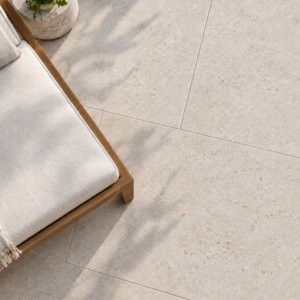
Wet stone is a different material
The surface you inspect dry in a showroom is not the surface anyone will walk on. Around a Cayman pool, stone spends much of its life carrying a film of water, and often a film of salt underneath that. Sunscreen, suntan oil and fine wind-blown grit join in. Any grip assessment that ignores those three conditions is theater. The useful test is simple and takes a minute: wet a sample, tilt it, and walk on it barefoot with wet feet on the site itself, in the sun, before anything is ordered in quantity. Do it in the afternoon, when the deck is hottest and the surface dries fastest, because that is when the film of water is thinnest and grip is least forgiving.
The finishes that hold grip when wet
Texture is created by how the top face is worked, and each method gives a different balance of traction, comfort and cleaning effort. None of them is a slip rating on its own, so treat the list below as a starting point and confirm the choice with a wet sample on your own deck.
- Bush-hammered: the deepest texture and the strongest wet grip, best on ramps and steps.
- Brushed: a softened, gently abraded face that keeps traction while staying kind to bare feet.
- Sandblasted: an even matte surface with reliable grip and low glare across large open decks.
- Tumbled: rounded edges and a broken face, forgiving underfoot and good on informal terraces.
- Honed and polished: excellent indoors, unsuitable anywhere water reaches on an exterior deck.
Coping is its own decision
The coping course is the most demanding stone on the property. It is permanently wet, it takes hands and elbows as swimmers pull themselves out, and it is the first place a poor detail announces itself. Settle it before anything else, because every other level on the deck is set from it. Our textured limestone pool paving is normally specified with the coping fixed first and the field stone matched to it.
- Choose a bullnose or eased edge so nothing catches shins or knuckles.
- Carry the strongest available texture through the coping, even if the field is gentler.
- Specify a thicker unit here, since coping takes point loads no field paver ever sees.
- Bed and mortar the coping properly, because a loose coping stone becomes a hazard immediately.
Salt water, fresh water and the rinse habit
Freshwater rinsing is standard practice on these islands for good reason, and a pool deck sits in the middle of three water sources at once.
- Salt haze arrives on the breeze whether or not the property fronts the sea.
- Pool chemistry, whether chlorine or a salt system, splashes out with every swimmer.
- Heavy rain dilutes and redistributes both across the whole deck within minutes.
- The routine rinse removes salt film before it dries, crystallizes and works into open pores.
A textured face holds slightly more of that film than a smooth one, which is a fair trade for grip provided the rinse actually happens on schedule.
Texture versus barefoot comfort
There is a real trade-off between grip and comfort, and pretending otherwise leads to decks nobody enjoys. The most aggressive textures give superb traction and feel harsh under bare feet on a hot afternoon. The gentlest textures feel wonderful and give up traction exactly when a wet child runs across them. The workable answer is zoning rather than compromise: the strongest texture on steps, ramps and the coping run, a moderate brushed or sandblasted face across the main lounging field, and the softest surfaces reserved for covered areas where water rarely reaches at all. Written that way, a specification stops being a single decision and becomes a short map, which is also far easier to price and to lay.
Falls, drainage and the detail that fails first
No finish rescues a deck that holds water. Grip is a partnership between the surface and the way water leaves it, and the drainage detail usually decides the outcome.
- Set falls away from the pool so rinse water and splash never pond at the coping.
- Keep joints consistent and properly filled, since a failed joint becomes a trip edge.
- Use linear drainage where a deck meets a building, rather than relying on surface slope alone.
- Check the low points after the first heavy rain and correct them before the deck is furnished.
The texture choices behind all of this are worth reviewing alongside the layout, and the surface finishes we can apply are described in more detail elsewhere on the site.
Specifying texture zone by zone
Write the specification as a map rather than a single line. Steps, ramps and coping take the strongest texture available. The main deck field takes brushed or sandblasted. Shaded loggias and indoor transitions can relax toward a honed face because water rarely reaches them. Outdoor shower areas and any slope steeper than a gentle fall go back to the strongest texture, without exception. Then test the choices on site with a small sample before the order is placed, because a deck specified from a screen is a deck specified on hope. Remember too that stone arriving through George Town is handled twice, so the packing that protects a textured face matters as much as the texture itself. Grip is the one thing on a pool deck you cannot fix after the stone is laid.