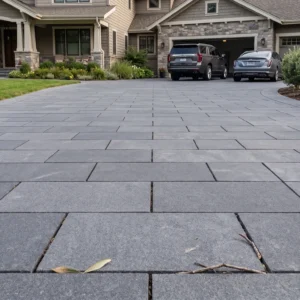
Duty Cycle First, Appearance Second
Ask what crosses the surface, how often, and how heavily. Bare feet twice a day is one answer. Housekeeping trolleys on a condo deck is another. A landscape truck reversing to a bin store is a third, and it will destroy a specification written for the first two. Cayman sites concentrate all three within a few hundred feet of each other, which is why a single thickness across a whole property is nearly always either wasteful or a future repair. Break the site into duty zones on the drawing, then price each zone, then look at samples. A plan marked with duty zones also gives the installer something concrete to argue with, which is exactly what a good specification should invite.
Thickness Bands That Actually Get Used
These conventions are a starting point for a discussion with your engineer rather than a substitute for one.
- Around 2 cm suits interior floors and covered walkways where the bedding is continuous and no vehicle ever appears.
- Around 3 cm is the workhorse exterior thickness for terraces, pool surrounds and pedestrian paths.
- 5 cm and above is the honest answer wherever vehicles turn, park or reverse, including light service traffic.
- Steps, copings and edge units are separate items with their own dimensions and should be ordered with the main run.
Format Size Meets a Lighterage Port
Large formats read beautifully on a rendered drawing and behave differently on an island served by barge. Every oversized unit is a heavier lift at the ship, at the yard, on the truck and in the hands of two installers on a narrow terrace. Breakage risk climbs faster than ambition does. That does not rule out large slabs, and plenty of Seven Mile Beach schemes use them well, but it does mean the format decision belongs in the same conversation as packing and access. Ask how many pieces a two-person crew can place comfortably at the chosen size, then decide. Modest formats in a considered pattern often deliver the same visual calm with far less handling risk.
Condo Decks and Amenity Terraces
Amenity decks carry a duty cycle owners rarely picture: service carts, event furniture, cleaning crews at dawn and a constant traffic of wet feet.
- Confirm whether the deck is a pedestal assembly or a bonded bed before fixing any thickness.
- Ask which service vehicles or heavy carts reach the deck, and how often they do.
- Check wet slip performance underfoot rather than trusting a finish name on a sheet.
- Allow for event loading wherever the amenity space is used for functions.
Driveways, Service Yards and Turning Circles
Vehicle areas punish optimism. Turning wheels apply a twisting load that no bedding forgives, and the failure shows first at joints and edges.
- Move to a thicker unit than the pedestrian areas, and keep the format smaller so each piece is better supported.
- Detail the edge restraint properly, since an unrestrained edge unravels a whole field over a couple of seasons.
- Keep the joint pattern free of long continuous lines running along the direction of travel.
- Plan a spare pallet from the same production run for the repairs a driveway will eventually need.
Where the duty is genuinely heavy, basalt for driveway duty is a sensible material conversation to have alongside limestone.
Caymanite Belongs in the Jewelry Case
Caymanite deserves a paragraph of its own and no comparison at all. This banded, earth-toned dolomite forms in paleokarst voids in the Bluff Formation and is found only on the Cayman Brac bluff and at the East End of Grand Cayman. It is cut and polished for gold-set jewelry and fine souvenirs, and it is a national pride object rather than a paving material. Nobody should be pitching it against imported dimension stone, and nobody should be laying it in a driveway. Local quarrying works the Ironshore and Bluff formations for fill and aggregate, which is a different industry to calibrated paving entirely. Treating a national ornamental stone as a competitor would be both wrong and slightly absurd.
Calibration Is the Real Difference
The argument for imported stone on this island is not quality of rock, it is consistency of product. Calibrated units arrive within a known thickness tolerance, with square edges, a documented finish and a repeatable batch. That is what allows an installer to hold a tight joint across a long terrace, and what lets a facility manager reorder in three years and get a match. Fill and aggregate serve the island superbly; they were never meant to be cut flat and stacked on a pallet. Consistency is the product being bought here, and it is why a specification survives a change of contractor halfway through a build.
A Short Specification Checklist
Before the order goes in, confirm the following against the drawings and against reality on site.
- Duty zones marked on the plan, each with its own thickness and format.
- Finish chosen from a sample handled wet, not from a photograph on a screen.
- Edge, step and coping units counted and added to the same shipment.
- Spare stock from the same production run held aside for later repairs.
Thickness choices for each zone are set out further on our thickness options for Cayman paving page, alongside the formats we hold in stock.
Specify by duty, order by zone, and the terrace outlives the fashion that inspired it.