Start With the Duty, Not the Look
Specifiers in Antigua and Barbuda usually choose a stone by appearance and then ask what thickness it comes in. Reverse that. Decide what will roll, park, drip and drag across the surface, set the thickness and the unit size from that answer, and only then choose the material and finish that meet it. A terrace and a service yard can share a color and a texture; they cannot share a section. Almost every failed paving job on the island is a pedestrian section installed where a vehicle eventually turned up.
Pedestrian Duty: Terraces and Pool Surrounds
Foot traffic is the lightest structural demand and the highest visual one. Larger formats read as calm and expensive, which is exactly what a villa terrace or a pool surround is trying to achieve, and a thinner section is acceptable because nothing heavier than furniture crosses it.
- Around one and a quarter inches suits a bonded terrace on a sound concrete base.
- Large-format slabs need a full mortar bed, not spot dabs, or they rock and crack.
- Keep a textured finish anywhere bare feet meet water, and test it wet.
- Set falls away from door thresholds before you argue about the layout.
The one rule that overrides taste: a thin unit is only as good as what is underneath it.
Light Vehicle Duty: Villa Driveways
Private driveways carry cars, a delivery van and occasionally a small truck. That is a different world from a terrace, and it is where thickness has to step up rather than the pattern getting cleverer. Two inches is the honest starting point for a residential driveway in flexible construction, and heavier again where a turning circle concentrates load in one place. If you are pricing paver thickness options for the island, price the driveway section separately from the terrace section; averaging the two is how a project buys a beautiful drive that ruts in its second season.
Service Routes and Shared Access
Resort service roads, marina back-of-house and shared estate access take laden vehicles, repeated turning and point loads from jacks and legs. Here the format that wins is small, deep and interlocked rather than wide and shallow. The base build-up matters as much as the unit, and locally produced subbase and crushed stone from Burma and Bendals quarries do that job well, which is why imported paving is best understood as the wearing surface over an Antiguan base.
- Setts and cobbles distribute load through joints instead of resisting it in one plate.
- Small units are far more forgiving where a route will one day be dug up and reinstated.
- Edge restraint is structural on vehicular work, not decorative trim.
- Specify the turning areas as the heaviest class on the drawing, not the average.
How Format Size Changes Failure
Thickness and plan size are one decision, not two. A unit resists bending across its span, so a wide slab at a modest thickness is a much weaker element than a narrow one at the same depth. As the plan dimension grows, the section has to grow with it, and the bedding has to become more continuous. On a driveway that means smaller units and deeper stone; on a terrace it means bigger units are fine if the base is right. Ignore that relationship and the crack will appear across the middle of the largest slab on the job, which is invariably the one everyone walks past.
- Wide plan sizes belong on rigid, fully bedded pedestrian areas.
- Narrow plank formats tolerate more movement than square slabs of the same area.
- Setts and small units suit anything a vehicle will cross or turn on.
- Mixed-size layouts should keep one thickness so the bedding stays level.
Density and Absorption on a Salt Coast
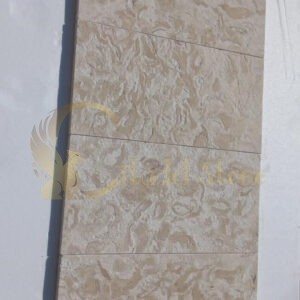
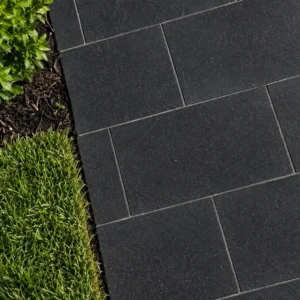
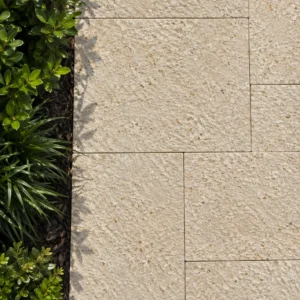
Freeze-thaw ratings are irrelevant in Antigua and Barbuda and should be struck from any specification that copies a northern template. What matters is salt. Airborne salt reaches the surface, works into pore structure and crystallizes there, and low-absorption, dense stone is the defense. Our dense basalt paver range is specified for exactly that duty on exposed frontage, while dense limestone holds up well in sheltered courtyards and inland terraces where the salt load is lower and the visual brief is softer. Ask for absorption behavior and a wet slip result on the actual finish you intend to lay, because two pieces of the same stone in different textures can perform very differently once a squall passes over.
Pattern, Bedding and Joint Choice
The laying pattern is a structural decision on trafficked areas and a visual one everywhere else. Choose it after the section, never before.
- Interlocking patterns resist creep where vehicles brake and turn.
- Stack alignments look sharp on pedestrian decks and move under wheels.
- Joint width should suit the tolerance of the stone, not a photograph.
- Avoid jointing products and sealers that could taint water running to a cistern.
- Keep the bedding consistent; changing bed type mid-area guarantees a differential settlement line.
Getting the Section Signed Off
Write the duty classes on the drawing before anyone shops for a look. Mark pedestrian, light vehicle and service areas as separate zones, give each its own thickness and unit size, and note the base build-up you expect underneath. Then order small samples of the shortlisted stone and look at them wet, in sun, next to the actual base material you will be using. Signing off a section on paper and a finish in the hand is a short conversation; reversing a wrong section after laying is not. Match the stone to the traffic first and the mood board second.