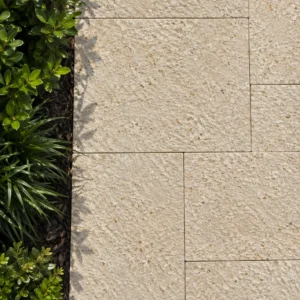
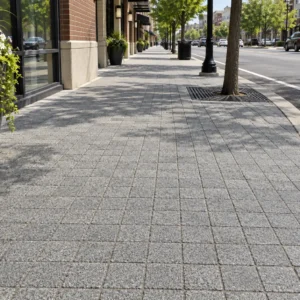
The depth ladder worth starting from
Bermuda work tends to sort into three depths, and the sorting is done by traffic rather than by taste. Around 2 cm suits floors under cover. Around 3 cm is the everyday standard for exterior paving in the open. Anything carrying vehicles wants 5 cm or more. Those are working conventions rather than a code clause, and your engineer or installer may move you off them for a particular build-up, but they are the right place to open a schedule. Start there and you will rarely be badly wrong. What the ladder really encodes is a simple idea: the harder a surface is worked, the more material has to sit between the load and the ground beneath it, and the less forgiving the bedding becomes if you skimp.
Under cover: interiors, loggias and shaded terraces
Covered floors do the easiest job on the plot. They see footfall, furniture and cleaning rather than standing water or wheel loads, and a thinner unit bedded on a sound floor performs perfectly well. The benefit is not only price. Thinner stone lifts floor levels less at thresholds, which matters when you are working into an existing property rather than a fresh slab, and it keeps unit weight in a range a single person can place without drama. It also gives you more room to run the same material inside and out at matching levels.
Open terraces, steps and pool surrounds
Outdoors the stone stops being a floor and becomes a weathering surface. Bermuda winters are genuinely cool and damp, so material spends long stretches cycling between wet and dry at low temperature instead of baking dry. Depth buys resilience against that cycle and against the point loads of furniture legs and planters. Pool surrounds add a wrinkle: swimming here is seasonal, so a deck may sit wet and little used for months and then take concentrated barefoot traffic through the warm season, which is a very different duty pattern from a year-round deck.
Driveways, aprons and turning areas
Vehicles do not damage paving by weight alone. They damage it by turning and braking, concentrating that weight onto a small contact patch, which is why the step up in depth for vehicle areas is larger than people expect. The thicknesses we hold for Bermuda follow that ladder, with the heavier depths reserved for exactly this situation.
- Move to 5 cm or more anywhere a vehicle crosses or stands.
- Use smaller units where wheels turn, so no single piece takes the twist.
- Treat the gateway and apron as the hardest-worked area on the plot.
- Restrain the perimeter properly, because a driveway fails at its edges first.
Format size and what a site can handle
Large formats read beautifully and they are harder work on this island. A big slab weighs more per piece, needs more hands or plant to place, and is less forgiving through a narrow gate or up a flight of garden steps. None of that rules it out. It simply means the decision belongs with the access route in view rather than with a mood board on a screen.
- Match unit weight to how the stone will actually reach the terrace.
- Pair a generous field format with smaller units at edges and curves.
- Keep one thickness per area so nobody is shimming on laying day.
- Allow for the cut pieces a real plan shape will demand.
Planning modules before you order
Waste is decided on paper, long before a saw comes out of the van. Set the module against the actual terrace dimensions, decide where the cut course lands, and agree whether the pattern runs to the house or to the view. Ten minutes of setting out at this stage routinely saves a pallet, and it prevents the sort of argument that starts halfway through laying. It also tells you honestly whether the format you fell in love with suits the space, or whether a slightly smaller module would leave every edge landing clean.
- Draw the terrace to size and place the first full course deliberately.
- Push awkward cuts to a discreet edge rather than the main sightline.
- Carry a sensible allowance for breakage, cuts and future repairs.
- Order steps, edges and field stone together so shade and depth agree.
What sits beneath decides more than you think
Depth is only half the answer, because a unit is only as sound as what supports it. Establish what the build-up in front of you actually is before you fix a thickness. Where it is a properly designed concrete slab, thinner units become viable; where a vehicle area is being formed on compacted base, depth and unit size do more of the work, and limestone paving for driveway loads is the right shelf to pick from. Have the installer or engineer confirm the layers rather than inferring them from what the surface looks like.
Turning this into a schedule
A good stone schedule reads like a map of use. It names each area, states what crosses it, and assigns a depth and a format on that basis, which also makes the quote comparable between suppliers instead of a guessing game.
- List every area separately: interior, covered, open terrace, pool deck, drive.
- State the traffic each one takes, including delivery and service vehicles.
- Assign thickness by that traffic, not by a single site-wide figure.
- Note steps, edges and thresholds as their own line items.
Get the depth ladder right on paper and the paving will still be flat and quiet years after the crew has gone.